It may seem commonplace to overhear someone’s drunken banter at Snar on a Saturday night, but 221 years ago, tumultuous or indecent noises could result in a fine of up to five shillings — equivalent to around $50 today.
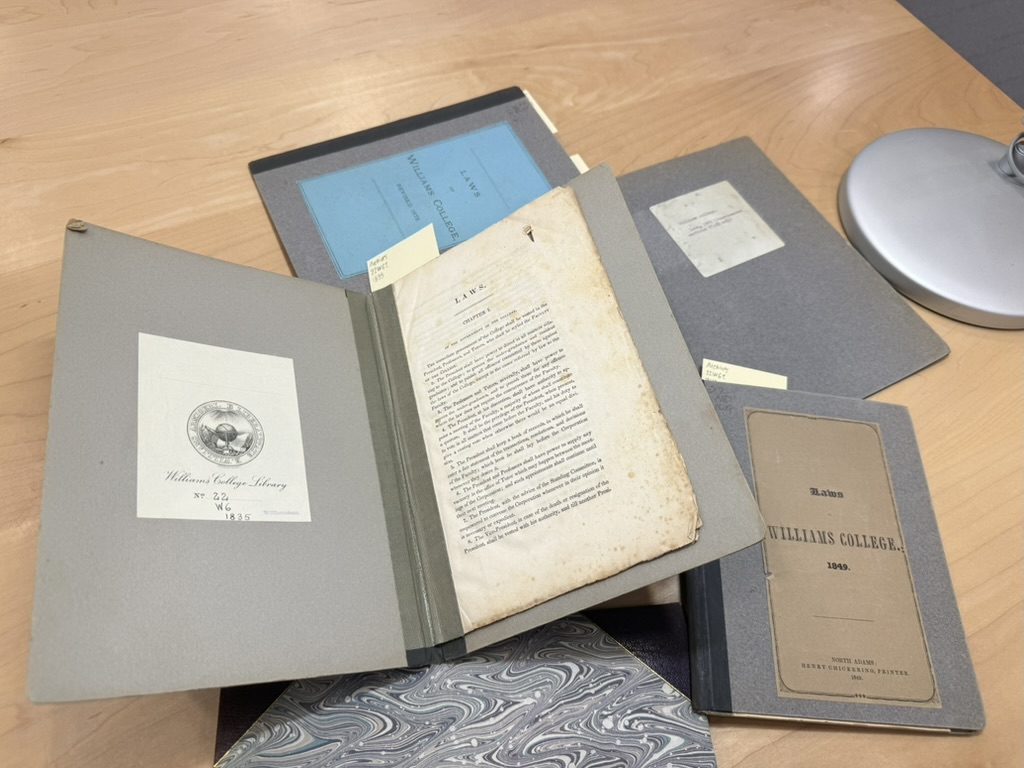
How do we know this eccentric tidbit? A list of laws published by the College each year since its founding can be found in Special Collections. Today, the laws of the College concern internal governance and the rights and responsibilities of the Board of Trustees. Before the turn of the 20th century, however, these same laws included a detailed list of bizarrely specific crimes and punishments that make student life today look unbridled.
Nowadays, students wouldn’t think twice about making a quick Sunday trip to the Clip Shop, but a law from 1795 prohibited students from visiting a barber or hairdresser, or allowing one in their chamber, on “the Lord’s day.” Students caught with their personal hairdressers on Sundays were charged 50 cents on first offense and an additional 50 cents for every offense after, with continued violations eventually resulting in suspension.
On top of having to wait until Monday for a trim, students’ options for Town activities were limited by a restriction on attending dancing classes of any kind. According to the 1805 laws, “No student shall, in term time, attend any dancing school in Williamstown, but by permission of the President.”
If a student managed to get invited to a Town ball — despite being prohibited from structured dance lessons — they dared not get used to the extravagant life of gala attendees: Students were not “permitted to attend more than three public balls or dancing assemblies in Williamstown annually,” according to the same year’s set of laws.
In fact, the early laws seemed to forbid most forms of planned movement and noise. Not only were students fined for putting on “stage-plays, interludes, or theatrical entertainments,” but also for singing or playing instruments of any kind.
Even the simple privileges of a nighttime drive off campus or a walk to stargaze at Stone Hill were prohibited. Students caught outside their chambers during assigned study hours — which are not specifically defined in the law — or after 9 p.m. were liable to be fined up to sixpence in 1795. If they were spending time in other students’ rooms, students were deemed “a dishonor to the Institution.”
The College also enforced dress regulations. Any male student caught wearing women’s clothing was “liable for public admonition or suspension,” as stated in an 1805 law.
There were many laws that banned oddly specific activities. In the Laws of 1795, students were prohibited from throwing water, or anything else, out of a window unless they were certain no one was below. The 1858 laws prohibit “indecent pictures… lascivious, impious, or irreligious books.” Today, in contrast, students can take a comparative literature course on “Boys Love” that involves reading and analyzing yaoi, a genre of fiction characterized by erotic relationships between male characters.
In 1915, laws banned ball games at any time besides Saturday afternoons, except by express permission, and never on Thanksgiving Day. Cards, billiards, or any “game of hazard” induced a five shilling fine in 1795, and by 1858, the list of punishable games had expanded to include dice and backgammon.
Students today may fear an embarrassing run-in with Campus Safety Services after a night out, but in 1858, students caught intoxicated or in possession of alcohol would be suspended for at least three months. A second offense threatened expulsion.
The somewhat ridiculous nature of many of these laws are a reminder of how much fun students are able to have at the College compared to centuries ago. In 1795, students who would “profanely curse or swear… or [sing] offensive songs” would be fined up to ten shillings, with continued violations possibly resulting in expulsion. In contrast, in 2024, bbno$ performed his popular song “edamame” at Spring Fling, which begins with the lyrics “Balls hanging low while I pop a bottle off a yacht.”