
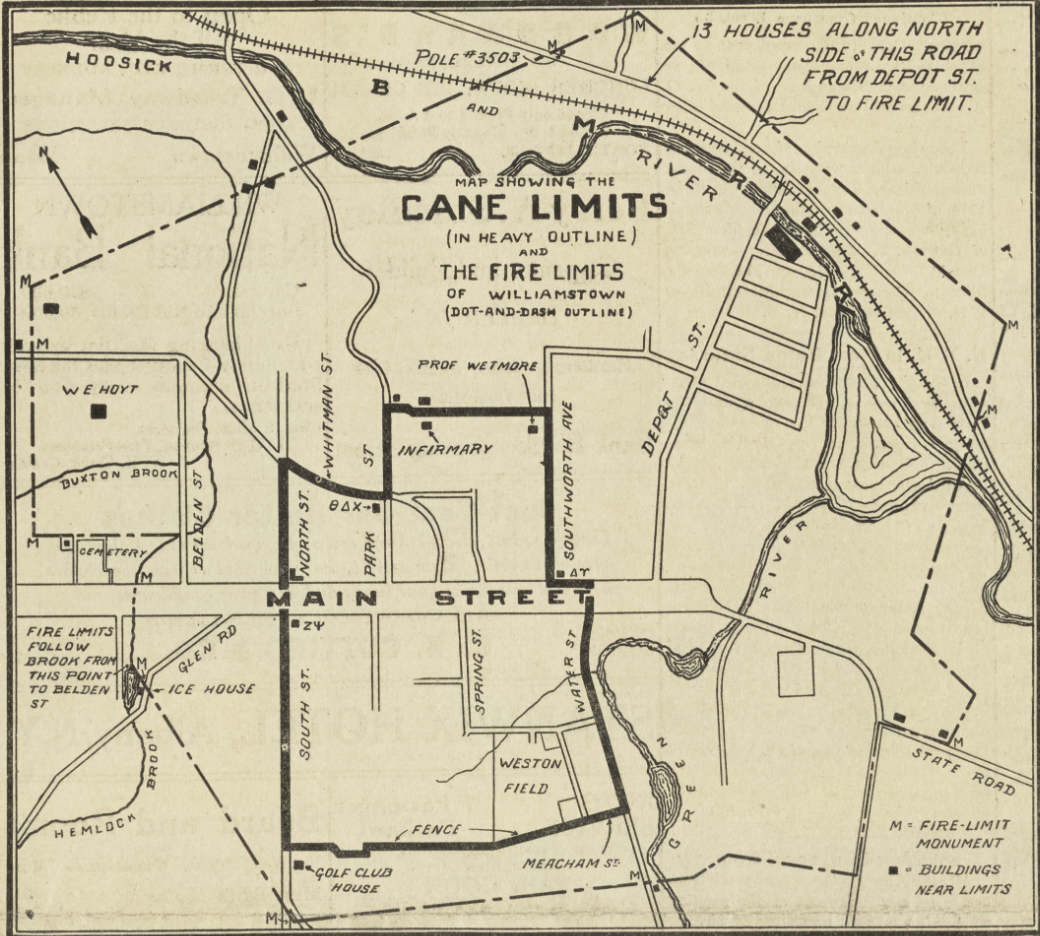
Today, students spend the first weekends of March enjoying the last ski days of the year or fighting through an ever-growing stack of midterms. From 1901 to 1914, however, students at the College spent one weekend at the beginning of March consumed by deceit, theft, and violence.
The Cane Contest pit the first-year and sophomore classes against one another in a war of artful strategy. Devised by the student body in 1901, it took place on one of the first Saturdays of March.
The contest’s playing field was divided into two concentric rings. The “inner limits” spanned most of campus, including faculty homes and fraternities, creating a quarter-mile arena. The “outer limits” covered five miles of surrounding territory, according to a brief written by Frank Tiebout, Class of 1912.
The students’ objectives were simple: Between the hours of 5 and 11 p.m., first-years had to transport a large number of wooden walking canes — about 150; one for each student in the class — from beyond the “outer limits” and into the “inner limits.” The sophomores tried to hold them off. If the first-years successfully transported all of the canes before the game’s end, they were named champions and awarded the prized “competition canes.” If the sophomores thwarted them, they were given the canes.
While first-years could only move the canes to inside the “inner limits” during the actual competition, they spent months prior positioning them for retrieval when the time came. As early as November, the first-year class president would appoint a secret first-year committee charged with hiding the canes beyond the outer limits. “His agents are many,” Tiebout wrote about the first-year president. “His committee changes from time to time to avoid suspicion, so that nobody but the president himself and a few helpers know the true position of the canes. Perhaps they lie in an unpretentious farm house within a mile from the college — perhaps two hundred miles — perhaps they are buried under our very noses.”
While the first-years prepared for the contest with the utmost secrecy, the sophomores attempted to uncover the committee, find the hidden canes, and hinder the first-years in any way possible. “For the space of two weeks before the end of the contest [they] have guarded all roads and bridges leading from town, tracked prominent freshmen, watched telephones or cut the wires, … and held weighty conferences,” Tiebout wrote. The sophomores often hired professional detectives to aid their cane-recovering efforts, according to a Special Collections article written by Amber LaFountain ’09.
The day before the contest, the first-year president would sneak off campus with a small subset of his committee. He would leave the remaining committee members instructions on how to deploy the rest of the first-years. Sometimes, the subcommittee would shirk on-campus responsibilities to go into hiding long before the contest started. “In the contest’s early years, they would cut classes as much as a week in advance in order to leave campus and hide away,” LaFountain wrote. In 1904, new regulations banning the cutting of classes during the contest forced a later departure.
When the day of the contest arrived, the first-years employed a number of strategies to deceive the sophomores and secure the canes. “Their class breaks up, is shifted wholly or in part to different parts of the surrounding country with fake canes [and] fake committees,” Tiebout wrote. On the day, both classes would communicate by fireworks, whistles, and telegraphs, according to Tiebout.
Throughout the evening, physical violence between the classes was common. At one point, the College’s administration banned kidnapping and imprisonment during the contest, according to Tiebout. Despite these constraints on gameplay, “there still remains a hearty and lively interest,” Tiebout wrote.
While the contest was intended to unite first-years and sophomores, it often increased their animosity. After 1914’s Cane Contest, the College put an end to the tradition when a first-year was “pounded to insensibility,” according to Special Collections.
This decision to end the contest met forceful opposition from its proponents. In a Letter to the Editor published in the Record on March 26, 1914, members of the Cane Contest Committee appealed the faculty’s decision to sympathetic alums, asserting that then-College President Harry Augustus Garfield had told the committee that the tradition would not be abolished. Despite these pleas, the tradition was never revived.
The Cane Contest reflects the old College’s markedly different attempts at community-building. Before the tradition’s cancellation, every contest would end with a culminating ceremony on March 17. The entire first-year class would parade up West College Hill, led by the Town’s marching band, to “bury the hatchet” — literally throwing a cardboard hatchet into a bonfire to cheers from the audience, according to a 1908 Record article.
The ceremony was attended by the whole student body, faculty, staff, and local residents, and included student speeches.
After the 1908 contest, which the sophomores won, senior president “Speed” Butler, Class of 1908, called for peace among the student body. “I see all the upperclassmen lined along the hillside with ‘chips’ on their arms,” Butler said in his speech, referring to the sophomores’ gloating. “Now, we must cast these chips — some, not all — into the fire, and, with their consumption, bury all previous sources of enmity between the two lower classes.”
Despite this message of unity, the culminating ceremony still hinted at signs of rivalry. The event included wrestling matches between the two classes, beginning at the shot of a pistol. All first-years attended wearing pajamas stolen from the sophomores. “One sophomore had all his night-shirts stolen, got some more, had those stolen, and finally resolved to sleep in his basketball suit till after the 17th,” LaFountain wrote.