“Touching grass” the morning after a night out might not be doing enough for Ephs to connect with the lovely nature around us. Eating grass, however, is a more plausible solution. This week, the Record looked at varieties of edible plants in the Berkshires, and how students at the College can learn about ecology and gastronomy from flora.
Walking by Sawyer, the heart-shaped, toothed leaves of garlic mustard plants can be seen poking their heads among the dandelions and uncut grass. The plant is invasive, Professor of Biology Joan Edwards said, but easily pulled from the ground.
While garlic mustard’s scent may be appetizing to some, the same compounds that give the plant its signature smell also make them toxic to local species. “Those compounds are allelopathic, meaning [garlic mustard] leaches compounds into the soil that kill native plants,” Edwards said. This is a concern because native plants are important for sustaining healthy ecosystems.
However, Edwards believes it is not too late for the College to address this scourge to local plant kind. Since garlic mustard is a biennial, it only lives for two years. According to Edwards, during its first year the plant is just a rosette of leaves, but in the second year it releases most of its seeds and the removal process becomes harder.
The trick, according to Edwards, is pulling the weeds at the right time. “If it makes it through to the second year, it puts up a flowering shoot, with lots of flowers, and many, many seeds,” she said. “If you can go around and pull it out before the seeds get dispersed, so in the flower bud stage […] you can control them.”
Bradley St. Laurent ’26, an environmental studies major and amateur botanist, has taken the overgrowth of garlic mustard into his own hands. “I have been on a bit of a crusade against garlic mustard since high school when I learned about it,” St. Laurent wrote in an email to the Record.
Learning more about the natural world has given St. Laurent a whole new perspective, and led him to notice things he otherwise wouldn’t have. “I have since noticed it basically everywhere, which can really be a bit depressing — once you take botany, you realize that essentially everything you see is invasive,” he wrote.
Over the four years that he has been actively weeding out garlic mustard, Bradley has seen some success. “This year, I have noticed dozens of strawberry plants popping up in places that were once fully dominated by garlic mustard. I think that was a cool little sign that I am maybe having a little bit of an impact.”
On the corkboard at the top level of Driscoll, St. Laurent’s wanted posters for garlic mustard can be seen encouraging others to take action to pull out the invasive plant. As an additional incentive, St. Laurent added that garlic mustard can be made into pesto. Fans of arugula will also enjoy its pungent and complex flavor profile.
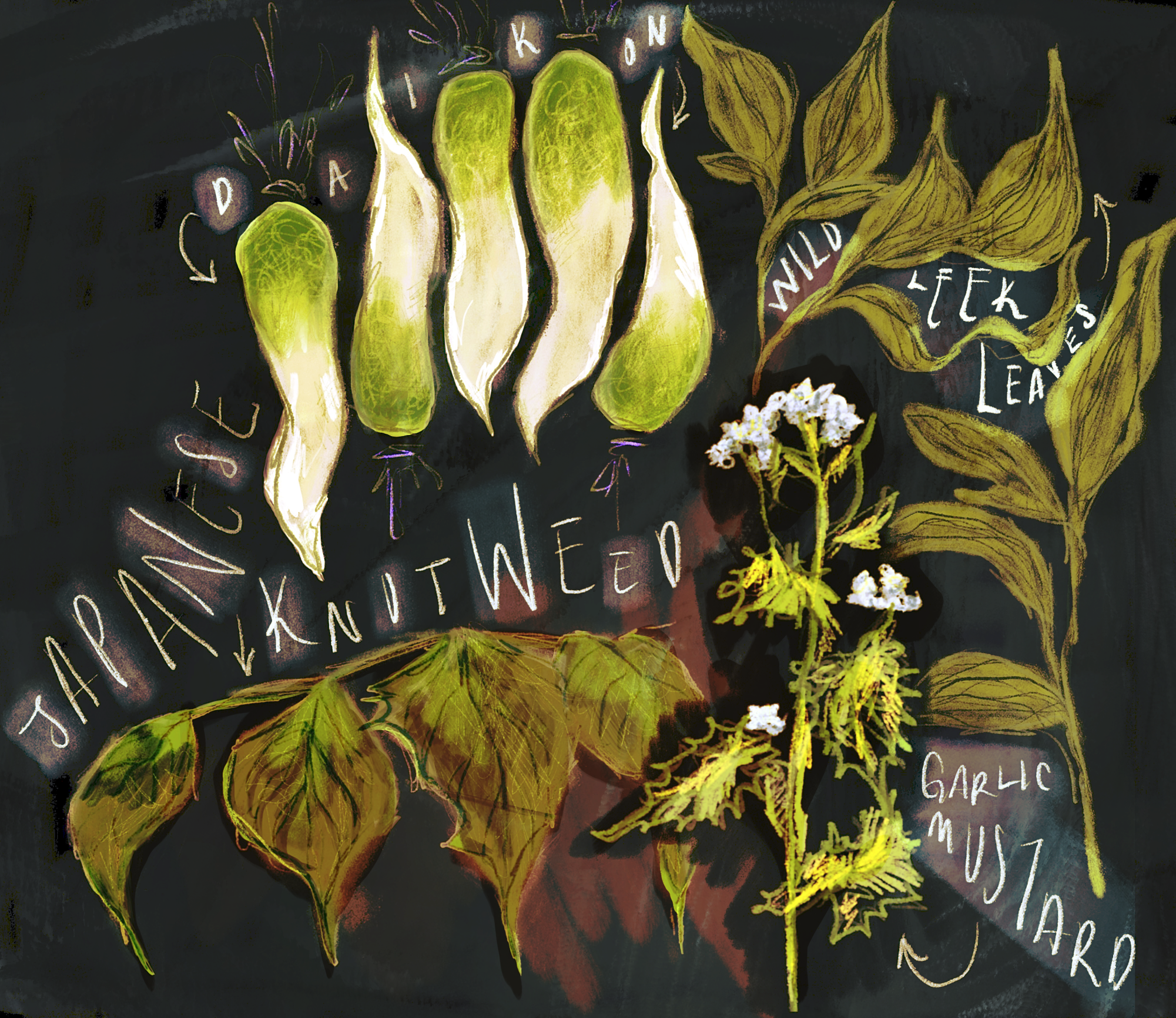
When walking through areas a high density of invasive plants like Linear Park, Ephs will likely notice Japanese knotweed — another notorious foreign plant on Massachusetts’s Prohibited Plants List — growing around them. With its green, shovel-shaped leaves and red-specked stalks resembling bamboo, Japanese knotweed is not only invasive, it’s also exclusive. The plant, which usually grows together in large groups, takes up valuable nutrients from the soil and outcompetes other plants for space. The knotweed was introduced to the country because of its beautiful foliage, but it has since taken over.
Although its growth is difficult to control, Japanese knotweed is a beloved rhubarb substitute in pies or crisps. In “Field Botany and Plant Natural History” — a biology course that Edwards has been teaching since 1999 — Edwards has had her students bake a crisp using Japanese knotweed and one using rhubarb, and then compare the two. “You could tell the difference,” she said. “But they were both quite edible. You could serve it with some vanilla ice cream and it would be quite good.”
Not all edible species in the area are invasive. Wild leeks, also known as ramps, have broad, bright green leaves in clusters of twos and threes, and are an example of a native species with culinary uses. Ramps belong to the same genus as onions, and can be harvested in small quantities from Hopkins Memorial Forest.
According to Edwards, wild leeks have an unusual developmental strategy. They are one of the first plants to leaf out in the spring, before the canopies of trees develop leaves and block out the light. Then, after a period of dormancy up until June, the plant puts up a round globe or white flowers without any leaves.
Some students at the College are already finding creative ways to incorporate edible plants into their everyday palettes. The Williams Sustainable Growers host weekly work parties in the garden outside of Parsons House, where they plant, weed, and harvest four beds of greenery. According to student gardner Lili Winkelman ’26, Sustainable Growers use no pesticides or human-made fertilizers, which could run off into bodies of water and enrich harmful algae growth. “[We employ practices] that are not harming the land or soil, but instead enriching it,” Winkelman said.
Students familiar with the plant world expressed opinions on their favorite edible plants. Jenny Chen ’27 said that, out of the crops she and the Sustainable Growers grew, daikon radish was the most coveted. When there was no daikon radish left in the garden, Chen went out to buy more, but the pickled radishes did not taste the same. “I think it was something about how it was freshly harvested,” she said.
For Winkelman, participating in the annual October Williams Sustainable Growers Garlic Festival, during which students celebrate the harvest of the previous year’s garlic crop and plant new cloves, has cemented garlic as her favorite garden item the club grows. “It’s a super fun event,” Winkelman said. “[Garlic] is a really successful crop that we grow.”
Apart from running the raised beds filled with tomatoes or kale near Parson’s House, Williams Sustainable Growers is involved with taking care of the berry bushes and surrounding plants on campus, has collaborated with the Sawyer seed library, and has run cyanotopic artmaking events, during which students make prints through sunlight. With the academic year coming to a close, students who wish to connect with plants on campus will find themselves having a few plant enemies, and hopefully some floral friends, around the College.