

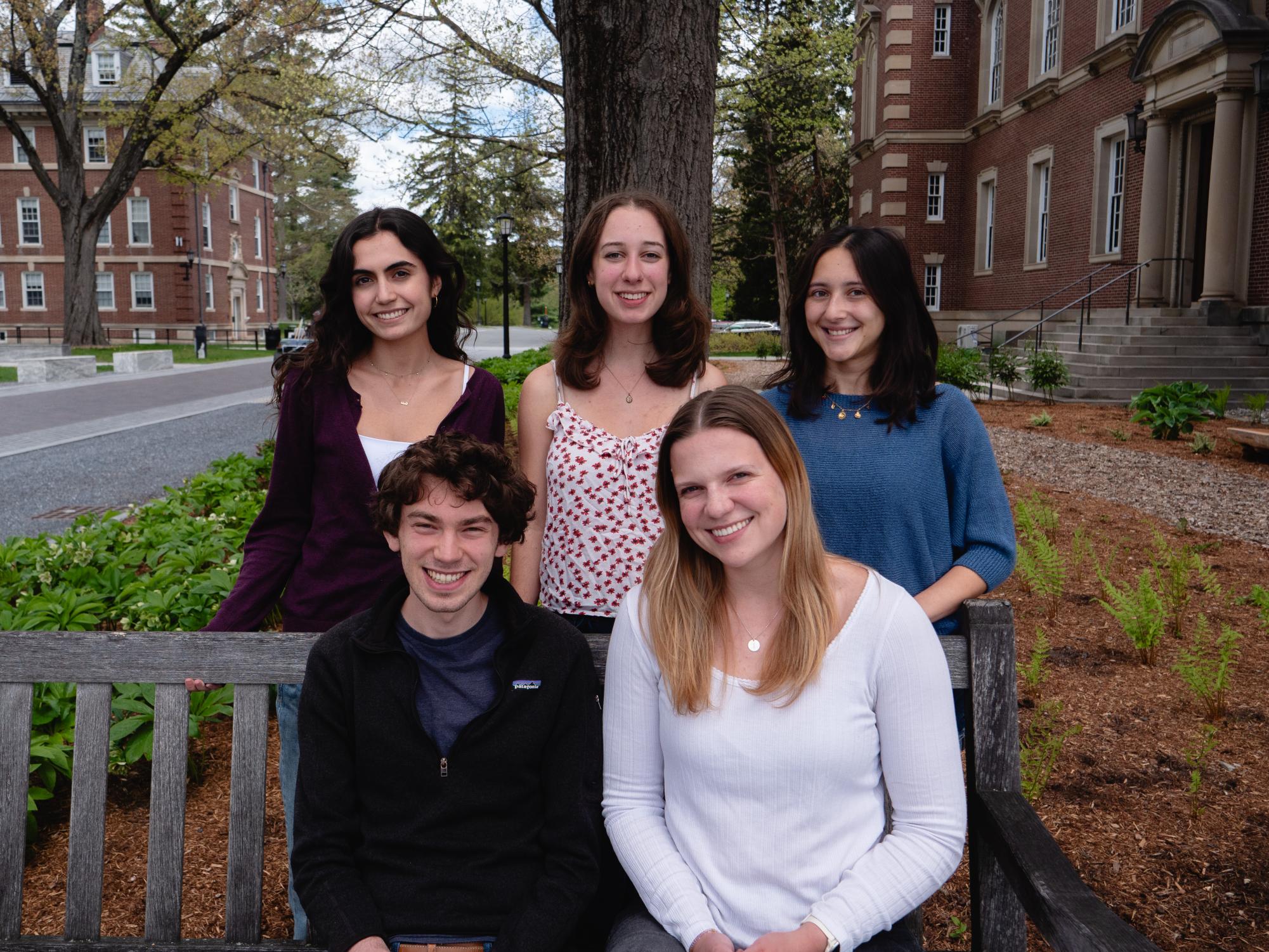
For the last issue of the Record this semester, Sports Executive Editor Arleny Flores ’28 sat down with graduating members of last year’s Record’s management team to discuss their retirement from the Record and memories from their time leading the paper. In spring 2025, Max Billick ’26 served as editor-in-chief. In the fall, Haley Zimmerman ’26 served as editor-in-chief, with Aliya Huprikar ’26 and Inés Garcia ’26 as managing editors. This spring, Ellie Davis ’26.5 has served as editor-in-chief. This interview has been edited for length and clarity.
Arleny Flores (AF): Being on the editorial board of the Record is a time-consuming undertaking. What about the board made the long hours and pressure worth it to you?
Max Billick (MB): What made me want to stay was getting to learn about every part of Williams. This is an institution filled with really passionate people who really care about what they do and really care about what Williams’ place in the world is. At the Record, I started by working with Inés [Garcia ’26] on the news desk, and every week I’d get to learn about something new. Even the most minute administrative policy changes — there was a lot of thought that went into them. I loved the process of getting to learn something about this community every week, getting to share that, and getting to work with people on the writing, on the reporting. I got addicted that first semester on the editorial board.
Aliya Huprikar (AH): I got to Williams, and I was like “I am not joining the newspaper.” And then sophomore year, I was like, “Okay, maybe I’ll be a staff writer.” But only the editorial board application was out, and I was like, “Oh, I’m not gonna get in and then they’ll make me a staff writer.” And then I got in, and I was like “I guess I’m an arts editor.” And I’m not that artsy — well, like a little bit. I’m on Twitter and stuff. And then I had the most fun ever, became best friends with my section, got to report on really amazing stories, and really got to punch above my weight. It was my first semester, and they let me report on really big stories. It was really meaningful because it reminded me that, at Williams, you can start something a quarter through your college career, and it can really transform your life.
AF: Beyond editing dozens of articles each week, Record management members take on many other responsibilities — communicating with college administrators, fostering community among board members, and more. What valuable lessons did you take away from your experience?
Inés Garcia (IG): You have to learn how to lead by example to foster the culture that you want. I feel really lucky that I had two such competent co-editors with me that led by example and inspired me to do the same. I think when you’re on management, it goes beyond just being a good journalist and a good editor, but it’s about being a good team player and making people want to come back again and again every week to dedicate themselves and their time to this newspaper.
Haley Zimmerman (HZ): I think it’s a little like running a team in a real workplace, but on hard mode, because one, everybody’s friends, and two, you don’t get paid. We’ll see if I still hold up this statement when I’m in a real workplace. But I learned that you have to approach working with your team and being in charge of people from a place of respect and I think the way that the Record holds together is that people respect each other as friends, peers, writers, and editors, and everyone has a shared mission of finishing our group project every single week. I also think that running a student paper requires a strange blend of perfectionism and letting things go because ultimately a newspaper needs to be perfect — every fact needs to be true and fact-checked, and the spelling of every name and the accuracy of every class year needs to be checked — so it demands this excessive precision. But also, to successfully run a student newspaper and do our homework every single week means that you just have to let some things go, whether that’s in the process of how things are done, or recognizing what is realistic to report on or not to report on in a given time. So it’s a strange beast, and I think I learned that kind of flexibility the hard way, running the Record.
AF: All of you have either retired from the Record or have taken some time away from it at one point. During that time off, what reflections did you have about your experience on the board?
Ellie Davis (ED): When I took time off in the fall to work at The Chronicle of Higher Education, I went in every Wednesday morning and the first thing I did was read the Record. But every day I was also paying attention to a lot of other college publications, and the thing that I learned from that is that the Record really punches above its weight for a small, liberal arts newspaper and a newspaper representing a college of just over 2,000 students.
MB: When I was abroad, I really missed Williams. The Record was my connection back to this place. I think that that made me understand, on a deeper level, the role that the Record plays in our community. This is a community that a lot of people really care about — faculty, staff, students, alums, parents. And the Record serves to keep those people, especially the ones who aren’t in Williamstown, in the loop about what’s going on here, and keep them connected to this really special place.
AF: How do you define a “good” issue? What was your favorite issue from your time on management, and what made it stand out?
IG: I think, in the abstract, a good issue is one where multiple groups on campus, or different types of students, feel heard. It’s true that we are the Williams Record — we’re a record of student history, student happenings, and community happenings, so when we can make that front and center of our paper, we’ve done a good job. I think Aluna [Brogdon ’26] and Aiden [Clarke ’28] did some really great reporting on the bias incidents on Route 2, and that was something that was really important to our campus, and I’m glad we did that.
AH: In a similar vein, the staff grievances regarding healthcare benefits were really meaningful to report. Staff are part of campus, but because of the way Williams works, the student body was not really tapped into that problem. So we were able to platform that struggle for our student and alumni readers.


