


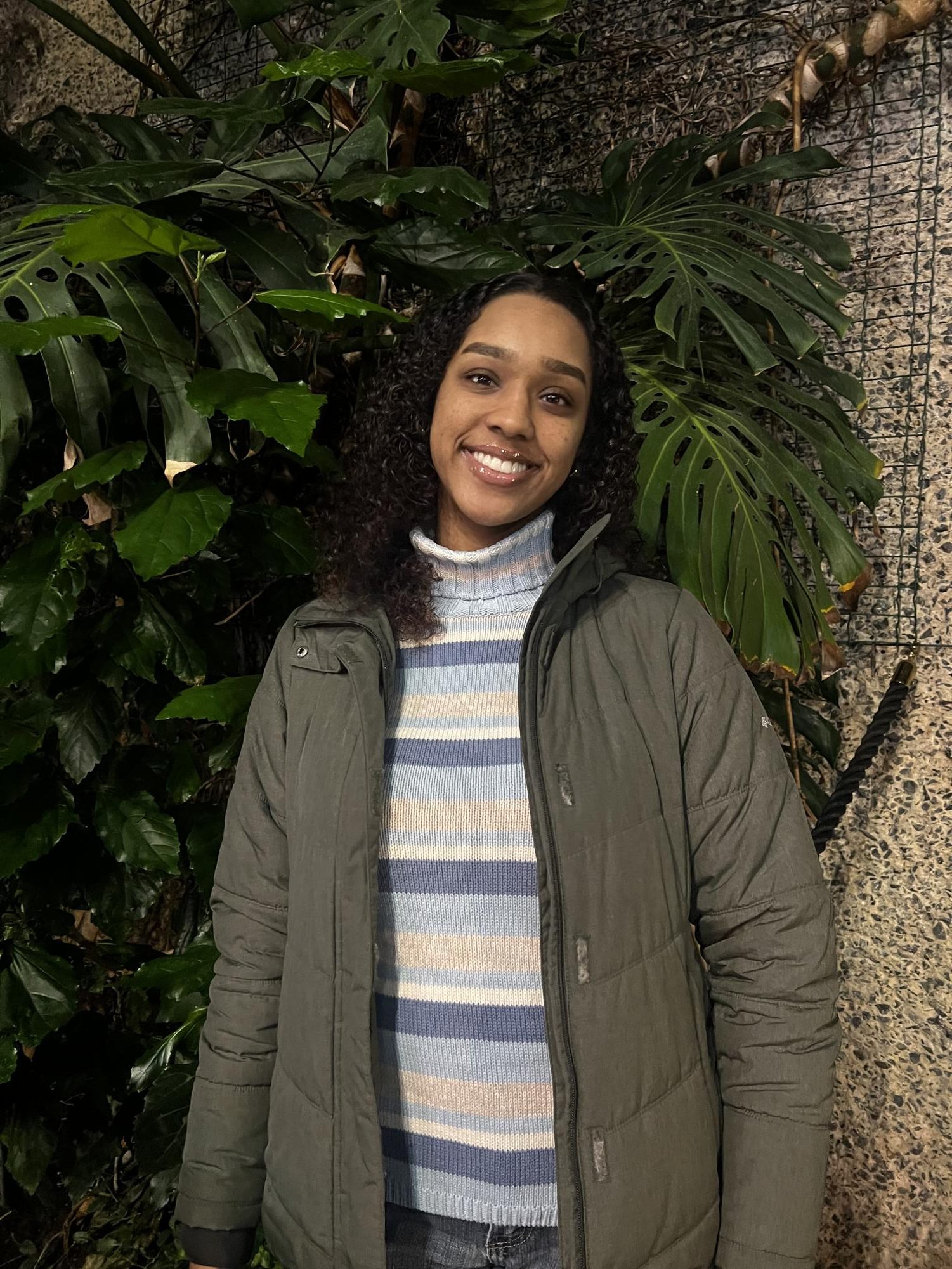
Each week, the Record (using a script in R) randomly selects a student at the College for our One in Two Thousand feature, excluding current Record board members. This week, Kathryn Ramsamooj discussed the crochet coral reef, her time studying abroad, and her passion for environmentalism. This interview has been edited for length and clarity.
Julia Karp (JK): I heard that you’re involved with the Berkshire Satellite Reef project. Could you tell me about that?
Kathryn Ramsamooj (KR): The Crochet Coral Reef is a community-based art project where everyone contributes to building a crochet coral reef for display. My involvement has been through engaging local elementary school students because I thought they would like the craft aspect of it, and they did. A lot of them had a grandmother and some even had dads who crochet. But they didn’t have their own hooks or yarn, so we let them take the yarn if they wanted to try crocheting at home. I also wanted to help them learn about the environment, which I think is really important and can be made fun for younger people.
JK: Where do you think your interest in environmental issues comes from? Have you always had a meaningful relationship with climate advocacy?
KR: I would say that I’ve always been into being conservative about how much I consume, and maybe that comes from my family background. My parents are from the Caribbean, which is ecologically vulnerable, and maybe seeing pollution and other negative impacts of humans on the natural world affected them. My mom is always recycling, and ever since I was four or five, she tried to instill that in me — just to reuse things if you can.
JK: It’s Earth Month right now … what does that mean to you?
KR: I think it’s really important to have discussions about the climate and the Earth. Here at the College, I’ve gotten the opportunity to see different kinds of activism. People are trying things, and even if they don’t always work, at least you have the space, resources, and the encouragement to try things out for the betterment of others. I’m from the South, from Florida, and we don’t really have any kind of language or education around the climate or being more eco-conscious. [Laughs.] I feel like that’s more of a joke down there than it is up here.
JK: Can you tell me more about growing up in the South and how people there felt about the environment?
KR: For sure. I think that there’s a lot of natural beauty down there, but in a different sense. You have the beaches and the Everglades, and it has utility to people, for sure. But like you said, when it comes to actually taking care of the climate, the rhetoric and legal protections are not the same. It’s not taken as seriously.
JK: I heard that you studied abroad in two different places. What was that like?
KR: Yes. For my junior year I was in Freiburg, Germany in the fall semester, and then I was in London for the spring. In Germany, I did an IES program focused on the European Union. My major is political science with an international relations concentration, so we did a lot of travel. We visited maybe seven or eight different cities, just through that program, and talked to different think tanks, researchers, and representatives of the European Union. It was really interesting for me to see how their governments are set up differently from ours. Overall, I really liked Germany and the environmentalism I witnessed there. I also took a class on urban planning and urban design, which was interesting.
JK: How did Germany compare to the U.S. in terms of urban planning and design?
KR: From what I observed, it’s definitely more thoughtful. In the city center of Freiberg, they had a bin, almost like a community pantry. When I left, I had extra groceries, and instead of throwing them away, I gave them to the community bin. And as I was putting things down, people were picking them up. So the food was obviously used, but it’s less stigmatized there — taking leftover food is not only for homeless people or impoverished people.
JK: Yeah, I feel like people here have unnecessarily high standards about what’s “gross,” but do you really need something to be the cleanest, most pristine product ever? Probably not.
KR: Yeah. I think that’s a mindset we have to escape. Even for me, over the past six or seven years, I’ve been completely thrifting my wardrobe. I don’t really shop firsthand for anything. It’s not gross because it was owned by someone else or because you didn’t buy it directly. I think our mindsets around things like that are so taught — someone definitely taught you that the expiration date is like life or death, but that’s just capitalism and consumerism, so you go buy more than you need. I think unlearning those things is important.
JK: And in terms of your other semester abroad your junior spring, how was your time in London?
KR: I was really impressed by the food scene there. It was amazing. The best pizza I had there was Ecco Pizza, and it was so, so, so, so good. I would say I definitely ate over 100 pizzas from them over the course of the spring, which is insane. But it was very affordable and they’re open 24/7, which was a plus.
JK: Wow, noted. To wrap things up, do you have any reflections or advice as someone who is about to graduate from the College?
KR: Being a senior, I’m very grateful that I’ve had this experience. My advice to people is not to wait to be happy, and instead, try to really think about how amazing this experience is. Try not to take for granted basic things like being healthy and being somewhere safe, which not everyone has.


