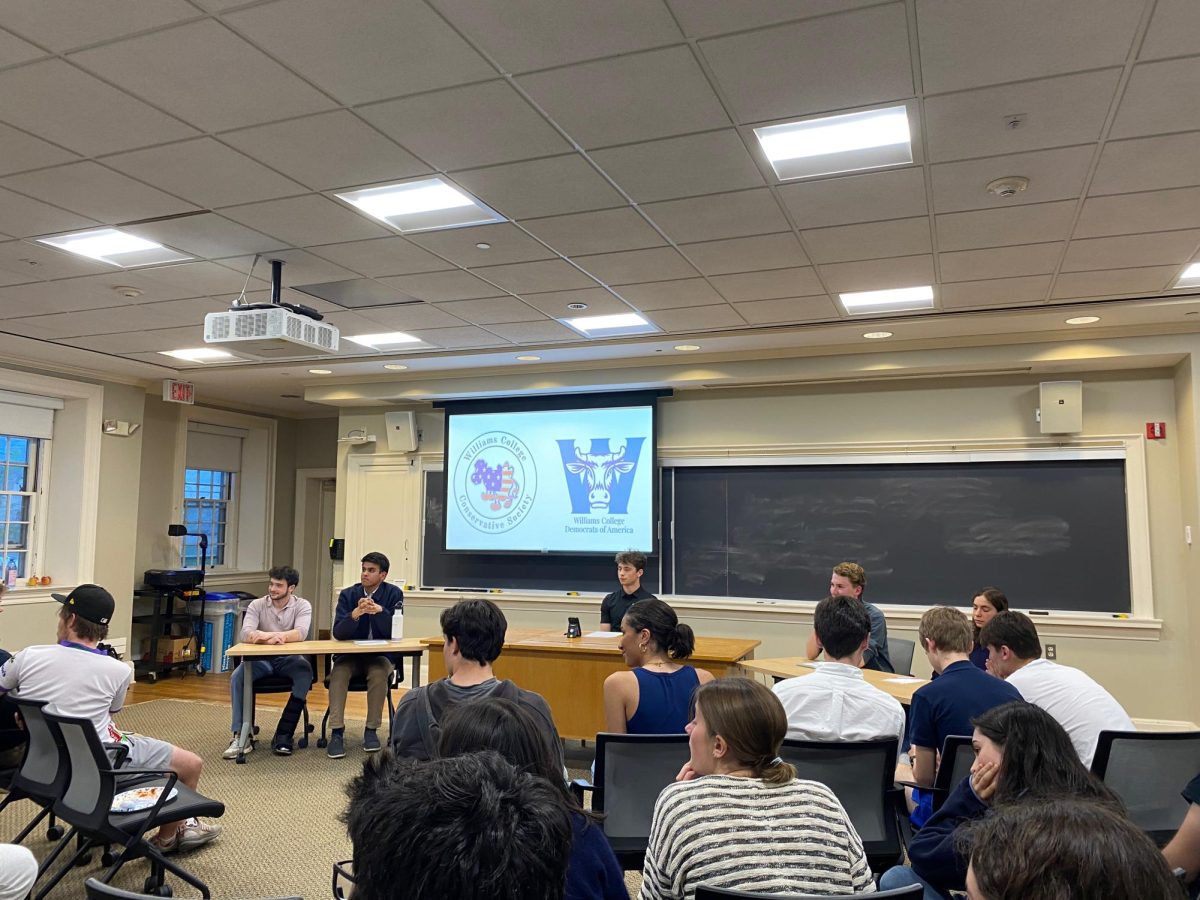

Calls to reform the Facilitators for Allocating Student Taxes (FAST) have intensified as a group of elected FAST facilitators are pushing for a referendum proposing several changes to FAST’s constitution, in an effort to make the funding allocation system more equitable. This academic year, the Williams College Debating Union received over $42,000 from FAST, thousands more than the Williams Outing Club (WOC) and nearly as much as all campus performance groups combined.
Amid this discourse, FAST’s facilitators are up for reelection. Voting closes tonight at 10 p.m.
Per its constitution, FAST distributes funds according to a sector-based model, in which certain categories of Registered Student Organizations (RSOs) are guaranteed a fixed percentage of FAST’s $485,818.49 budget for this academic year, which is funded by the student activities tax. The current sector allocation system was set in 2020 and has remained fixed ever since.
FAST consists of five elected student facilitators who oversee the distribution of funds: one for competitive teams, one for performance groups, one for Minority Coalition (MinCo) groups, and two at-large facilitators.
Zippy Casteal ’28, one of the at-large FAST facilitators, told the Record that the large sums allocated to groups like the Debating Union are evidence of bias among the facilitators that results in preferential treatment for clubs connected to facilitators. “I don’t think it’s fair to other groups for one club to have this much funding,” she said. “When I think of what FAST is intended to do, my idea is that we are intended to use these funds to spread the [money] across as many RSOs and as many events to affect as many students as possible.”
FAST facilitators Leo Margolies ’26 and Elijah Adu ’27 told the Record that the sector model is responsible for the imbalances in RSO funding. To address the imbalances in funding among RSOs, several FAST facilitators and student leaders are advocating for changes to the FAST constitution, including eliminating sector allocations so that all RSOs can draw from the same pool of money.
To receive funding, an RSO must first submit an itemized budget request to FAST. Requests are reviewed by all five facilitators and approved by majority vote if they comply with the FAST bylaws, which include limits on daily per-person expenses on food and hotels. According to FAST’s constitution, facilitators are “not the gatekeepers of funds, rather they help registered student organizations and students access funding to provide programming and activities for the student body.” After a budget receives a majority-vote approval, funds are transferred to RSOs by Cailin McGowan, who serves as the financial and administrative coordinator of Student Life and Leadership and oversees FAST’s work.
Margolies said that as a FAST facilitator, he cannot deny a group access to available, unclaimed funds if their budget request meets the bylaw requirements and isn’t competing with other groups. “There’s no constitutional way for us to deny a budget that is … within all of our per diems,” Margolies said in an interview with the Record.

A push for change
The sector allocation system remains in place despite significant changes over the past six years in which RSOs have drawn from each pool. Two years ago, multiple club sports teams began receiving their funding from the Department of Athletics instead of from FAST, according to FAST’s MinCo facilitator Ellington Fagan ’26.
Despite the decrease in the number of competitive teams receiving funds from FAST, the amount of money in the competitive teams’ funding pool remained the same. “It wasn’t fully thought out that the competitive team sector allocation would still keep the same percentage of the FAST funding pool, but with the most expensive RSOs — club sports — now removed,” Margolies said.
With club sports no longer competing for funds in the sector, the Debating Union, mock trial, and model United Nations (MUN) teams now receive the bulk of the allocation for the competitive teams sector. Mock trial received $15,501.00 from FAST this academic year, and MUN received $11,020.91.
Other groups see the structure of FAST’s operations as placing too low a ceiling on their potential funding. WOC board member Ethan Young ’28 said he is frustrated with the rigidity of FAST. “WOC is an institution of the school,” Young said in an interview with the Record. “But we’re constrained by money in what we can do for the community.”
This year, WOC received roughly $34,000 from FAST. According to Young, WOC could better support outdoor activities for students if its funding did not flow through FAST. “I personally think it would be very beneficial to our entire school if WOC were to move outside of FAST and receive its funding separately,” he said.
Three members of FAST — Margolies, Adu, and Jezebiel Gonzalez ’26 — wrote an April 29 op-ed in conjunction with other student leaders, advocating for the abolition of sector allocations, along with other measures aimed at improving FAST’s fairness and transparency. The op-ed asked students to sign a petition, which will trigger a campus-wide referendum on the measures if the number of signatures reaches 10 percent of the student body.
The petition has nearly met this mark, according to WSU co-chair Dylan Safai ’26.
Another provision of the petition proposes that FAST be allowed to delegate funding distribution to other “oversight clubs,” which are voluntary associations of at least three other clubs. This provision is intended to allow FAST to grant MinCo, an oversight club, the power to distribute funds to its member organizations, according to Safai. In practice, MinCo has already taken on the role of distributing FAST funds to its member organizations, but this constitutional change would make the practice official.
Sam Samuel ’26, MinCo steering committee co-president, said that the two bodies’ agreement this year has better allowed MinCo to manage its own FAST-allocated funding. “I find it better that MinCo should be in control of it, and the way that we did it this year does work … But it took a while to get there,” Samuel told the Record.
If the referendum is successfully triggered, any measure that receives at least 50 percent approval will pass.
Not all members of FAST completely disapprove of the current sector allocation system. Though Casteal sees FAST’s allocation of funds as unequal, she worries that doing away with the sector allocation system altogether would create too much of a free-for-all competition for funding among RSOs. “I’m pro [sector allocations] being amended in some way, but I’m a little hesitant about them being abolished,” she said. “[Sector allocations] give some funding decisions structure.”
In addition to the changes proposed in the student petition, FAST is considering voting on a new rule that would prevent any one RSO from taking more than 7 percent of FAST’s budget, Margolies said, though FAST has taken no concrete action towards this change
Potential conflicts of interest
Casteal believes that problems of inequitable funding ultimately fall on the shoulders of FAST facilitators. Casteal said she has repeatedly cast the only vote against the Debating Union’s budget proposals and believes that FAST has given this group preferential treatment.
FAST’s bylaws do not require facilitators to recuse themselves from voting on budgets of RSOs in which they participate. Adu, who is a member of the Debating Union and is the group’s former president, began voluntarily recusing himself from Debating Union-related votes in October, following McGowan’s advice that all FAST members abstain from voting on budgets for RSOs in which they are members.
Adu has sent text messages to all the FAST facilitators asking that the group approve the Debating Union’s funding requests quickly, though he has also sent similar requests advocating to expedite the funding approval process for other RSOs to which he does not belong, according to copies of these messages obtained by the Record.
Adu believes that passing along requests for money to be approved quickly is a routine part of the job. “Everyone on FAST has gotten calls from people and done essentially the same thing,” Adu said. “Everyone has, at points, been like, ‘Hey guys, can we vote on X, Y, or Z,’ in the [group] chat, generally because of either a personal connection or being on the RSO itself.”
Margolies agreed. “We’re people on campus, and so people will text us about things that they care about,” he said. “If someone texts me, I’m going to text the group chat and say, ‘When we get to office hours, we need to talk about this thing.’ But that never impedes funding for other clubs.”
Adu doesn’t believe that his presence on FAST has led to increased funding for the Debating Union this year. “There is a delta between this year and last, but that is almost exclusively driven by a single request: Flights for the World Championships in Bulgaria, which totaled over $11,000,” Adu wrote in an email to the Record.
Adu also said that the money allocated to the Debating Union has not caused other clubs to miss out on funding. As of Tuesday, FAST has a remaining $2,355.94 in its budget for competitive teams. “No RSO this year was denied money because of spending on debate,” Adu wrote.
Tallying the votes
FAST facilitators also unanimously voted to trigger a referendum on whether or not students should be able to serve on multiple pillars of student government — FAST, WSU, and the Advisory Board for Lobbying Elections (TABLE) — at the College. If the referendum passes, students will not be able to serve on more than one. Historically, no student has served on WSU and FAST at the same time, although students have simultaneously held positions on TABLE while also serving on either WSU or FAST. Under the proposed rule change, students will be able to hold one position and run for another at the same time, but will be forced to choose between positions if elected to multiple.
Four current WSU representatives, Tatum Leuenberger ’27, Osegie Osayimwen ’27, Sahil Sajid ’29, and Annabel Smith ’29, are currently running for FAST. Leuenberger, Sajid, and Smith told the Record that they will not run for WSU in the fall if they are elected to FAST.
Margolies sees the proposed rule as an essential separation of powers. “WSU is a student group that requests funding like any other, so there should be a separation,” Margolies said. “Our student government’s really modeled on the American concept … there’s a check of the three powers. I think the same thing should happen at Williams.”
Voting on the referendum that would bar students from serving on FAST and WSU simultaneously closes at 11:59 p.m. tomorrow.
Correction: A previous version of this story mistakenly stated that Elijah Adu is the president of the Williams College Debating Union. Adu is a member of the Williams College Debating Union and is the former president. This article was corrected at 1:40 a.m. on May 13 to reflect this.