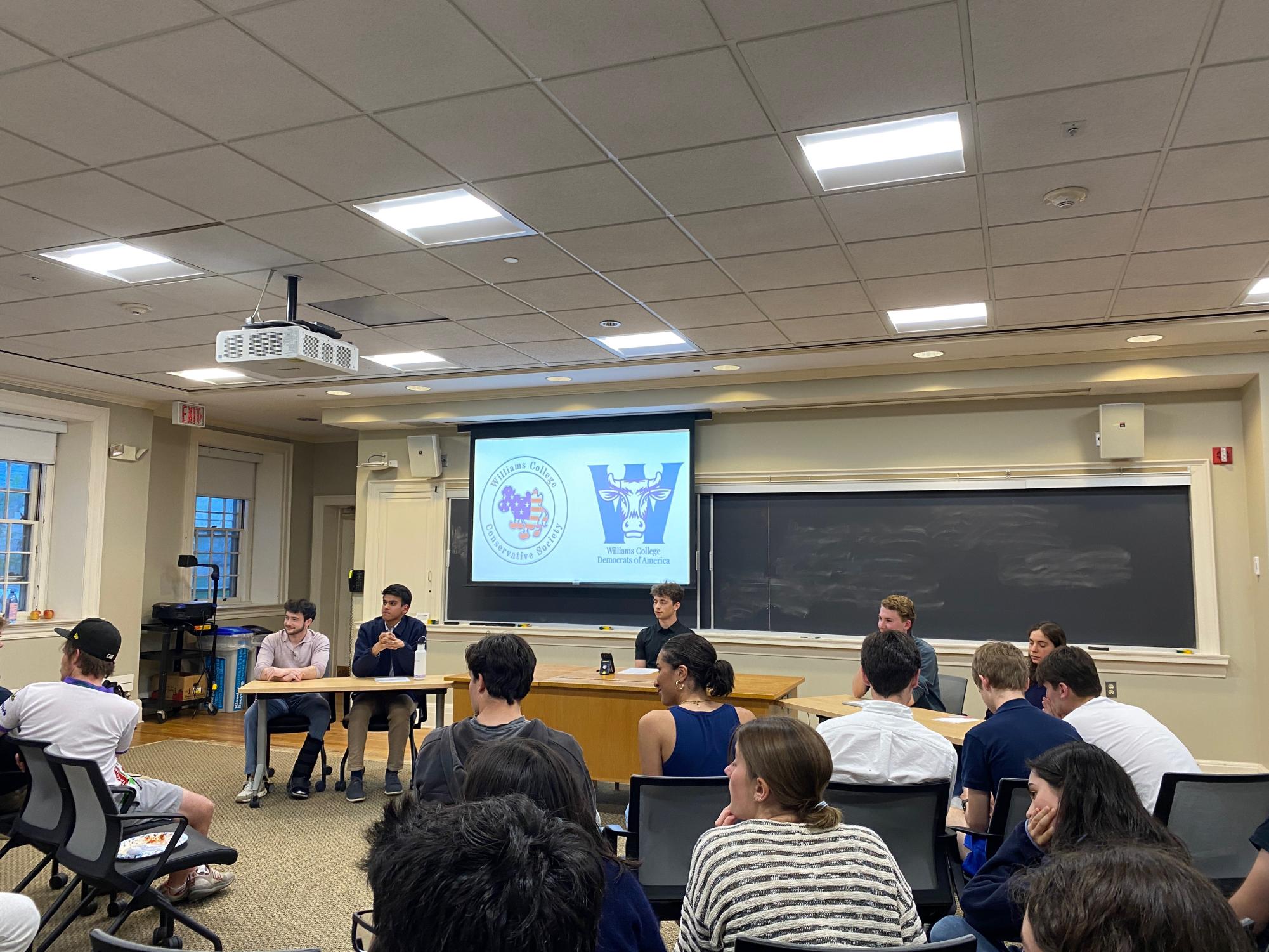
The Williams College Conservative Society and the Williams College Democrats of America (CDA) hosted a moderated conversation last Thursday in Griffin. Conservative Society founder Arjun Patel ’29 and treasurer Bennett Gorman ’29 joined CDA co-founders Charles Hughes ’28 and Eve Kaplan ’29 to answer questions on politics at the College and the state of the Democratic and Republican parties.
Representatives from both groups said the goal of the event was to foster healthy political discourse on campus. “I hope this is an event that acts a little bit as a catalyst on campus,” Hughes said in an interview with the Record. “People weren’t yelling at each other. There wasn’t a fistfight about views. There was a calm conversation about the issues.”
Patel and Hughes, who are friends and sit next to each other in their political science class, had long floated the idea of a public discussion. Eventually, they decided to plan one with the support of the Phi Beta Kappa society and the political science department.
“The goal here is to foster some sense of bipartisanship and bring people together,” Patel said at the start of the event. “Have some nice food, and hopefully have a thought-provoking discussion.”
The conversation’s moderator, Caden Burns ’29, posed a series of general questions, giving each side two minutes to answer.
When asked to describe the state of political activism at the College, both duos quickly came to the same answer: apathy. Patel attributed this disengagement to students at the College being overly intellectual. He recounted that when Oren Cass ’05 — an economist and conservative think tank founder — spoke at the College, there was no significant pushback or hostility. “A lot of the students who came asked questions about tax policy,” he said at the Thursday event. “They were asking about economic stagnation, very specific, nerdy things.”
Similarly, Hughes cited the passive disposition of the student body. “There’s not a culture on campus of having these kinds of conversations,” he said at the event. “That’s a big part of why we’re here today, to foster an environment where people feel comfortable discussing differences without necessarily feeling like they’re going to be attacked for a viewpoint that maybe isn’t correct by some certain standards.”
The groups also discussed their views on the future of the national Democratic and Republican parties. Kaplan argued that the Democratic party must broaden its platform and do away with what she described as non-negotiable ideological standpoints to attract more voters. “Democrats are realizing that to win in the places they want to win, they have to appeal to different things in each location,” she said. “The same thing that might work in a city isn’t going to work as well in a rural area.”
Gorman said that he hopes the conservative movement, led by intellectuals versed in what he described as the Western intellectual tradition, will bring the right “toward a greater emphasis on family, faith, communal life, and ultimately, a restoration of national life, which hopefully can constitute a reinvigoration of the patriotic principles which seem to be eroding.”
Both Patel and Hughes stressed that events bridging the political divide are rare on college campuses. “At the end of the day, regardless of whatever political positions you take on campus, you end up going back to the same dorms and the same dining halls as everyone else, so there’s some people that don’t like to put themselves out [there] politically,” Patel said. “I consider Charles a good friend of mine, and I think it’s good that that can happen across political boundaries.”
Kaplan said that she hopes the CDA will remain as ideologically respectful as possible. “I would never want to characterize our club or our party in a way that felt alienating to anyone, especially in a situation where I get to represent a large group,” she told the Record.
Patel sees party affiliations as not always black and white. “The national conversation likes to be filtered into Republican and Democrat, but that isn’t always how it bubbles down, especially at a place like Williams, where people have really interesting life perspectives and intellectual patterns that produce political opinions that don’t often fit into one category,” Patel said in an interview with the Record.
Kaplan told the Record that discussion is important not only in resolving political disagreements, but also in combating political detachment. “We’re not fighting conservatives, we’re not fighting Republicans, we’re fighting political apathy and people who feel they don’t have opportunities to be involved,” she said.