The Williams Free Speech Alliance (WFSA), an alum-led organization pushing the College to focus on institutional neutrality and ideological diversity, is seeking a student liaison to serve as an on-campus leader for the organization. This is the first time the group has recruited a student employee. The student will be paid $5,000 for a five-month term.
WFSA was co-founded in 2023 by Dan Blatt ’85, William Strong ’71, Steve Corkran ’71, and Niko Malhotra ’24. WFSA’s steering committee includes Professor of Biology Luana Maroja and Professor of Mathematics Steven Miller.
Blatt, the group’s vice president for communications, said informal organizing efforts began in 2021, before the group’s official launch in 2023, in response to a series of disputes about speakers invited to the College in 2016. These speakers were later disinvited or withdrew following backlash from students and faculty.
After it became clear that former conservative political commentator John Derbyshire was fired in 2012 from the National Review for posting racist comments online, President of the College Adam Falk cancelled Derbyshire’s 2016 talk. At that point, Blatt said many alums became concerned about freedom of speech on campus. “It’s not the president’s role to cancel speakers,” Blatt said. “It’s the president’s role to make sure controversial speakers have a place to speak, are allowed to speak, and that students and faculty have the right to question them and engage them.”
WFSA’s motto is “Don’t Cancel. Engage,” a principle that board members say reflects their vision for campus discourse. “Controversial speakers are good,” Blatt said. “Bring somebody who’s going to stir something up, so that students learn how to engage with that controversial person.”
Maroja was also disappointed in the College’s decision to cancel Derbyshire’s talk, saying that the move curtailed free speech, and emphasized the value of listening to people with different views. “It’s important to actually see the best argument of the other side in order to learn how to respond to that argument,” she said.
The organization’s website highlights that the Foundation for Individual Rights and Expression (FIRE) ranked the College 145th out of 248 on the national 2024 College Free Speech Rankings. The College received a “yellow” speech code rating from FIRE, which the organization defines as having “at least one policy that restricts a more limited amount of protected expression or, by virtue of vague wording, can too easily be used to restrict protected expression.” This ranking comes from surveyed student data.
Satya Benson ’26, a student representative on the Steering Committee, first connected with WFSA after publicly defending the Record’s publication of a pro-Israel op-ed despite his personal support of pro-Palestinian movements. Benson says he has felt pressured to self-censor his opinions at the College.
Co-founder Strong emphasized that WFSA is not a partisan organization, as members share different beliefs. “This certainly shouldn’t be a partisan issue,” he said. “To have free speech as a partisan goal is shocking.”
WFSA is also concerned about a lack of viewpoint diversity among the faculty. “I think that [professors] should not grade on opinions, that they should not cancel classes for political events, that they should judge students by the quality of their arguments,” Blatt said.
Blatt pointed to the women’s, gender, and sexuality studies department as particularly politicized. “The gender studies program is teaching an ideology, and it’s an ideology that should be given a lot of space in college,” Blatt said. “But it’s an ideology to which there’s much opposition … [and it] should be heard in tandem with the opposition.”
Maroja agreed that freedom of expression is repressed in certain classes at the College. “I’ve heard horror stories even in classrooms where people say what I think is perfectly acceptable within the range of views,” she said.
Blatt and Strong both described how their experiences at the College shaped how they think about intellectual disagreement and the purpose of higher education.
Blatt said that his experience taking classes at the College with the late Professor of Political Science Kurt Tauber shaped his appreciation for debate in an academic setting, even though the two fundamentally disagreed on a variety of political issues. “[It’s important] that professors encourage students with different views to express themselves … And more importantly, to encourage students to ask tough questions,” Blatt said.
Blatt says a key part of WFSA’s work moving forward is strengthening connections between alums and current students, particularly those who feel their views are unpopular. “I hope that we as alumni can be there when students who have unpopular opinions want to express them,” he said.
Although some members of the alliance still have significant concerns about free speech, they praised President Maud S. Mandel’s policy of institutional neutrality on political events, which she articulated in a 2023 all-campus email. “My policy [is] not to send out campus-wide messages about domestic or international events or even natural disasters, no matter how tragic or painful,” the email read.
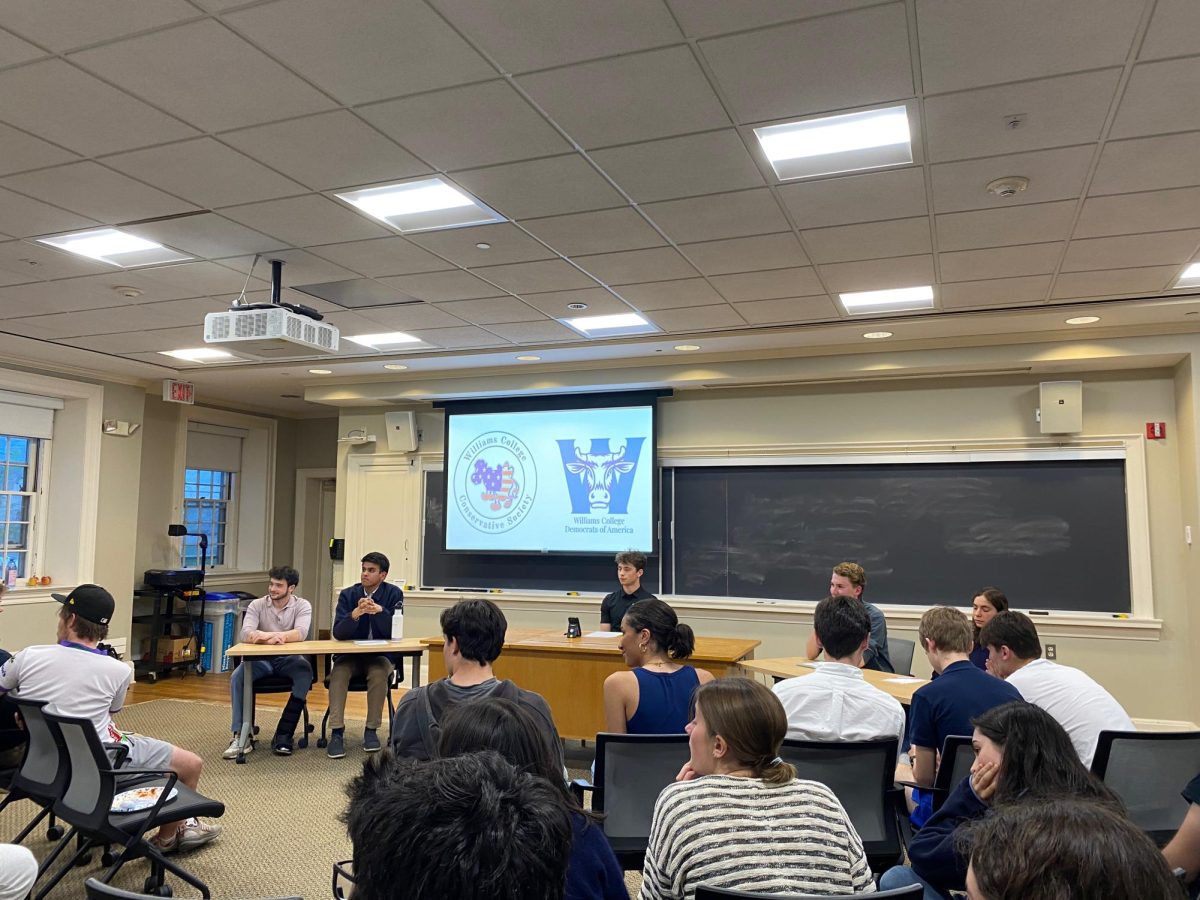
Blatt also endorsed forums that bring voices across the ideological spectrum to the College.
The WFSA advocates for the College to adopt the Chicago Principles, a set of guidelines for universities that affirm a commitment to free expression, as well as the Kalven Report on political neutrality. The report argues that universities should remain neutral on political and social issues.
Blatt expressed that his connection with the Alliance results from his appreciation for the College and concern for its future. “What Williams was in the 1980s was very much the ideal of what a liberal arts college should be … I’m concerned that the Williams I loved is disappearing,” he said.