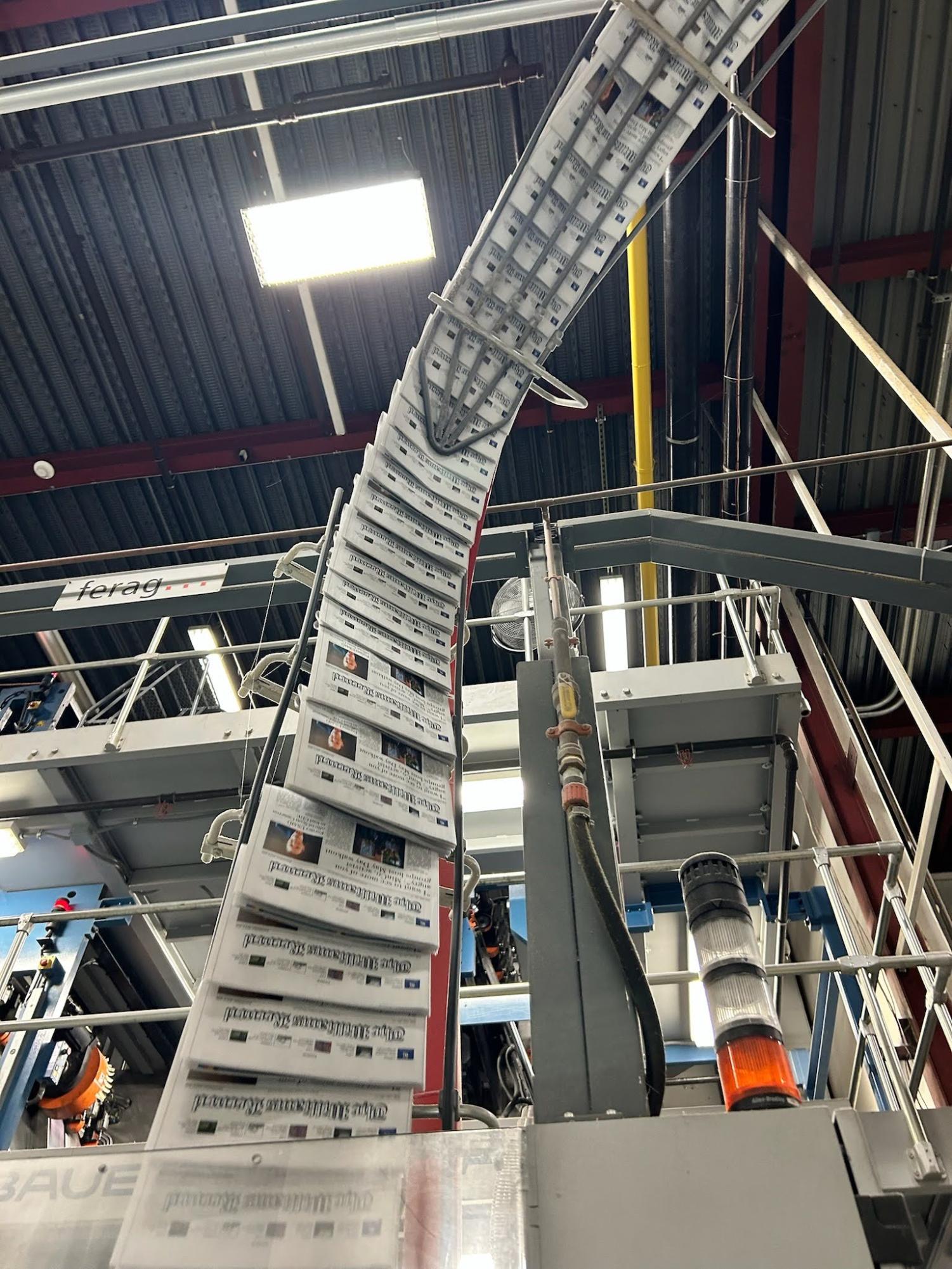
Copies of the Record after being printed in Albany.
Over the course of four years as Record editors, we’ve spent our Tuesday nights finishing up the paper before it gets published the next day — following up with sources, adding last-minute quotes to articles, editing stories, and designing the paper’s layout.
After all the facts are checked, commas quarreled over, headlines written, and kerning readjusted, we finalize PDFs of each page and send them off to our printer, Albany’s Times Union. At the end of many Tuesday nights past, we have walked home from the Record office wondering how those files become printed pages, ready to be distributed across campus and Town on Wednesday morning.
Last week, on the second-to-last Record Tuesday before our graduation from the College, we jumped into a minivan and drove to Albany to see it all unfold.
Since 2021, the Record has contracted with the Times Union to produce its print edition. Founded in 1856 as the Morning Times, the Times Union is a daily newspaper serving the Albany region. While it manages its own printing, the Times Union also provides the service for a host of smaller papers from places such as Middletown, C.T. and Troy, N.Y.
Last Tuesday, after an hour-long drive on the winding roads of Southern Vermont, we arrived at an industrial building near the Albany International Airport. At the door, we were greeted by a voice that had become familiar after many late night phone calls from the Record office: that of Plate Room Operator Jason Applegate. He’s responsible for shepherding the Record from a PDF into the analog industrial size printers that buzz along in the room next to his workspace.
At 11:05 p.m. last Tuesday, editor-in-chief Ellie Davis ’26.5 called Applegate to let him know that the PDF files were uploaded to the cloud and sent to the Times Union. When we were Record management, this was the symbolic end of the night, the final moment when no more edits could be made and the paper was completely out of our hands. But for Applegate, it’s just the beginning.
The crucial intermediary step where Applegate turns the Record into analog form is the plate room, where he produces plates that are later used to make impressions on newsprint. The plates are made by a machine that engraves blank plates and then folds them at the edges so that they can be inserted into the industrial printers in the next room over.
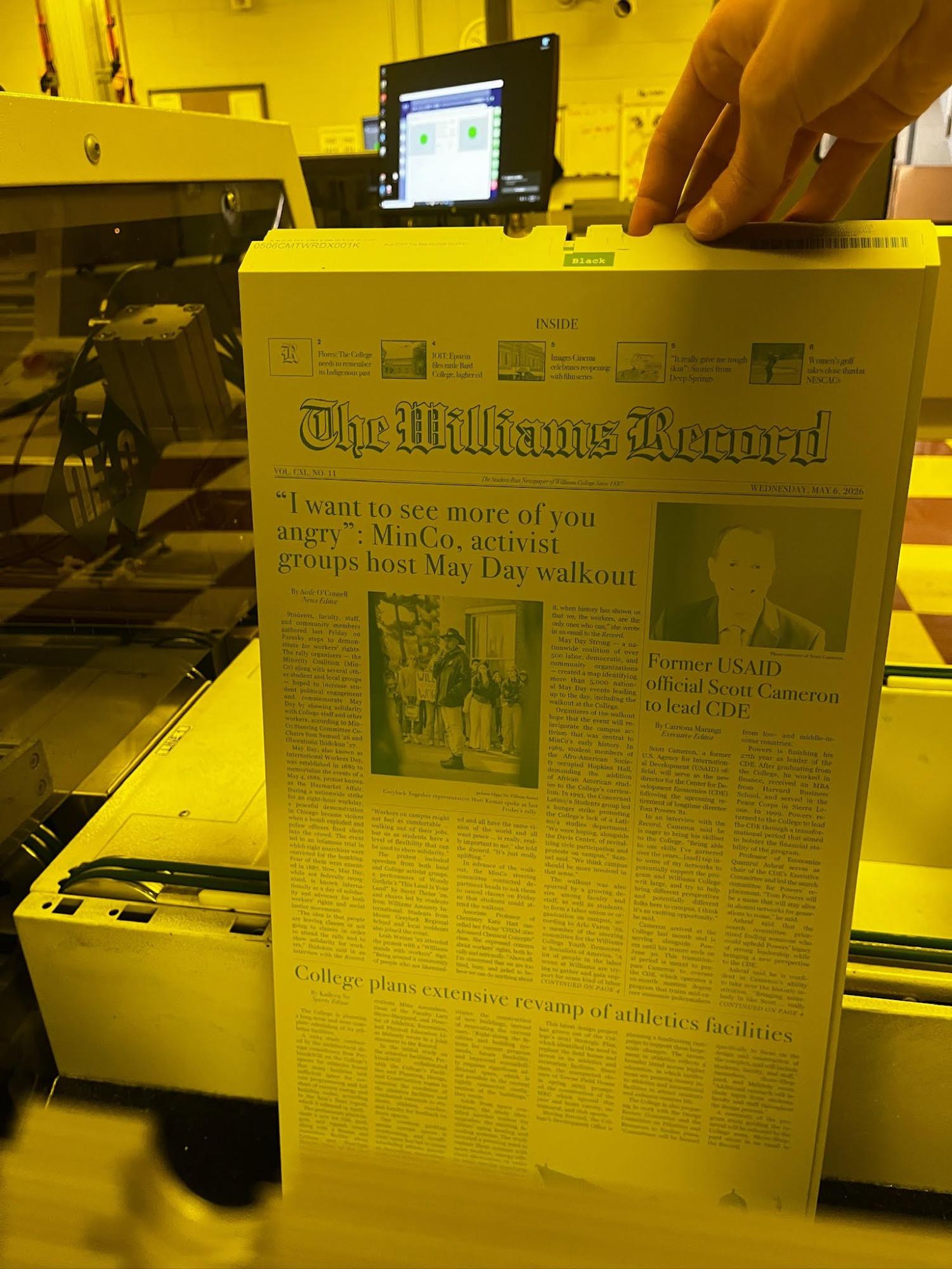
The black plates from the Record’s second-to-last issue of the semester.
After receiving the PDFs, Applegate loads plates into an etching machine that makes engravings on them. Next, the processor runs a laser over the plate and peels the top layer off, pulling off the engravings with it. Finally, the bender folds the edges, making notches that allow the plates to be inserted into the press.
After the finished plates were loaded onto a cart, we donned ear plugs as Applegate wheeled 32 engraved plates — to be used for printing the eight pages of the Record — into the pressroom. There sits a four-story-tall Commander CL printing press, capable of producing 80,000 copies per hour of newspapers up to 32 pages long. Installed in 2013, the press allows the Times Union to print color on every page and to begin offering outsourced printing services to weeklies such as the Record.
By 11:47 p.m., we were watching this process unfold, as the Record’s plates were loaded into the H-type tower units in the Commander CL. Each tower is equipped with its own inking unit, consisting of four foam rollers that roll cyan, magenta, yellow, and black ink onto a rubber blanket cylinder. This cylinder transfers the ink onto paper to ensure high quality images.
Then, paper is fed into the press at high speeds, passing through each of the four foam rollers. After printing, the pages are left out to cool and dry. Once the ink has set, the paper is folded over a triangular structure called the “kite,” after which it is cut and ready for distribution.
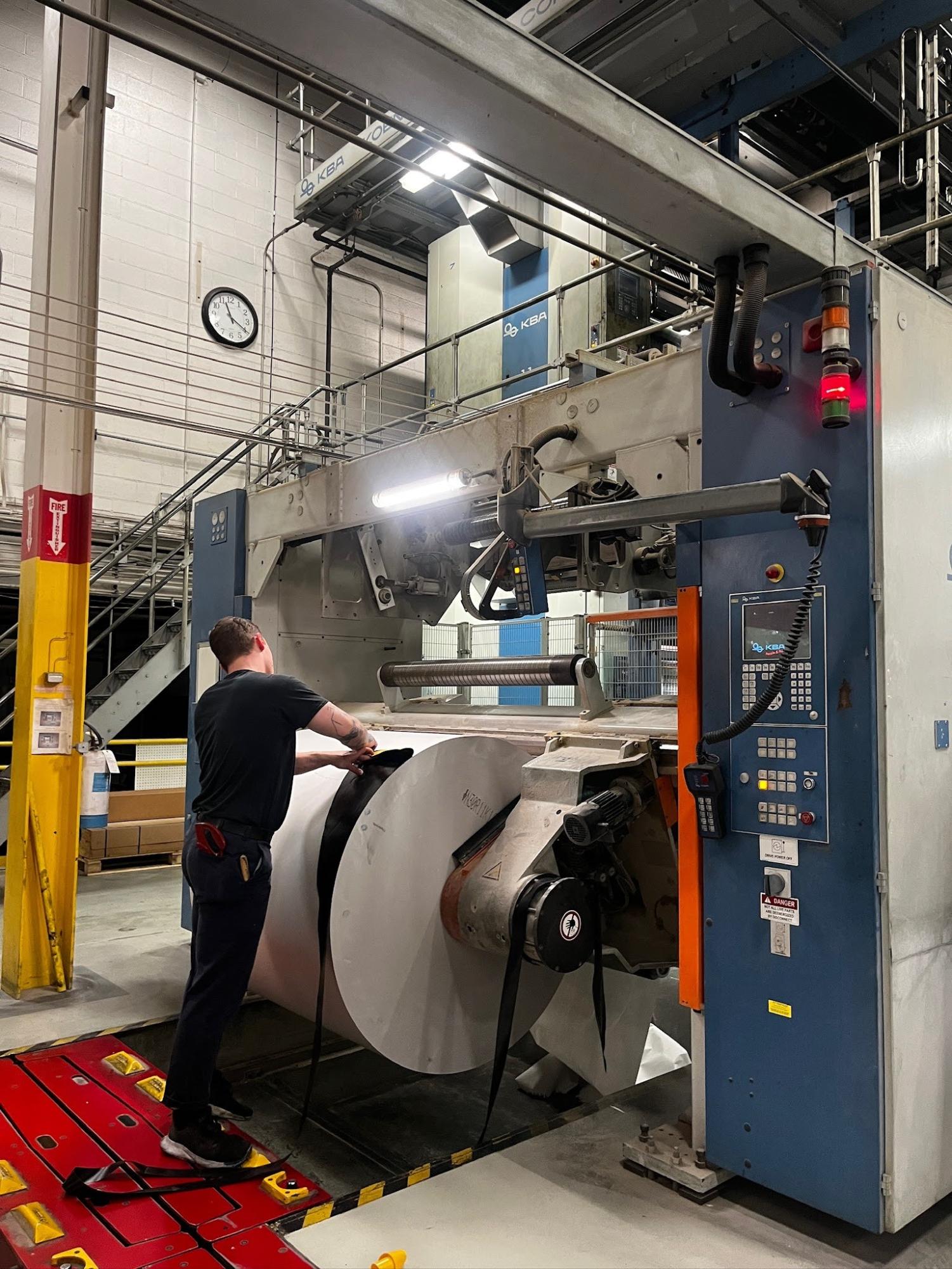
The kite being applied to the roll of paper for that night’s issue.
We watched as hundreds of copies of the Record were then loaded onto an overhead conveyor system. One by one, copies of our newspaper zipped above our heads, zigzagging along the ceiling of the pressroom.
The whole print run, which produced 2,000 copies of the Record, was over in a matter of minutes. It was a succinct conclusion to what had been a whole week’s worth of work back on campus. The process elegantly put things in perspective.
At the end of the night, the two of us walked back to our rented minivan, tired but happy, each with an advance copy of the day’s Record issue in hand.