Julia Karp/ The Williams Record
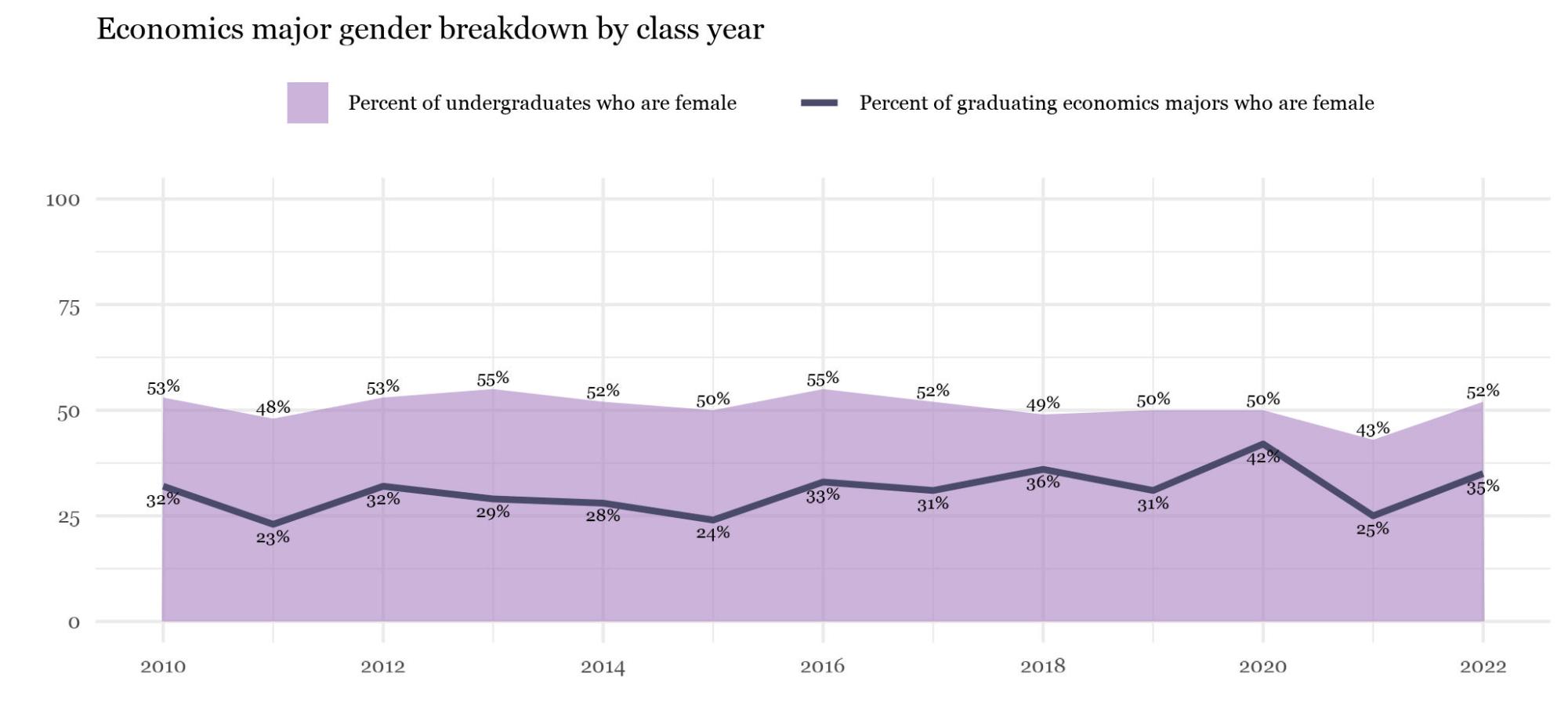
The economics department has a longstanding gender imbalance among students, according to the department’s internal data. The department’s most recent report from 2023 revealed that, at the time, 36 percent of economics majors were female. According to members of the department, the number of female students has remained stagnant over the last decade. Faculty are aware of this trend and are working to increase the proportion of female economics majors.
“We have long identified the fact that there is a gender imbalance within the major,” Professor and Chair of Economics Steven Nafziger said in an interview with the Record. “This has been a known thing.”
Professor of Economics Sarah Jacobson told the Record that she has been working to even out enrollment between female and male students in the major since arriving at the College in 2010. “It is difficult to not notice that when you walk into an economics classroom, certain identities are strongly underrepresented … professors notice it, and students notice it,” she said. “While many other STEM fields have gotten more diverse on both race and gender over the last couple of decades, economics has really lagged behind.”
The gender breakdown
The economics department conducts regular internal studies that examine the racial and gender breakdown of majors and track which students take introductory and 200-level courses. The most recent report is from Dec. 2023, and the department intends to conduct another survey soon, according to Nafziger.
Nafziger said that the gender gap begins when students decide whether or not to take “ECON 110: Principles of Microeconomics,” the first foundational course for the economics major. “There are probably reasons prior to Williams that set students up to approach what they experience in their first semester in different ways.”
The Dec. 2023 report found that the number of female students that registered for ECON 110 had declined significantly since the department’s 2020 report. “Understanding why non-males opt not to enroll in ECON 110 early on at their time at Williams may be worth exploring to see whether, within the binding constraints we face, we are able to put in place some structures to encourage non-males to enroll at a higher rate,” the report concluded.
The 2023 report also found that the proportion of female students in 200-level core courses for the major remained largely unchanged from 2020 to 2023. While male students outnumber female students, the report also found that female economics majors are more likely than their male counterparts to write theses.
The 2020 report had already documented that the number of female economics majors at the College lagged behind the rates of women pursuing the major across the country. In 2020, 35 percent of economics majors at the College were women. However, this proportion of female majors was still three percentage points lower than the national average, which has been above 35 percent since 2015 and reached approximately 38 percent in 2020.
The 2020 report also found that the turnover rate from ECON 110 to ECON 120: Principles of Macroeconomics — defined as the number of students who choose to take ECON 120 in a year divided by the number of students who also took ECON 110 the same year — is far lower for female students than their male peers. Between 2010 and 2020, the average turnover rate was 54.7 percent for female students and 77.4 percent for male students.
A ‘striking finding’
In her April 2015 report on gender and the undergraduate economics major, Claudia Goldin, the first woman to be tenured in the Harvard economics department, posited that women enter college with less desire to major in economics than their male counterparts. This desire, in turn, can determine whether female students choose to enroll in introductory economics courses, like ECON 110 and ECON 120 at the College. “Grades in Principles are extremely important in determining whether females major in Economics. But that is far less the case for males,” the report noted.
Goldin is a Nobel laureate in economics for her work on women in the labor market and will deliver a seminar at the College tomorrow. In the 2015-2016 academic year, the College participated in her Undergraduate Women in Economics (UWE) research study.
“The idea [in the UWE study] was to try to find out why women were not concentrating or majoring in economics as much as men were,” Goldin said in an interview with the Record. “We discovered it was generally that women thought that economics was mainly about finance and not about people. They didn’t understand what it was really about.”
Goldin and her colleagues randomly selected 20 institutions of higher education — including the College — to implement interventions aimed at bringing more female students into the field of economics. These interventions included increasing the number of female TAs in economics courses, creating learning groups and committees for female students, supporting independent research projects, pushing professors to convey the importance of making mistakes in economics, and facilitating opportunities for female students to connect with various alumni in the field.
A 2023 summary of the UWE intervention results found that creating informational flyers, holding more departmental information sessions for students to become further informed about the major, improving pre-major advising systems, adding new economics courses to the curriculum, and supporting student clubs were generally effective interventions in the participating schools.
The UWE study found that female students are much more likely to drop the economics major after receiving a poor grade in an introductory course. “Males major in Economics almost without regard to their grade in the elementary course … women, on the other hand, major in Economics primarily if they did well in Principles,” the report read.
The report also found that a male student who receives an A in an introductory course is just as likely to major in economics as one who gets a B-plus. In contrast, female students are one-third less likely to pursue the major if they receive a B-plus rather than an A in the same introductory course.
In response to the UWE data, Jacobson said that the economics department further analyzed their own program. “My then-colleague Lucie Schmidt did a study and found that that correlation holds at Williams,” she said.
The result was informative for the department. “It was a striking finding,” Nafziger said.
Since the UWE report was released, the economics department has made a concerted effort to encourage female students to continue with the major. “It was fairly clear in the data that if two students get a B-plus in ECON 110, the female student is statistically significantly less likely to continue on and complete the major,” Nafziger said. “Without being too interventional, [we are] trying to be as supportive and encouraging as possible about students who are in this B-plus-A-minus margin, especially if this is a cliff that is going to shove people into other majors,” he continued.
‘Econ is for finance bros’
Through conversations with students, Jacobson anecdotally confirmed another of Goldin’s findings. “Students report that ‘econ is for finance bros,’” Jacobson said. “We are at this equilibrium where everybody is reinforcing to each other, ‘This is what economics is, and this is what economics looks like.’”
Jacobson said that this stereotype of the typical economics major appears to be widespread throughout the student body. “A lot of students feel like there is a certain type of student that majors in economics that they don’t feel in community with naturally,” she said. “When students don’t have this strong identity match with other students who are in the major, it can be very isolating.”
In her research, Goldin also found that students have a misconception that the economics major is only about finance. “What’s really odd is that it’s not mainly about finance,” she said. “It’s about a host of important people-oriented subjects. Those who major in economics because they think it’s mainly about finance are also doing the wrong thing.”
Pioneering new interventions
In response to the internal studies, ECON 110 professors have implemented strategies that aim to encourage students to retain the major, including sending supportive emails after exams in the hopes of encouraging students to continue taking economics classes, according to Nafziger. “There is now this thing in the back of everyone’s mind about this gap,” he said.
While some students leave the major after taking ECON 110 — and thus do not enroll in ECON 120 — a greater proportion of students drop economics courses between ECON 120 and the 200-level core classes. Nafziger believes that having female professors teach these introductory courses can make female students more comfortable enrolling in upper-level economics courses. “It’s clear that the gender of the instructor can reduce the gap [in gender across majors and classes], and this gap persists into 120, and even into [“ECON 251: Price and Allocation Theory”],” he said.
The department also started to host the Promoting Inclusion in Economic Research (PIER) conference, which brings together undergraduate economics students from a broad range of institutions to share their research. According to Nafziger, the conference demonstrates to prospective majors that anyone, no matter their interests, can become involved with the field. This year’s PIER conference will be held on May 2.
The department also supported the creation of the Economics Student Advisory Committee, which encourages prospective majors to explore the field more deeply by providing opportunities to engage with the field through alumni conversations, student mentoring programs, and promoting opportunities to engage with economics research.
Jacobson said that over the past few years, the department has made some progress in encouraging female students to continue with the major. “It’s moving, but it’s moving slowly,” she said. “It definitely feels challenging, and it is very slow progress.”