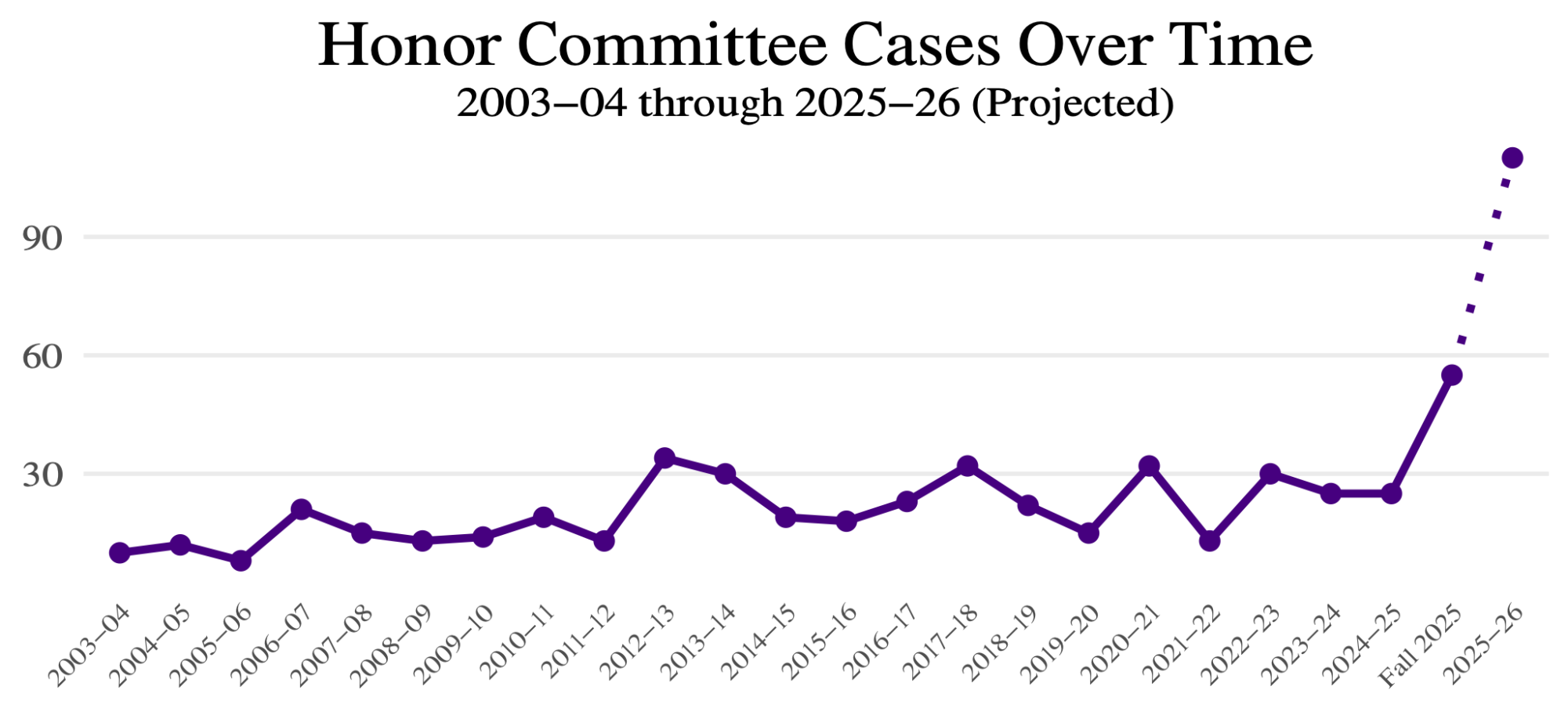
The College’s Committee on Academic Integrity (CAI) found more students responsible for violating the honor code last fall than in recent years, primarily driven by prohibited use of artificial intelligence.
Fifty-five violations of the Honor Code were reported to the CAI in the fall, according to unofficial data provided by Faculty Chair of the CAI Justin Shaddock in an email to the Record. An official anonymized report will be released by the Dean’s Office at the end of this academic year. In the 2024-2025 and 2023-2024 academic years, the Committee’s annual report documented 25 Honor Code violations each year. If violations continue at the current pace for the remainder of the academic year, the total will amount to a more than four-fold increase in reported violations compared to the previous two years.
All of the students whose suspected Honor Code violations were considered by the CAI this fall were found responsible, another sharp contrast to recent years, according to Shaddock. 5 out of 25 students were found not responsible in the 2024-25 academic year, and 7 out of 25 in the 2023-24 academic year.
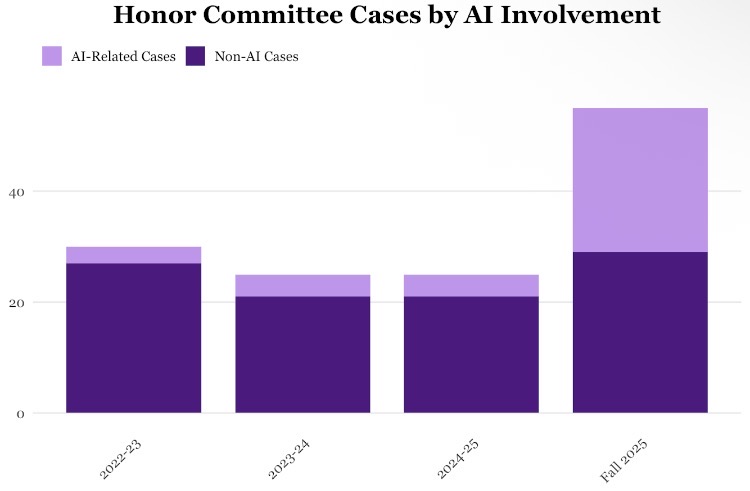
Shaddock posited that the primary reason for the increase in Honor Code violations is due to increased faculty reporting. Changes to the adjudication process this fall, which include allowing professors to impose sanctions without resorting to hearings and allowing faculty to vote at student appeal hearings, may have improved faculty trust in the process, he said. Additionally, increased use of AI contributed to the uptick. Last fall, 26 out of 55 cases were due to illicit use of AI. In the 2024-2025 and the 2023-2024 academic years, only 4 out of 25 cases each year were attributed to AI use.
A new process for addressing Honor Code violations
Last fall was the first semester that the process for addressing Honor Code violations operated under the newly-named CAI, which was previously the Honor and Discipline Committee (HDC). The committee was suggested by the faculty Ad Hoc Committee on Academic Integrity, which was convened by President Maud S. Mandel in November, and approved at a faculty meeting last spring. Under the new CAI, students are approved by faculty through an application process, rather than through student elections.
In previous years, all accusations of Honor Code violations went to a hearing, where professors presented evidence of cheating, the accused student presented their defense, and the HDC faculty members weighed in on the case, but did not have voting power. Ultimately, the students who served on the HDC, having been elected by the student body, decided if the accused student was guilty of cheating.
This semester, hearings are not convened automatically. A professor may find a student responsible for an Honor Code violation and decide on appropriate sanctions in consultation with the CAI, bypassing the process of a hearing. Professors have the option to request a hearing if they do not feel comfortable privately confronting a student. Accused students may appeal professors’ decisions and present their case in a hearing. Beginning last semester, both students and faculty, rather than only students, voted as members of the CAI.
According to Shaddock, only a few of the accused students appealed their cases during the fall semester. Now that hearings do not automatically take place when a student is accused of violating the Honor Code, students who feel mistreated or falsely accused must submit an appeal for a hearing. “The mechanism now for saying you didn’t do it is filing an appeal,” Shaddock said.
The low number of appeals has surprised Shaddock. “I assumed that half of the cases reported would have appeals, and it’s only been [about] five out of 55,” he said.
Shaddock wonders whether the reduced number of hearings reflected students’ tacit admissions of guilt. “A sort of cynical take is, well, if you [were] already going to the hearing, why not just say you didn’t do it [and] see what happens?” he said. “But [now] if you have to write up an appeal, then maybe you’re like, ‘Nah, I did it,’ or at least, ‘I did something.’”
The fear of stricter sanctions from the CAI rather than from professors could contribute to students’ unwillingness to appeal their cases. “A lot of professors are choosing a sanction lower than the suggested one… If you file an appeal, you’re going to come to the committee, and then the committee’s standard penalties are more severe,” Shaddock said.
Shaddock partially credits the increase in cases this fall to improved faculty trust in CAI. Professors previously expressed concerns that sanctions were too lenient or disagreed with student-panel votes.
More explicit inclusion of faculty voices in the Honor Code process has led to greater engagement from faculty, according to Shaddock. “There’s definitely people who had previously told me [that they] would never run a case again, who brought a case this semester,” Shaddock said.
However, some students expressed concern that this new approach removes student voices. Williams Student Union Co-Chair Dylan Safai ’26 said that the increased power given to faculty negatively impacted students facing honor code violations. “Faculty don’t necessarily understand what it’s like to be students … when it was just students on the committee, we saw more fair decision-making,” he said.
The selection of CAI members by application rather than student election, Safai said, has led the committee to be more favorable to faculty interests. “[Electing representatives] is a right we’ve had forever,” he said. “For [the faculty] to just pluck it up, just so they would have their own specific outcomes, in one summer, is egregious.”
Shaddock said that one reason for the change in the student member selection process was that elected representatives were often confused about their role on the committee. “Students that we got on the committee by way of the elections oftentimes seemed like they didn’t want to do the work they actually had to do on the committee,” he said. “They wanted to do some other kind of work, like changing the system or something.”
The CAI has not eliminated student voices entirely. “It’s not like we’ve taken students off the committee… You get the same number of students on the committee by way of applications,” Shaddock said.
Ellie Walker ’27, student chair of CAI, explained another change that she has spearheaded: the introduction of optional restorative conferences, meant to promote resolution between professors and accused students. “[Students and professors] will meet and they can talk about repairing trust and taking accountability,” Walker said.
Violations in an AI world
The increase in Honor Code violations comes at a time of heightened concern about student use of AI. In an internal faculty survey conducted this past January, 72 percent of the 140 respondents suspected at least one student of violating academic integrity during the past semester. 79 percent of faculty who suspected students of academic integrity violations also answered that they believed those violations were “different in degree or kind from prior years.”
In a Record survey conducted this fall, 77 percent of the survey’s 749 respondents reported they use AI, and 17 percent of respondents admitted that they believe their personal use of AI violated the honor code.
Over the past three years, AI usage made up a small portion of cases before the HDC: 4 out of 25 cases in the 2024-25 academic year, 4 out of 25 cases in the 2023-24 academic year, and 3 out of 30 cases in the 2022-23 academic year. This past fall, however, suspected AI use made up 26 out of the 55 cases reported by the CAI.
Shaddock pointed out the difficulties in detecting AI in student work and emphasized that the Committee often balances multiple competing factors. The best kind of evidence that shows a student used AI, he said, is incorrect or false citations. Another good indicator, Shaddock said, is a student’s writing style. “If one student’s writing on one assignment differs significantly from their writing on previous assignments … then you’re like, ‘Okay, that’s not dispositive, but it’s something,’” he said.
At the beginning of the academic year, CAI received AI detection training, according to Dean of the Faculty Lara Shore-Sheppard and Dean of the College Gretchen Long. “The committee is directed to look at student work in the context of the class,” Shore-Sheppard and Long wrote in an email to the Record.
The ambiguity in detecting AI use has left some students upset over false accusations. Caroline Grist ’29 told the Record that she was falsely accused of using AI on an essay for her Spanish class last semester. “There were only nine people in my class, and then four of us get an email … where [the professor is] like, ‘Hey, I think you used AI on your essay,’” she said. Grist went to her professor, explained that she did not use AI, and encouraged her professor to look at the Google Docs history of her essay.
After speaking with her professor, Grist was ultimately found not responsible for using AI in the class, but she said that the accusation of cheating impacted the quality of her future work. “I feel like he was just so afraid of AI use that he went to extreme measures that made me feel and made other people in my class feel like we had to dumb down our essays,” she said.
Grist also believes students at the College are more committed to avoiding AI in their work than students at other institutions. “I feel like there’s more of an academic culture here than there was at my high school … But maybe that’s just way too optimistic, and maybe I’m naive.”
Safai was less optimistic, saying that many students at the College do write essays with AI. “Williams students do use it to write, and will use it to write more,” he said. “That will water down the quality of education that we have here.”
AI in the classroom
Although Safai acknowledges that students use AI in non-sanctioned ways, he still feels that the College has a responsibility to incorporate AI into coursework. “Do I think that just because there’s a couple bad apples means that we should stop eating apples as a whole?” he said. “No.”
Some students find that AI can be helpful as an aid in understanding complex course material. Puzant Kiwanian ’27, a math and philosophy double major, said that AI can be helpful for explaining background information or filling in the gaps in Division 3 classes. “I’ll take my notes and stuff to AI and have it explain concepts to me,” he told the Record.
In some courses, there’s a gray area for what level of AI use is acceptable. Shaddock recognized that some Honor Code violations are due to students’ misunderstanding of professors’ policies. “I’ve had a handful of students who don’t file an appeal, but email me and are like, ‘Dude, I was just confused about what a violation was here… I take responsibility, but I wish I understood better what is and isn’t a violation,’” he said.
Walker emphasized that students need professors to guide them through their courses’ unique AI policies. “If you’re in four different classes and they’re all kind of different … it’s hard to keep track,” she said.
Jaya Shri ’29, a prospective history major, expressed some disappointment with the ways different professors are responding to the rise of AI. “A lot of what we’re being tested on has changed, because it’s a lot fewer long-term, take-home assignments and a lot more in-class writing, which I think is a little sad,” she said. “And, I don’t know, I just miss the papers.”