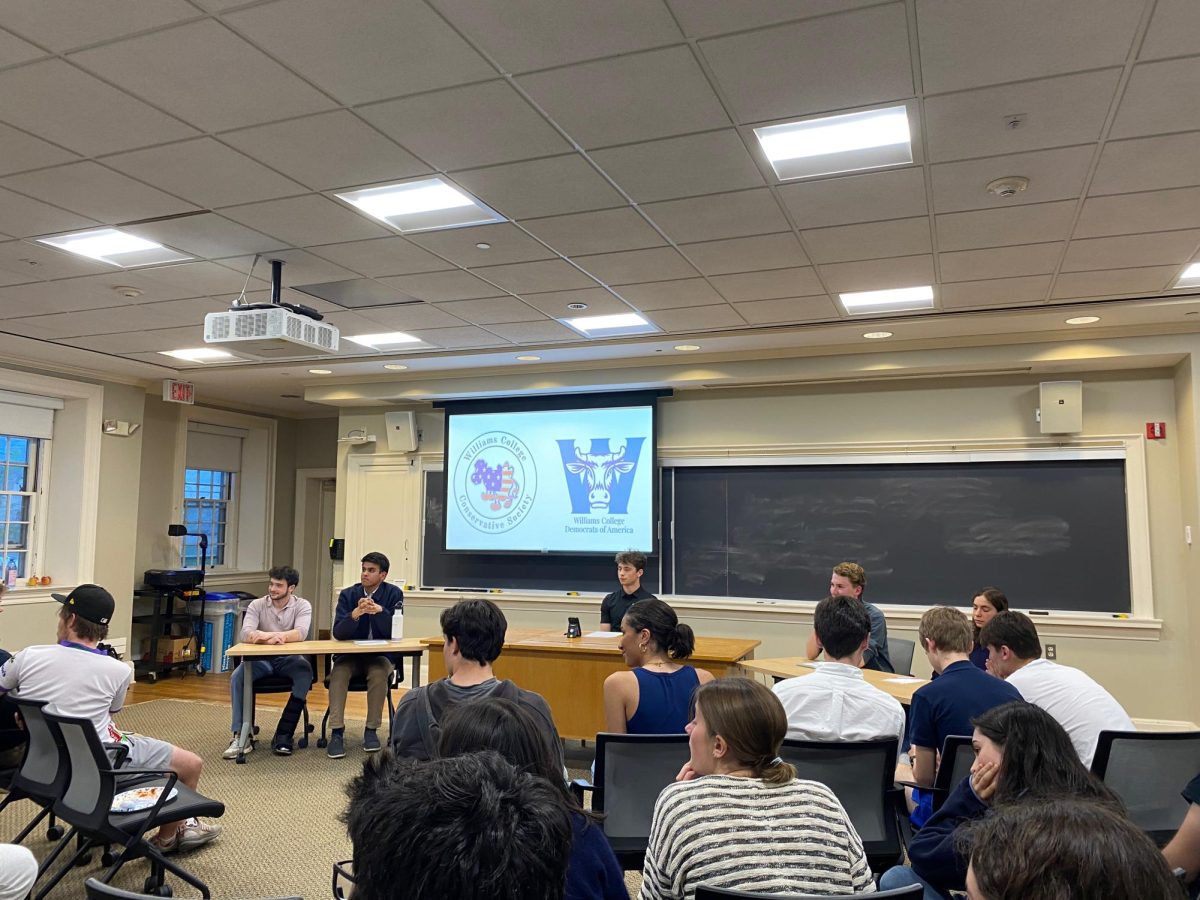

The Black Student Union (BSU) hosted a community conversation at the Davis Center on Nov. 12 in response to recent bias incidents on campus. This semester, five students have made reports to Campus Safety Services (CSS) of individuals in passing cars shouting racial slurs at Black students. More students told the Record that they experienced similar harassment but did not make an official CSS report.
At the gathering, students shared personal experiences and ideas for combatting racial discrimination on campus. A similar informal gathering of students took place the day before.
Originally, instead of the student gathering, the BSU had planned to host a town hall where students would have the opportunity to talk to CSS Director Jeff Palmer, Berkshire County District Attorney Timothy J. Shugrue, and Williamstown Police Department (WPD) Chief of Police Mike Ziemba about their concerns and experiences, discuss the campus surveillance camera policy, and the possibility of increasing surveillance and implementing cameras along Route 2, according to BSU Co-Chair Jeffrey Zigbuo ’26. “The first step is dialogue,” Zigbuo said in an interview with the Record. “That was what my goal was — dialogue between the student body and the three people who actually have the ability to work with us and actually create effective change.”
The town hall, originally planned for Nov. 12, was postponed to allow further discussion among students first, according to Zigbuo. “It was postponed to give students enough time to gather their thoughts,” he said.
The BSU will host a town hall in the spring, Assistant Vice President for Campus Engagement and Director of the Davis Center (DC) Bilal W. Ansari wrote in an email to the Record. “The leadership of BSU asked for the creation of a safe space to unpack the impact of so many incidents this semester… [The DC] gave support,” Ansari wrote in an email to the Record. “As a result, this Spring semester a BSU Town Hall is being planned to discuss implications and possible institutional demands.”
In interviews with the Record, Black students shared their experiences of racial harassment both in Town and by students at the College and expressed concerns about the campus community’s response.
Taahira Garnes ’28 recounted being targeted on Route 2 by a bike gang who shouted racially and sexually explicit comments at her. “It made me really upset and I felt myself getting emotional,” she wrote in a message to the Record. “I wasn’t sure why. I’ve experienced racism my whole life but I think it was a reminder that it follows me.”
These incidents are not isolated to Route 2 but reflect experiences on campus as well, students said. “What’s most upsetting is that these acts of hate aren’t exclusive to the broader community but also within this purple bubble,” Garnes wrote. “I’ve gotten weird looks and remarks. I once overheard a group of white boys walking from Hoxsey talking about my sister and I in a derogatory manner — referring to us as ‘that one’ and inserting a slur after.”
The College receives a wide range of bias reports — some involving drive-by harassment on public roads and others occurring in classrooms, residence halls, or student groups, according to Vice President for Institutional Diversity, Equity, and Inclusion Leticia S.E. Haynes ’99. The response differs depending on the situation, she continued.
“Our office historically adapts to whatever is going on,” Haynes said in an interview with the Record. “We don’t have one strategy or one practice that we engage in. We think about the needs of the community at any given time and try to adjust accordingly.”
Part of that response, she said, includes helping students navigate the aftermath of experiencing harassment. “We try to understand what happened, and also oftentimes, if someone has identified themselves … we will follow up and encourage [them], if they haven’t, [to reach] out to CSS directly,” Haynes said.
The Davis Center similarly focuses on supporting and advising students who experience harassment, according to Ansari. “Students who were assaulted asked for particular support around holding assailants accountable,” he wrote in an email to the Record. “We gave advice.”
Palmer said CSS responds by both supporting the victim and investigating the incident. “Generally speaking, our response is making sure the victim(s) is/are safe, providing support resources, gathering information, providing information to campus partners, and determining next steps, including if campus communication is warranted,” Palmer wrote in an email to the Record.
“It’s also important to pay attention to details during these kinds of incidents, so that you can provide as much information as possible to law enforcement or other entities you’re reporting to,” he continued.
CSS has recently increased its presence along Route 2 after receiving reports of racial harassment.
Students, however, often do not report incidents.
One student, who has been granted anonymity due to concerns for their safety, said they were harassed by a group of students after leaving senior fall formal on Nov. 8.
“I see some dudes in a car — white dudes — and one of them gets out of the car and asks me for my pizza,” the student told the Record. One of the students then called this student an anti-Black racial slur. The student did not report the incident to CSS, citing disillusionment with the response to such incidents. “It’s been happening the last couple years actually, and the school just consistently does nothing,” they said.
Students told the Record that the College’s lack of action against anti-Black harassment allows targeted incidents to continue and fosters a culture of disrespect toward Black students on campus. The same anonymous student recounted how, during their first year at the College, they watched a group of white students trying on BSU sweatshirts and joking about them. “One of these girls is in one of my classes now, and I have to look at her, and I’m like, ‘Oh, I remember you,’” the student told the Record. “So I’ve never really felt safe on this campus because of stuff like that.”
Garnes emphasized that non-Black students must hold the campus community accountable for anti-Black hate. “It’s not okay to use slurs, and if you’re aware of people that are, stand for something,” she wrote.
Zigbuo said the BSU postponed the town hall in part due to disagreement among students on the value of continued dialogue with CSS, the College, and law enforcement without tangible action.
Amirah Parker ’26 expressed irritation at “conversations” without change. “It’s easy to sit in conversations and talk in hypotheticals instead of getting on the ground and facing what is actually happening,” she told the Record.
Other students advocate for camera surveillance and support for Black students.
Sara Fevrier ’28 told the Record that she believes the responsibility currently falls excessively on Black students to catch and report the crimes. “We, as Williams College students, are so tired and exhausted,” Fevrier said. “When this stuff happened to me, I was also overwhelmed with work. We genuinely need help, and the burden of this shouldn’t be on the victims. Fevrier suggested involving members of Williams Black Alumni Network (WBAN) and increasing the physical presence of CSS officers on Route 2.
Garnes similarly proposed a middle ground that would increase CSS presence without expanding the role of WPD, an institution that she said has acted “mildly racist” toward Black students.
For some students, this history does not preclude the use of certain safety measures that may involve the WPD, such as increased camera surveillance on Route 2. Cameras would fall under the supervision of the Town, meaning the College cannot install them unilaterally. “Any installation process and implementation policies regarding footage and data would need to be in conjunction with and require approval from the town,” Palmer wrote.
Some students, however, told the Record they are opposed to the idea of increased surveillance from either CSS or the WPD.
Haynes said that the College’s strategy to limit bias incidents involves working with organizations that are adjacent to the campus community, including the NAACP of Berkshire County, WPD, and the Town. “In terms of education, we have a very robust suite of workshops and educational programming that we also adapt, and we engage students in some of this work as peer educators, and we also bring people in from the outside to help us think through and talk about some of these challenges,” she said.
Some students say these measures fall short. One student, who was granted anonymity out of concern for their safety, described experiencing a bias incident on Route 2 in fall 2024. “The day it happened, I remember … something being thrown at us really quickly,” said the student, referring to a bottle. “And then hearing the N-word from out the truck window, of course.”
The student described non-Black students’ reaction to this incident — which was reported by President Maud S. Mandel in an all-campus email without the students’ consent — as “lukewarm.”
Students told the Record that experiencing racial harassment on campus is significantly psychologically damaging and traumatic. They also described a sense that racism is escalating on campuses nationwide.
Fevrier said she was called an anti-Black racial slur while crossing Route 2 as a first-year — her first time wearing an Afro on campus, something she decided never to do again. The incident occurred right after finishing an exam, and it subsequently impacted her mental health and her academic performance, she said.
“I don’t think people understand the lingering fear,” Fevrier said. “You feel as if you’re being overdramatic for feeling the way you do. I was just so paranoid and felt so afraid and so small. It’s not just being called the word, it’s what it means for the future. I’m a person, you know? I’m a human being. And that hurts.”