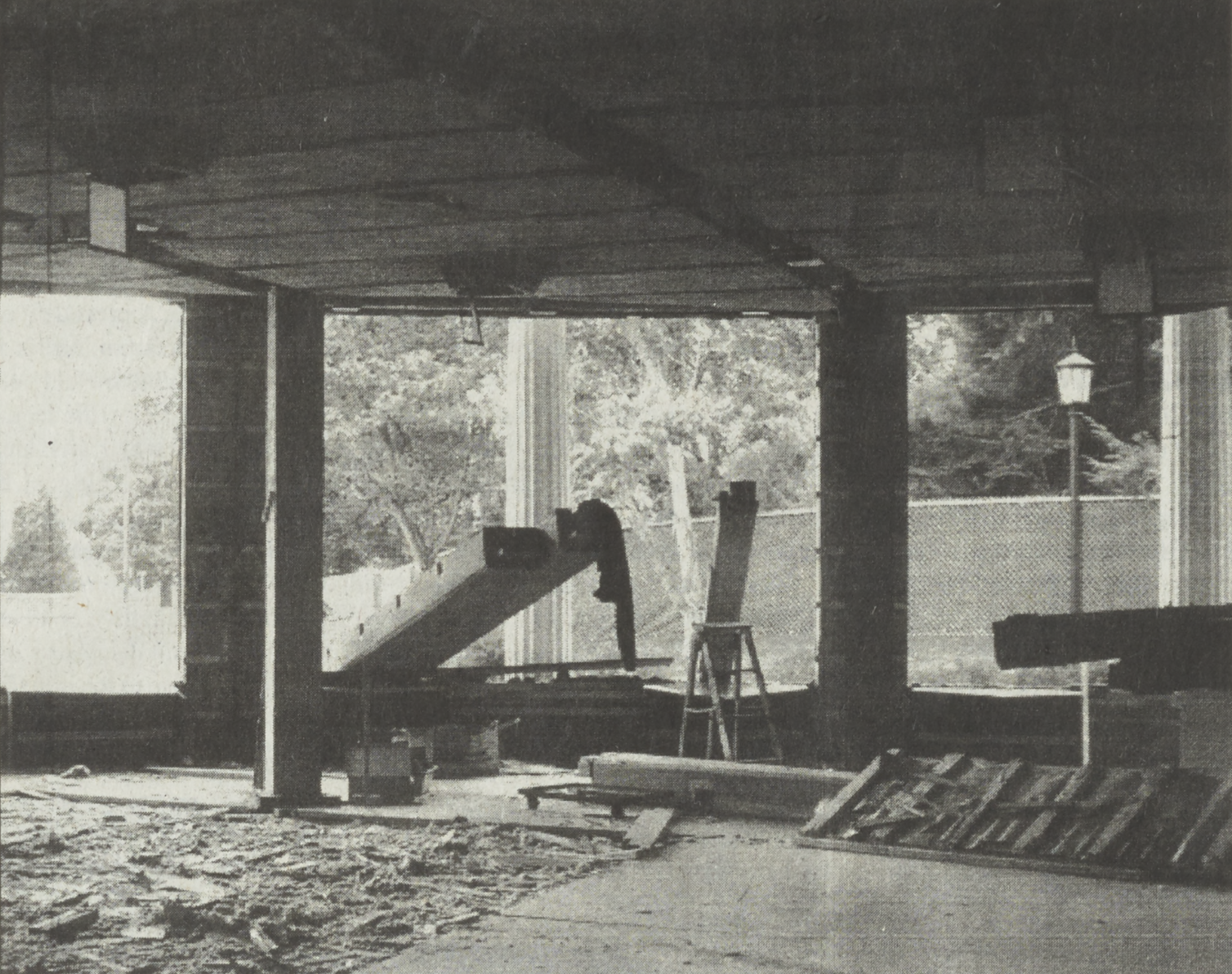
Before the days of scrambling to get the last booth in Paresky’s Lee Snack Bar, Baxter Hall’s Snack Bar provided a haven for student-faculty interaction and intellectual conversation. Located on the main floor of Baxter before it was demolished in 2005 and rebuilt as Paresky, the Snack Bar was a space frequented by students and faculty alike. This week, the Record spoke with current and retired professors about their fond memories from the bygone Snack Bar.
In Baxter Hall, the Snack Bar on the ground floor was entirely separated from the main dining hall upstairs. Adjacent to the enclosed Snack Bar, the ground floor contained cozy lounges styled like living rooms, Provost and Professor of History Eiko Maruko Siniawer ’97 wrote in an email to the Record.
Professor of English Stephen Tifft said that the Snack Bar was rarely overcrowded, because there were five operational dining halls on campus before Baxter was demolished. While resembling the semi-circular structure of the current Lee’s Snack Bar, the old space was slightly larger with more tables, so professors and students could count on finding a seat. The room was quiet enough for conversation, according to Tifft. Some of the Snack Bar’s most lively conversation took place at the room’s center — a large, circular table frequented by faculty regulars.
Emeritus Professor of Computer Science William Lenhart joined this group of faculty Snack Bar regulars when he began teaching at the College in 1982. “It was such a cool experience,” he said in an interview with the Record. “It was like the faculty version of what you imagine a Williams education should be like, right? You’d go to this table, and there would be philosophers, political scientists, computer scientists, mathematicians, you name it, classicists, economists, and they’d be talking about everything under the sun.”
Often, conversation turned into lively debate. “It was kind of rough and tumble,” Lenhart said. “People would get into these fake arguments about some topic and have a pointed back and forth about it, but it was just a huge amount of fun.”
The central table, which could seat more than a dozen people, was frequented not only by professors, but by deans, the provost, and other administrators, according to Lenhart.
Spending time at the Snack Bar was not just a staple of Lenhart’s daily routine, but a way to get to know colleagues in a casual setting. “It was never a plan,” he said. “I don’t know if anyone [ever] said, ‘Well, let’s all go to the Snack Bar.’ You just showed up, and whoever was there you talked to, and it was great.”
Beyond the big faculty table, the Snack Bar was a space for student-faculty interaction. Professors would meet with students one-on-one, hold independent study sessions or, in the case of Tifft, hold office hours.
Tifft said that one of his closest colleagues in the English department, Professor Stephen Fix, who passed away in 2024, invited students to the Snack Bar with him after every class. “He would just sit there with six or eight of his students and talk about anything they wanted to talk about,” Tifft said. “About their own lives, or about any intellectual matters. Not about the course — it wasn’t a follow-up of the discussion, unless somebody wanted to ask about that.”
After Paresky opened, the new Snack Bar, renamed Lee Snack Bar, lost many of its faculty regulars due to the condensing of the dining hall. For Lenhart, the space became too loud and crowded to facilitate the same kind of meaningful conversation. “A bunch of us slowly stopped coming as often,” he said.
Emeritus Professor of Political Science George Marcus agreed that the current Lee’s isn’t the same as the old Snack Bar. “It’s noisy as hell,” he said. “That destroys the ability to listen.”
Some professors who knew the old Snack Bar are frustrated by the lack of casual spaces for student-faculty interaction, according to Tifft and Lenhart. “Those spaces were bound up with student and faculty interactions, but more particularly, with an interface of academic and social interaction,” Tifft said. “I think we’ve lost a lot of that.”
Marcus said that the loss of the Snack Bar affected his faculty social life. When the space closed, the group he would see many days a week dissolved, as there was no comparable space where they could get together. “There were very few other places [to interact],” Marcus said. “There are some nooks and crannies, but they feel small. None of the new dining spaces foster the Snack Bar’s feel.”
Professor of English Kathryn Kent ’88 said that she does not feel that professors are welcome in Goodrich Coffee Bar, and she chooses not to meet other professors and students in Lee Snack Bar because of the noise and crowds. “There is a lack of that third space [on campus] that isn’t a faculty space or a student space,” she said.
Tifft said that before construction began on Hollander Hall in 2007, he put in a strong request that a cafe be included in the blueprint, hoping it would provide a new place to meet up and chat with colleagues. “It’s not as easy for us,” Tifft said. “Faculty can’t do that now, just sit down at a table with somebody you haven’t seen in a while and eat or have coffee together and talk. We can do that at the Faculty House, and that’s important, but there aren’t that many other places where that happens.”
Tifft and Marcus said that shared spaces for both students and faculty can have an important role in the educational experience that the College offers. “You’re not only learning when you walk into a classroom,” Marcus said. Lenhart echoed this statement, emphasizing that he learned new things from his colleagues daily at the Snack Bar.
Amidst the College’s On the Log initiative, faculty remember the former Snack Bar as a “log” of sorts. Now, faculty see the situation as different. There are few spaces on campus that are shared between students and professors. “You have to go in the woods to find that?” Marcus asked. “Isn’t that what the buildings are for?”