
If you think Williams is as isolated and tight-knit as a college can get, you probably haven’t heard of Deep Springs College, the secluded cattle ranch campus located in a remote corner of the California desert. Deep Springs, which caps its enrollment at 30 total students, is a higher education institution that offers a two-year, tuition-free program, after which most students go on to complete a four-year degree at another school. Some of these graduates have found their way to the relative metropolis that is the Purple Valley.
A Deep Springs education is underpinned by three pillars: academics, student self-government, and manual labor. Along with their courses, students do everything from preparing their own farm-produced food to caring for the livestock on the 155-acre property. Students also run the college’s administration itself in cooperation with a president and dean. Admissions, faculty hiring, and academic policy are mostly managed by the student body.
Lana Mahbouba ’26 attended Deep Springs before coming to the College. In an interview with the Record, she described her daily life on the ranch. The day would begin at 5:30 am, when Mahbouba and her peers would milk the cows and prepare for breakfast. At 7:30 am, students and faculty would all eat breakfast together before class. At Deep Springs, everyone eats at the same hour and meals are entirely prepared by the student body. That means that if you oversleep, the community has no milk for breakfast. “There is something really special about your actions having real repercussions. It builds a sense of competency, but it also makes you aware that you are just one piece of a big puzzle,” Mahbouba said.
After breakfast, students attend seminars with an average size of five. Courses in public speaking, writing and horsemanship are required, but the students co-design most of the curriculum. At the beginning of each term, each professor offers three proposals for what to teach, and the students vote on their preferred course.
During classes, thoughtful engagement is expected from everyone. “If you don’t do your readings or don’t participate, that is a big deal,” Mahbouba said. “Your ideas are also often pushed to a breaking point, and your professors and peers challenge you to think harder about your ideas.”
Mahbouba appreciates the tutorial format at the College and has found it a productive learning environment, but has generally been disappointed by the lack of constructive criticism within the classroom. “I don’t see much of that pushback here at Williams,” she said.
Melania Espinal ’27, who graduated from Deep Springs the year after Mahbouba, also feels like class discussions at the College are relatively unproductive. “Classes at Williams often feel like a Q&A session with the professor,” she said. “It feels like students are just there to state their own ideas. At Deep Springs we didn’t even raise our hands before speaking. This meant learning when to wait it out, and it forced us to respond to each other.”
Professor of Neuroscience Martha Marvin taught at Deep Springs for a semester in fall 2025. Initially drawn to the program by the challenge of teaching science in a low-resource environment, Marvin enjoyed being able to get to know her students outside of the classroom. “Going on hikes and taking horsemanship classes together really helped build rapport,” she said.
After her return to the College, Marvin has tried to find ways to integrate what she learned at Deep Springs in her teaching. “I’ve tried to make my intensive lab classes more student-driven,” she said. “There is a big culture difference — students at Deep Springs were much less focused on grades and class participation was incredible. That is not to say that our students are irresponsible, it’s just that the class size really makes a difference.”
At Deep Springs, mid-day seminars are followed by labor hours, which last until dinner time, Mahbouba said. Students rotate through tasks like feeding the cattle or slaughtering the livestock and receive brief training by expert ranch workers before being expected to perform the chores on their own. Mahbouba said that learning through manual labor and serving her community taught her to problem-solve and take responsibility for her mistakes. “If we didn’t castrate a calf correctly that meant it would get infected and die,” she said. “If we didn’t slaughter a chicken correctly, that would compound its suffering.”
Mahbouba also served as Deep Springs’ head nurse for a time, treating broken fingers and conducting sex education classes, among other responsibilities.
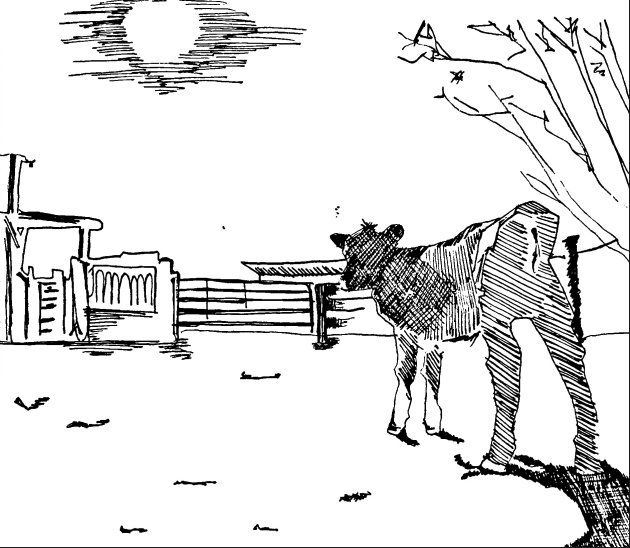
Labor was Espinal’s favorite aspect of Deep Springs. “It really gave me tough skin,” she said. “It is a very self-directed process, and mistakes have real impact.”
Espinal recalled a time when she was going about her task of feeding the cattle and accidentally left one of the gates open, only to find one of the horses had escaped. “He hadn’t gone very far so I managed to catch him, but the consequences could have been much worse,” she said.
Although the labor-oriented moments on the ranch could feel like an escape from academic rigor, Espinal noted that all activity was done with intentionality. “Academics had a huge sway on how we talked about the things that we did,” she said. “There was ongoing collective reflection about how we were living our lives there.”
Mahbouba said that this collective reflection happened most formally during weekly student body meetings, which started at 8 p.m. on Fridays and went until late at night. The president, elected by the students, would set an agenda and, after long disagreements and deliberations, everyone would vote on each issue.
During Espinal’s time at Deep Springs, one of the more controversial issues was whether the students should be able to eat meat and eggs produced outside of the ranch. “People had really strong feelings,” she said. “Many students were really committed to the value of total self-sufficiency. Even my opinion changed several times during deliberations.”
Mahbouba noted the difficulties that arise from a self-governing student body when all problems are dealt with through collective social action. “There are no official offices to step in when you are in trouble and it can be really hard when there is no one to speak for you,” she said.
When comparing Deep Springs to Williams, Mahbouba said she thinks there needs to be a balance when it comes to resource allocation. “It has been mind-boggling to see how much money gets thrown around at Williams for things that feel really fake,” she said.
Mahbouba added that she thinks that the College often fails to build community, and not just because of its larger size. “There just needs to be some sort of claim to [living] continuity,” she said. Mahbouba said she would like to see a housing arrangement where students would share their living spaces with the same people for a longer period of time, and be responsible for their upkeep.“This could help cultivate some of the values of communal living,” she said.
For Espinal, building community is about figuring out ways to exist with people with whom friendship might not always come naturally, something she sees as missing at the College. “Everyone says that Williams is tight-knit, but I don’t see us doing things for each other,” Espinal said. “Friendships are formed due to a common interest or sport, but there is no sense of overcoming difference and disagreement.”
Espinal worries that higher education in general is too focused on students’ GPAs, rather than instilling virtues. “I am concerned about the type of person these institutions create,” she said. “They promise us a life where we only have to worry about our career goals and social life. We are not asked to think about why we pursue what we pursue and how it affects other people in the world.”
For Espinal, it’s no surprise that so many students at the College go into finance, she said.
She has struggled to reconcile the values she found at Deep Springs with those of the College. “I’m still learning how to apply these values to my life here,” she said. “It’s easy to live by your values at a place like Deep Springs. I’m still figuring out how to translate them into the real world.”