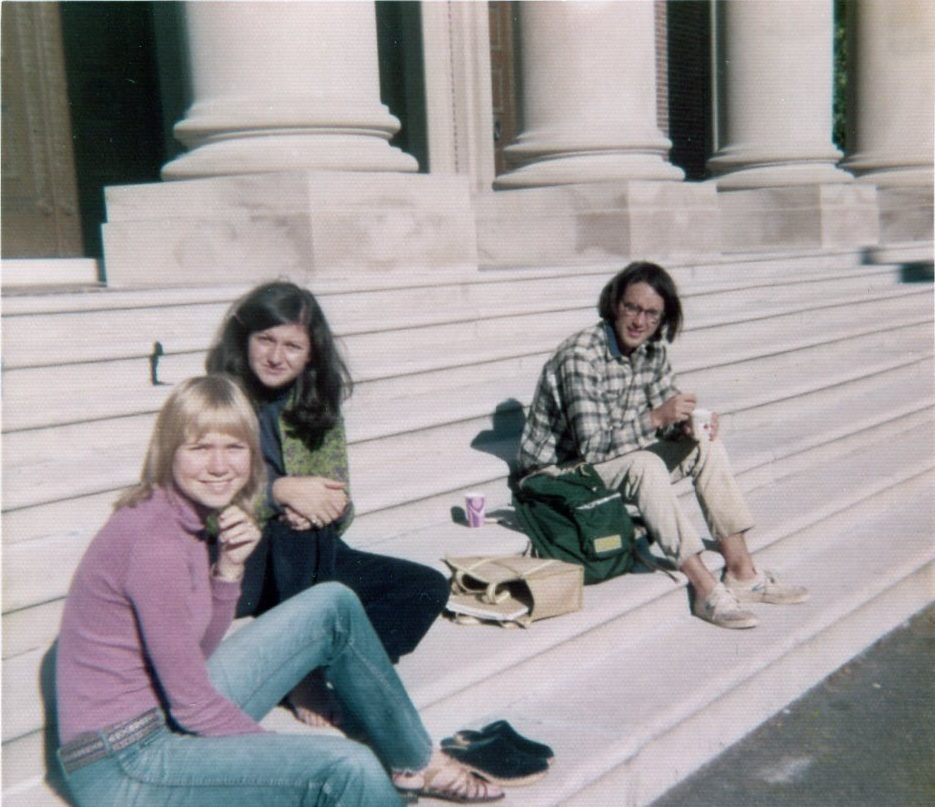
Today, women make up 51 percent of the students at the College. Before 1970, they were not admitted at all.
As the College marks more than 55 years of coeducation, the Record talked to some of the first women to break the gender barrier at the College.
Dede Gotthelf Moan ’73 had a mixed experience during her time at the College. She transferred here for her sophomore year in 1970, the first year women were admitted — and was one of the first ten women ever to attend the College. In an interview with the Record, she described how the female students’ housing accommodations were dispersed throughout campus. Gotthelf recalled living in a previously untouched room in Goodrich Annex, where there was only one bare lightbulb hanging from the ceiling.
Gotthelf didn’t enter the College expecting to face gender discrimination. Instead, she viewed herself as a trailblazer. “I thought this was the best thing in the world, to have schools that were becoming coed,” Gotthelf said. “It was extremely exciting to be part of it, to be a pioneer.”
On campus, Gotthelf’s options for getting involved with student life were limited. Popular activities such as swimming, golf, and gymnastics were unavailable to women due to the lack of proper facilities and equipment. Gotthelf said she did play on the new women’s tennis and men’s squash teams. “You didn’t have to worry about having a locker room, and it didn’t matter what length racket you used,” Gotthelf explained.
The faculty weren’t welcoming to female students, according to Gotthelf. She entered the College interested in studying music and English, but found obstacles for women in both departments. She had learned piano under famed pianist Alexander Lipsky, but was denied entry to music classes because those spots were reserved for the boys.
Sometimes she experienced hostility overtly. During her first English course at the College, Professor of English Clay Hunt started the class by saying, “My name is Clay as in lay, and Hunt as in cunt,” Gotthelf recalled. “He then looked right at me and said, ‘If you can’t take it, you don’t belong in my class.’”
During the first years of coed integration, Gotthelf noted a pervasive attitude of disrespect on campus towards women. “The pithy concept of the Williams men and the ‘girls’ was repeated way too often,” Gotthelf said. “We were there to service and to humor the men.”
Gotthelf’s experience with her male peers was also varied. “Some of them were disgusting, putting used condoms in my mailbox,” said Gotthelf. Despite this attitude, many men were respectful, and she felt like she formed a bond with many of her fellow Ephs regardless of gender. “They realized it was difficult, and we were just creating a wonderful group of colleagues, comrades, and supporters amongst ourselves,” she said.
During the first years that women were admitted to the College, the Record published an anonymous satirical column called “Suzy Coed” about the authentic experience of women at the College. In a Letter to the Editor titled “How to recognize a coed,” published in the Nov. 6, 1970 edition of the Record, Suzy Coed established that campus had formed into three groups: “1) the boys (true and rightful heirs), 2) the real girls (migrant week-end workers), and 3) the coeds, a strange new species which evolved from group two after the pressures of a new environment and the need for survival necessitated adaptation,” Suzy Coed wrote.
Gotthelf admitted to writing the Suzy Coed column 50 years later. “It was very tongue in cheek, a little sophomoric, kind of sarcastic, but I felt it needed to be said,” Gotthelf said.
Though many of Gotthelf’s high school peers chose to go to prestigious women’s colleges like Barnard or Pembroke, she didn’t regret her decision to come to the College. “I just felt that I was in one of the best academic places that people dream of. So I made it work,” Gotthelf said.
When Connie Rudnick ’73 transferred to the College from Mount Holyoke as a junior in 1971, she had the perception that she had a remarkably better experience than Gotthelf. Having a larger cohort of women helped, she said. “What happened in ’70 to ’71 was inexcusable and terrible,” said Rudnick in an interview with the Record. “There were so many upper class women from ’71 onwards that it would have been difficult for male professors to show bias.”
Rudnick describes her time at Williams as positive, especially contrasted with her years at Mount Holyoke. “I can’t think of a time where I wasn’t happy [at Williams], and I think part of it had to do with the fact that I really was unhappy at Mount Holyoke,” Rudnick said. There were more restrictions on the students at Mount Holyoke, and Rudnick complained that classes there lacked sophistication. “[At Mount Holyoke,] I didn’t like the atmosphere,” she said. “I thought they treated us like children. I also was not impressed with the intellectual capacity of the students.”
After her time at a women’s college, Rudnick valued the opportunity to learn at a coed institution. “I knew I was going to be in a world dominated by men, and I better learn how to function with them,” Rudnick said.
Anne Eisenmenger ’76, admitted only two years after Gotthelf, said she had a more positive experience with coed integration. “I felt at Williams, from the very beginning, very welcomed,” Eisenmenger said.
Eisenmenger’s stories of the College are more familiar than those of her predecessors: Living in Sage her first year, attending the dean’s First Days party in Frosh Quad, rowing for club crew. She was also involved with campus political groups in her first year, and worked for the Record.
According to the first female students, the College’s coed integration was difficult at the outset, but improved more quickly than peer institutions. Both Gotthelf and Eisenmenger mentioned that conditions were worse for women attending Dartmouth College during these years. “I think frats had a lot to do with that,” Eisenmenger said. “Williams didn’t have them. Dartmouth did.”
Gotthelf graduated in 1973 with 44 other women who had transferred into the class and entered the Global Credit Training Program at Chase Manhattan Bank, where she faced similar gender dynamics. “It was a continuation, except there were more women, so we were much stronger as a group,” Gotthelf said. “I was more mature after Williams. I had been through it before, but I’ve always been a woman in a man’s world.”
From there, Gotthelf continued to have a successful career in construction and real estate. She founded Catcove Corp, a commercial real estate company, in 1987, where today she serves as executive vice president.
Rudnick, who graduated in 1973, attended law school at Case Western Reserve University, and then went into private practice as a trial lawyer for 15 years. She later became a law professor at the Massachusetts School of Law, where she taught until she retired in 2021.
Eisenmenger graduated in 1976, and her class was about one third female. She went on to work at the Bennington Banner, and multiple other newspapers and media organizations. Eisenmenger founded Beaver Dam Partners, a Massachusetts company that publishes several local newspapers, and currently serves as its president.
While the years after 1970 brought easier times for women at the College, Gotthelf cautioned that the stories of women at the College and their struggles with gender parity aren’t linear. “The boys’ club is coming back, and we need to be careful that we’re aware of it,” she said. “It goes up and down, but it doesn’t go away.”
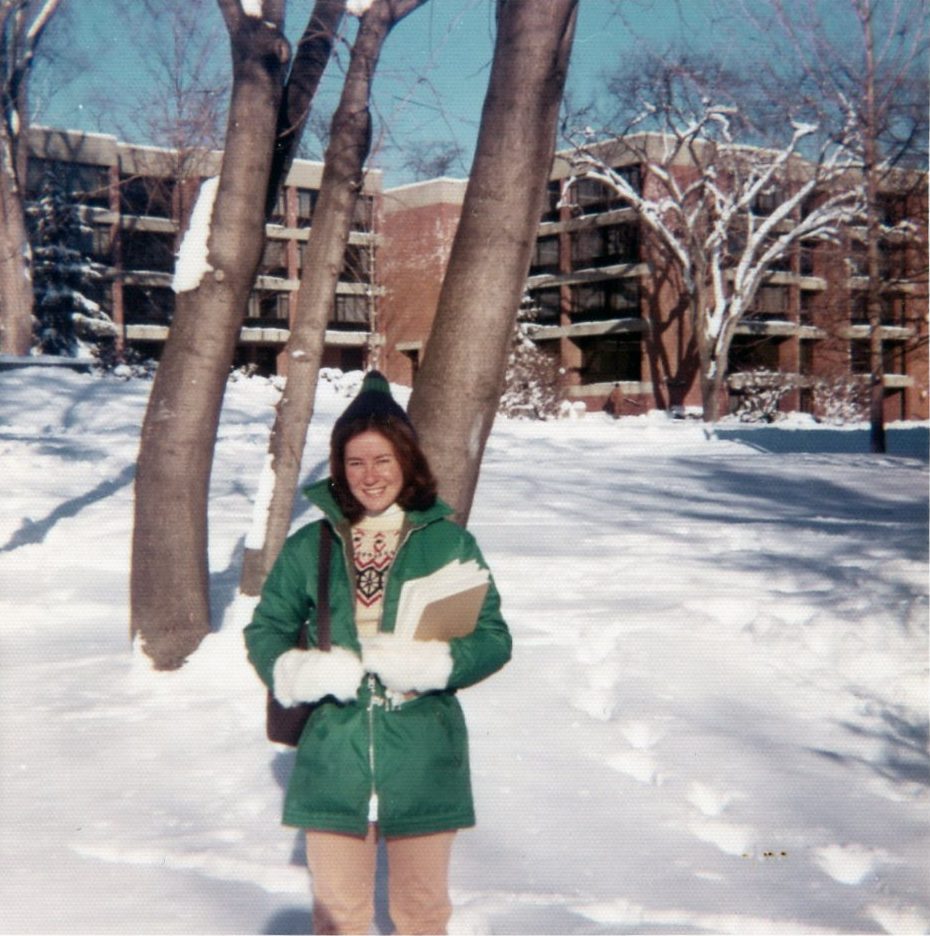
Dede Gotthelf Moan ’73 in Greylock Quad.
Correction: A previous version of this article incorrectly stated that the top image depicted Dede Gotthelf Moan ’73 and friends on the Chapin Hall steps. The image actually depicts Tommy Berry ’73, Connie Rudnick ’73, and John Parker ’73 on the Chapin Hall steps. The image caption was updated on April 29 at 8:25 p.m. to reflect this.