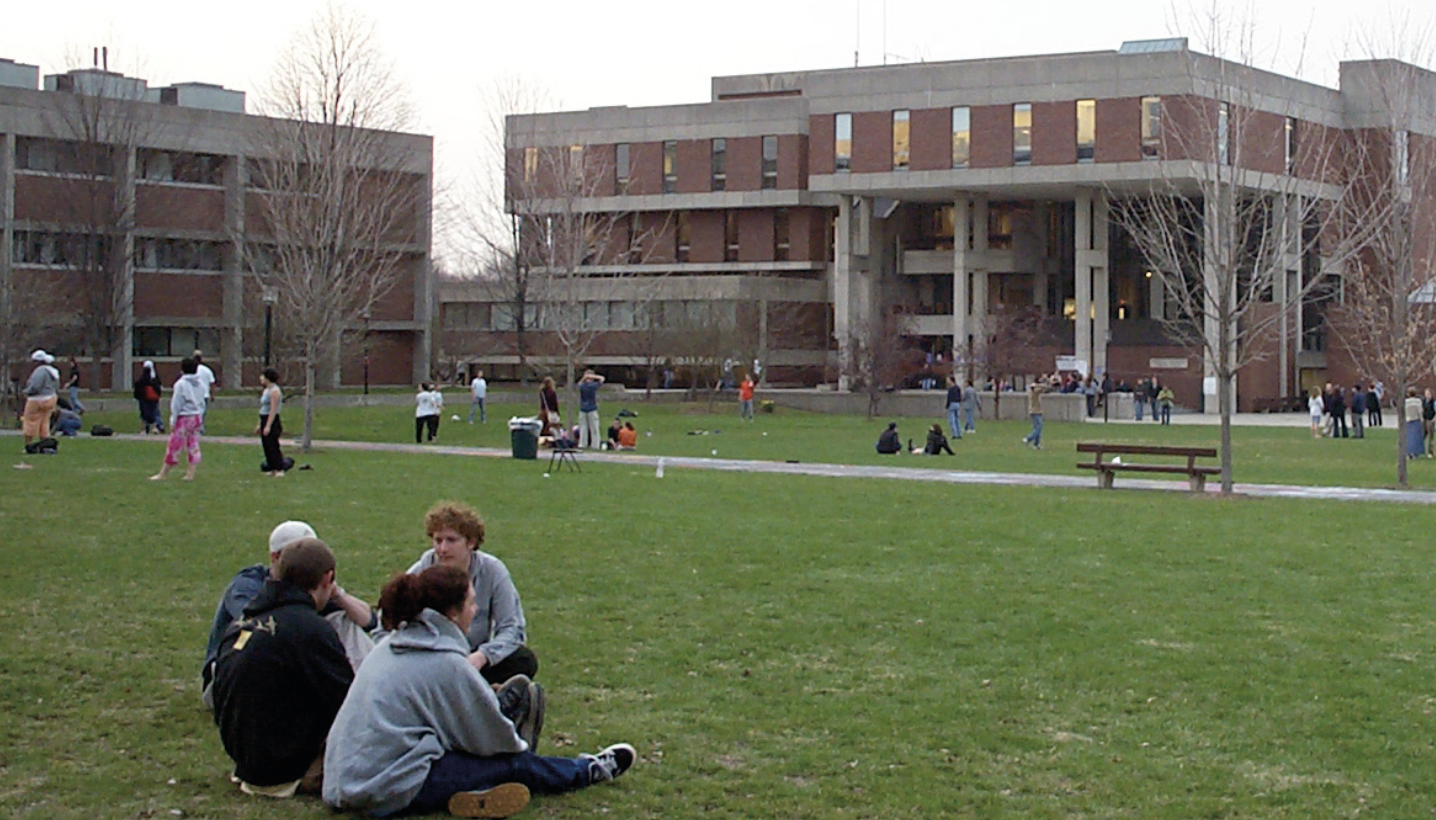
Hampshire College, a liberal arts institution in Amherst, Mass., announced on April 14 that it will close at the end of the fall 2026 semester. Another small liberal arts institution, St. Michael’s College, in Colchester, Vt., may suffer a similar fate if its enrollment continues to decline, according to the Wall Street Journal. These financial hardships follow a broader trend in higher education: According to the Hechinger Report, a higher-education news platform, between 2008 and 2023 nearly 300 higher education institutions have closed their doors. Liberal arts colleges in New England are feeling the financial strain.
In recent years, student interest in liberal arts colleges has declined as larger, research-focused institutions draw more interest. Importantly, these larger institutions are often much more affordable to undergraduates. According to Richard Vedder, an economist at Ohio University who studies higher education, more students are focused on enrolling in large, prestigious universities in order to achieve greater job opportunities. “It’s a flight to quality,” Vedder said to the Journal.
The value of a college degree has come into question in recent years, compounding the troubles of liberal arts institutions. Uncertainty about the job market in the age of AI and a high unemployment rate for recent graduates adds to potential students’ uncertainty about whether a college degree is worth the cost. In addition, the number of college-aged Americans is expected to decline due to low birth rates during the 2008 financial crisis.
Hampshire College, founded in 1970 as an experimental institution, nearly closed in 2019, but a strong fundraising effort led by alum and famous documentarian Ken Burns helped keep it afloat. Currently, the college has around 625 students, just under half of its average enrollment in the 2000s. Since then, the college has continued to struggle. Hampshire College President and Board Chair Jennifer Chrisler said the school has exhausted all other options, including land sales and refinancing existing debt, according to the the Journal, leading to its impending closure in the fall.
At St. Michael’s, a Catholic institution founded in 1904, enrollment has decreased by 45 percent over the past decade, and the college has run recent budget deficits of $12 million. In an effort to mitigate its losses, St. Michael’s has sold property, reduced its faculty, cut courses, and doubled its endowment withdrawals. They have also rented out dorm room spaces to refugee families, a local private high school, and students from nearby Vermont State University.
Despite ongoing financial challenges, St. Michael’s has an $87 million endowment, which school leaders cite as a reason for optimism. St. Michael’s President Richard Plumb, who took office in 2024, told the Journal that St. Michael’s has a narrow five-year window to get its finances on track.
In a statement on their website, Hampshire College said they cannot guarantee that the other institutions of the Five College Consortium (Amherst, Mount Holyoke, Smith, and UMass) will be able to offer comparable financial-aid packages to students should they choose to transfer. However, Massachusetts College of Liberal Arts (MCLA), a public liberal arts college, has been named as a “teach-out partner” for Hampshire College, meaning that all Hampshire students in “good academic and judicial standing” will be granted admission to MCLA, according to the Berkshire Eagle.
At Williams, enrollment continues to be steady. This spring, the College admitted its lowest number of students yet, a staggering 7.4% out of an applicant pool of 15,534 students for the class of 2030. This is an increase of over 1,000 applicants from last year. At the end of the 2025 fiscal year, the College’s endowment grew by 11.7% after facing a large dip in the wake of the pandemic.