
Students in the Williams Flying Club prepare for their trip.
In September 1911, a student from the College took off from Pittsfield, in a hot air balloon, hoping to reach the Canadian border, The New York Times reported. Midway through his journey, Percy Shearman, Class of 1912, got caught in a storm only to discover that the valve to release gas from the balloon and his emergency rip cord, both which allow a hot air balloon to descend, were inoperable.
Left with no alternative, Shearman climbed up the ropes and slashed the balloon with a knife, landing 200 miles away from his launch site. Rendered unconscious by the balloon’s gas, he was soon found and taken to a local hospital.
Shearman’s stormy balloon flight was the start of over a century of flying at the College. Ephs would go on to organize the first-ever intercollegiate balloon race, compete in a mile-long free fall skydiving competition in South Williamstown, and establish one of the nation’s first college flying clubs in 1919.
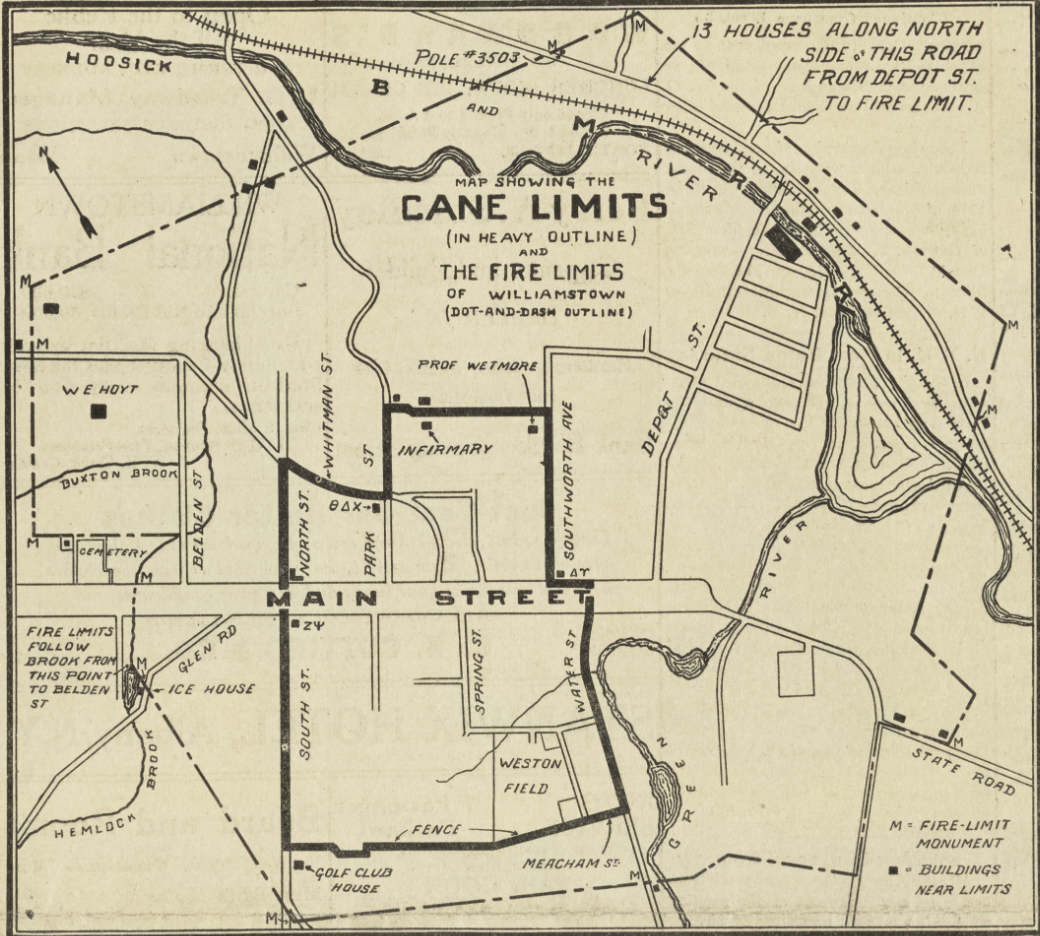
Active for almost five decades, the Williams Flying Club taught generations of students how to fly planes. Until its end in 1964, the club operated mostly out of the Fairview airport in North Adams. When that airport was closed for wartime operations in the 1940s, the club flew out of a small airfield in South Williamstown according to “Williamstown and Williams College” by Dusty Griffin.
In 1958, the club’s president, John Greer ’59, told the Record that its main purpose was to pave the way to a means of transportation that was becoming “increasingly common and practical.” Throughout its existence, the club was committed to accessible flying instruction, and offered relatively inexpensive classes, according to the Berkshire Eagle. Allowed to fly solo after eight hours of instruction, student pilots would sometimes use their new skills to drop leaflets on nearby college campuses that advertised house parties and reported football game scores, according to a 1958 article in the Record.
At times, the Williams Flying Club faced controversy. In 1941, the club was operating out of Fairview Farm in South Williamstown, where Mount Greylock Regional School is today, with the permission of the farm’s owner. On the grounds that the flights posed a danger to life, property, and “the celestial peace of South Williamstown,” locals employed the town’s attorney “in an effort to stymie the club’s infant airport,” according to an article in the Record. However, the dispute came to a close when the selectmen of Williamstown concluded that the club’s actions were perfectly legal. Only two months later, in December 1941, the airfield in South Williamstown was inspected by government officials to receive funding from Congress for preparing men for the Army and Naval Air Corps, according to an article in the Record.
Wood “Woody” Lockhart ’63 joined the club as a first-year in 1959, and soon became its president. At the time, the club had about a half a dozen members and flew out of the North Adams airport, where the members kept their own plane — a single-engine, two-seat Cessna 140. The Cessna was bought with a loan from the club’s faculty advisor, and sustained by membership fees that all users were required to pay. “We flew it all over the place,” Lockhart said in an interview with the Record. “I used to fly out to Bennington and Smith, you know, over to Amherst. I landed the plane on the Bennington Commons once to pick up a date.” During his time as a member of the club, Lockhart also flew the Cessna to Orange, Mass., for a parachute-jumping lesson and to New Haven, Conn., to tour the Yale School of Architecture.
While he was a member of the Williams Flying Club, Lockhart acquired a commercial pilot license with an instrument rating, which allows pilots to fly referencing only the aircraft’s instruments. Lockhart went on to work as a United Airlines pilot for more than three decades. Lockhart, now 85, continues to fly a single engine, two-seat Cessna, the same model he operated at the College. He flies weekly out of Schellville airport in Sonoma County, Calif., occasionally accompanied by a friend or relative brave enough to join him.
The Williams Flying Club’s time came to an abrupt end in 1964, when two teenagers from North Adams, ages 13 and 15, snuck into the club’s plane at night and attempted to fly it without a license, according to Lockhart. The plane had been left outside the hangar with the keys inside by a College student who planned to fly it early the next morning. According to Lockhart, the two teens managed to fly the plane to Albany, where it ran out of fuel and crash-landed in a General Electric parking lot. “The only reason we ever found out why our plane wound up a ball of metal was because a night watchman caught the teenagers trying to climb over the chainlink fence protecting the parking lot,” he said.
The two teens survived unscathed, but the Flying Club did not.
Despite the club’s abrupt ending more than six decades ago, the College continues to have a small but hearty community of student flyers. Harry Letterman ’26 told the Record that he takes pilot lessons in Pittsfield almost every week. He practices in a 1968 Piper Cherokee 180, which he flies to Columbia County, N.Y., Great Barrington, Mass., and Bennington, Vt. “It’s just something fun that I do,” he said.
Letterman hopes to continue flying after leaving the College, and highly recommends the activity. “I just learned about the flying club that used to exist,” he said. “If I wasn’t graduating I’d want to start something similar. The world needs more pilots and it would be great if Williams could facilitate that.”
Others at the College are trying different forms of flying. Myles Pointer Mace ’29 and Rebecca Bossow ’29 are members of the Mohawk Soaring Club, along with a few other students at the College. The club, which is not affiliated with the College, operates out of Harriman & West Airport in North Adams, two miles east of campus. There, Mace and Bossow learn to fly small, engineless planes called gliders. “A tow plane drags you up in the air and then releases you,” Bossow said. “You soar around until you want to come back down, or lose altitude and need to come down.”
Bossow values the experience of flying the motorless plane as a centering activity. “It’s meditative, in a way,” she said. “It’s hard to think of anything else because you need to be focused on your instruments. It’s very zen.”
Mace had never taken flying classes until he came to the College. “One day, I was sitting on the quad, and I looked up and saw a plane towing one of these gliders and I thought, ‘Wow, I want to do that,’” he said. Mace got involved with the Mohawk Soaring Club and convinced a couple of his friends at the College to join him.
Like the many fliers who have preceded him, Mace swears by his weekly dose of gliding. “It’s really great to step outside of campus and see the entire community in one small pocket from above,” he said.
Elodie G. Griffin-Schmidt ’26, who is the great niece of Wood Lockhart, contributed reporting to this story, but was not involved in its writing or editing.
Correction: A previous version of this story incorrectly named Wood Lockhart as Woodrow Lockhart. This article was corrected at 5:00 p.m. on May 5.
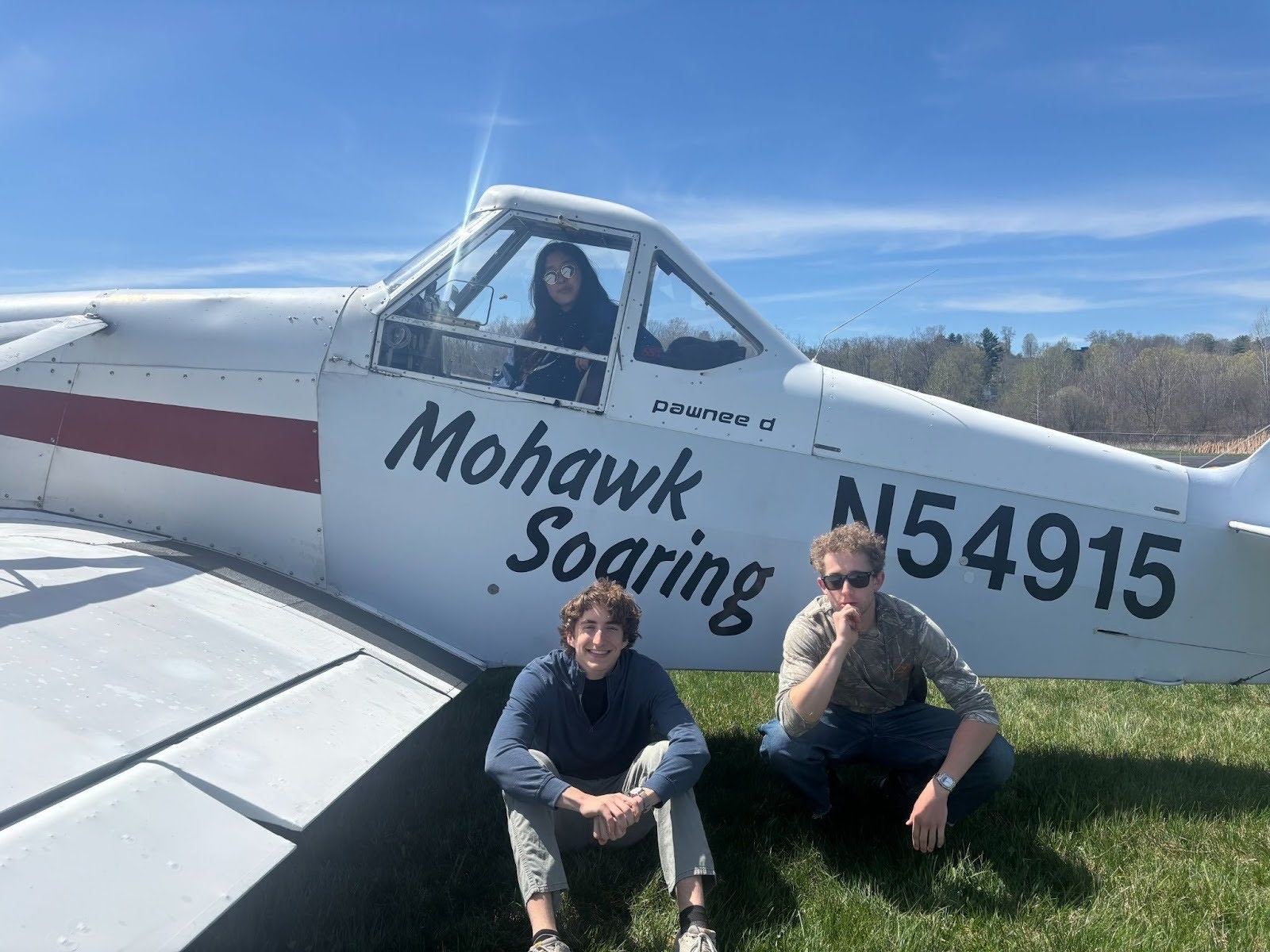
Clockwise, from top: Sienna Cai ’29, Leif Terre ’29, and Pointer Mace.