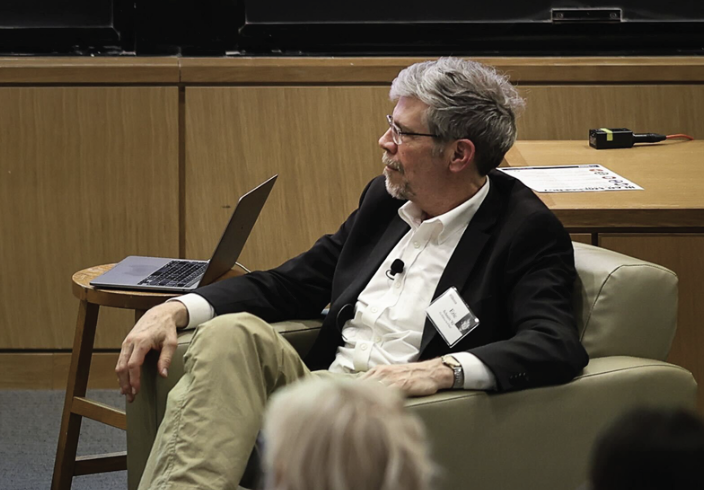
Just over a week ago, national security correspondent Eric Schmitt ’82 spent an entire night awake alongside his colleagues at the New York Times, pulling together a play-by-play story of the military rescue of a downed American airman in Iran. His other recent headlines on the Iran War have analysed NATO’s response, recapped the United States’ demands, and uncovered China’s potential role in the conflict. Between publishing these stories, however, Schmitt took center stage at the first-ever Record reunion on Saturday to speak about his time at the Record and his career in journalism.
Much of the discussion at the reunion focused on the challenges facing the journalism industry, and Schmitt didn’t sugarcoat the harsh reality. “It’s tough out there for young journalists because of the consolidation and the news deserts that we’re seeing in smaller communities,” he said.
Nonetheless, Schmitt views local reporting as essential. “We need local journalists holding local officials accountable,” he said. “It’s not like corruption [only happens] at the most senior levels of the U.S. or other foreign governments.”
Schmitt started his professional career at the Tri-City Herald, a local newspaper in central Washington state. He said it was there he began learning how to cultivate good sources and maintain their trust — skills which he believes have contributed to the effectiveness of his reporting. He has been awarded four shared Pulitzer Prizes since he started at the Times in 1983, and his coverage of counterterrorism and national security has taken him to military deployments across the Middle East.
Schmitt first reported abroad for the Times during the Gulf War. After Saddam Hussein invaded Kuwait in 1990, Schmitt spent three and a half months in Kuwait, Saudi Arabia, and Bahrain covering Middle Eastern politics and the United States’ military strategy.
After 9/11, Schmitt spent time on the ground with troops in Iraq and Afghanistan. Later in the 2000s, he reported from Pakistan, where he tracked al-Qaida’s activities up until Osama Bin Laden’s 2011 death.
In high-stakes reporting situations, Schmitt has learned to trust his instincts, he said. “Depending on what you’re falling into, whether it’s a permissive environment or a conflict zone, you kind of have to size people up pretty quickly,” Schmitt said in an interview with the Record. “Who can you trust on the ground? Are you going to get in that taxi cab?”
Schmitt used his experience in the Middle East and expertise in national security to co-author a book alongside fellow New York Times reporter Thom Shanker. Published in 2011, the book focuses on the evolution of American counterterrorism strategy amid the war on terror.
Though he has worked at the Times for more than four decades, Schmitt noted that his younger self would not have predicted his journalistic career trajectory. In high school, he was required to take an additional English elective, and, although his passion was for writing short stories and not to-the-point newswriting, journalism was the only open course.
Reluctantly, Schmitt joined the class. The rest, he says, is history. “What journalism did for me was it helped structure my writing,” he said. “It helped me think about how you organize your thoughts in a concise and clear way.”
At the College, Schmitt went on to work as a reporter for the Record and as a freelance journalist when he studied abroad in Madrid, Spain. He led the Record as co-Editor-in-Chief in 1981.
As a student journalist, Schmitt did not shy away from challenging reporting that hinged on gaining his sources’ trust. For one of his last stories for the Record, Schmitt interviewed several closeted gay and lesbian students, who felt that they were forced to live double lives on campus.
Schmitt identified these students through careful networking, and maintained their anonymity during his reporting. “It was a very difficult time for gay men and lesbians on campus,” he said in an interview with the Record. “This was a topic that was kind of simmering under the surface.” Schmitt returned to the topic in the 1990s, when he reported on gay service members who had to hide their identities in the era of the U.S. military’s “don’t ask, don’t tell” policy.
After graduating, Schmitt’s early career in journalism did not come easy. The journalism industry was facing a market downturn in 1982, and with no success finding a job at a newspaper, Schmitt returned to his home state of California to work as a lifeguard in the summer after he graduated. Then, a College connection helped Schmitt get his foot in the door of his first professional newsroom. The executive editor of one of the 75 newspapers he had applied to in his senior year, the Tri-City Herald, happened to have a brother who was a professor at the College, and offered Schmitt his first full-time job as a reporter.
He covered education for the Herald for a year, after which he got a job as a news clerk at the New York Times’ Washington, D.C. bureau.
Even in distant regions of the world, Schmitt has encountered and connected with other College alums in ways that have helped him forge relationships with his sources. While on a reporting trip in Pakistan, Schmitt met a Consul General who was a fellow Eph. “It was almost easier, when you’re dealing with somebody in government like that, to make that connection before [saying], ‘and I’m also a New York Times reporter asking you some questions,’” he said. “I think that gives you that little bit more entree, particularly in sensitive jobs that I’ve had.”
The choice to travel to unfamiliar places early on was one of the most foundational decisions of his career, Schmitt said. He encourages all students to do the same. “I think it’s so important to take the experiences you’ve had at Williams and then get out in the world and travel,” he said. “If you have that flexibility to get out in the world, do it.”