The remains of Ephraim Williams, the namesake of the College, have sat in the basement of Thompson Chapel since 1920. Yet Williams died 165 years before his body returned to Town. Williams’ remains were returned during an extravagant commencement ceremony parade, but as a Record analysis of historical documents from Special Collections has revealed, some have speculated that the remains may not even be Williams’, or might be nothing more than a pile of dirt.
On Jan. 13, 1915, Willard Hoyt, the treasurer of the College, sent a letter to the New York State Warren County Clerk asking to confirm the College’s purchase of a small plot of land in Glens Falls, N.Y., about 50 miles northwest of the College. Today, the closest landmark to this unassuming plot of land is known as Bloody Pond. While this moniker may have driven other buyers away, the plot’s bloody history was precisely why Hoyt was set on buying, he wrote to the County Clerk.
In the same spot, on Sept. 8, 1755, Colonel Ephraim Williams was killed along with hundreds of French and English soldiers in the Battle of Bloody Morning Scout at the height of the French and Indian War. The story of his death is explained in a Dec. 5, 1967, issue of the Record and the writings of Wyllis E. Wright, College librarian and a member of the class of 1925. As Williams rode into battle with 1,000 of his own troops and 250 Mohawk allies, he fell from his horse as it was shot from under him. Crawling out from beneath his steed, Williams summited a nearby boulder, where he tried to rally his troops before being shot directly in the head. Worried that his corpse would be mutilated by French forces, one of his comrades, “spattered in his commander’s blood,” threw Williams’ body into the woods, according to the Record article. Later, he buried Williams beneath an old pine tree near the boulder where he suffered his fatal blow.
There he lay.
Williams, of course, bequeathed in his will the establishment of a school in the renamed Williamstown, a school that was officially chartered in 1793 — Williams College. Sixty years later, in 1853, Williams’ sword and watch were presented to the graduating class at commencement, according to a 1925 Williams Alumni Review article. That same year, a group of alums gathered the funds to erect an 11-foot-tall obelisk on the legendary boulder where Williams was struck down. The College committee that built the monument also searched for Williams’ remains, unsuccessfully, according to the Record article from 1967.
While the committee may not have been successful in 1853, just 14 years later, a plow unearthed Williams’ bones not too far from the monument, according to the Record. The details are hazy, since the College did not address the purported discovery, and any knowledge of the nature of the Williams’ remains was isolated from the history books.
That is until E.W.B. Canning, a local historian and member of the class of 1834 broke the news. In an 1870 speech to the College’s alum society published the same year in The Williams Review, Canning recounted a visit he took to the site of Williams’ death. In his speech, Canning claimed that he had uncovered Williams’ bones, but upon discovering Williams’ skull missing, he chose to rebury them out of respect. He placed a rock engraved with the initials ‘E.W.’ over the gravesite to make it easier for others to find Williams’ resting spot.
Even when the United States entered World War I, the thought of Williams’ remains did not leave the College’s collective conscience. As the College’s men gave their lives overseas — 83 percent of the College’s students enlisted in a battalion of the ROTC, according to a Record article from 1917 — interest in the wartime death of the College’s founder stirred. Head of Special Collections Lisa Conathan confirmed that bringing Williams back to campus was a way to honor all students’ wartime sacrifices. “Burying Ephraim Williams Jr. on campus was a way to honor not only his legacy, but also that of the many Williams affiliates who perished in the war,” she wrote in an email to the Record.
Hoyt’s land purchase was in direct service of that goal. After the Warren County clerk confirmed that the plot of land, still marked by the legendary pine tree of yore, had officially been bought by the College, there was only one thing left to do: dig.
About four years later, in 1919, a prominent New York financier named Clark Williams received a letter from his alma mater asking him if he would like to be part of an expedition to exhume the remains of his college’s founder. After reading the letter, he hastily agreed to its conditions and set off right away for Albany. Clark wrote to the College that he was “glad to do whatever you wish me to.”
When Clark Williams eventually made it to Glens Falls in spring 1920, he was met by a team of three other men ready to search for the long-buried remains of Ephraim Williams. The team was led by John Clarke, who was a geologist and paleontologist. According to a letter Clarke wrote to Clark Williams, he thought of himself as particularly “familiar with the modes of preservation of organic life in the soils and muds.”
The team of four was not at the burial sight for long. According to a May 17, 1920 letter from Clark Williams to the College, the group began their work at 10:30 a.m. and were done by mid-afternoon. “We made a thorough search and secured the remains of our founder, which were easily identified, but which were recovered just in time, as they were rapidly passing into dust,” Clark Williams wrote. According to the same letter, the remains were then put into an urn and brought to a cemetery in Troy, N.Y.
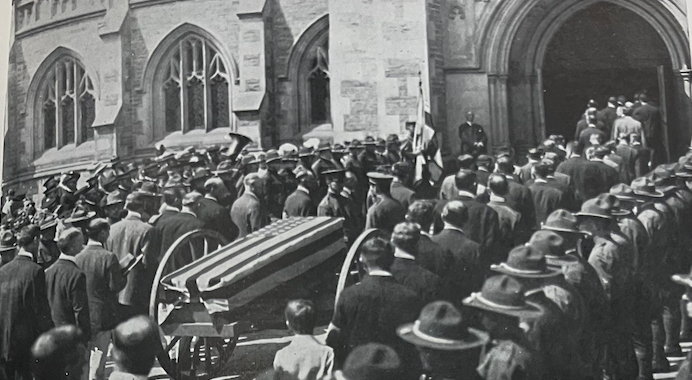
The next month, as the College prepared for the June commencement, the urn was collected and placed in a large casket wrapped in the American flag. When the casket eventually made its way back to Williamstown, it was at the center of a historic commencement ceremony.
On June 20, 1920, a parade of six white horses — ridden by World War I veterans who were alums of the College — pulled a carriage with Ephraim Williams’ casket to Thompson Chapel. The casket was flanked by dignitaries, including College President Harry Garfield, class of 1885, and Massachusetts Governor and future President Calvin Coolidge.
The College made a new inscription on the walls of the chapel for the occasion. “In faithful remembrance of the founder who fell in battle and of the sons of Williams who gave their lives that the blessings of free government might endure,” it read.
The assembled audience listened to speeches commemorating Williams and the veterans of World War I by Garfield, Coolidge, and the College’s reverend. Coolidge — an Amherst alum who had been named the Republican nominee for vice president a week earlier — gave a particularly memorable speech. “Above [Williams] is draped the flag that he and his comrades followed in battle and upon which perhaps he turned his last lingering glance,” he said. Unfortunately for Coolidge, his historical knowledge was rusty. Williams died as a colonist fighting for the British Empire during the French and Indian War, more than 20 years before the American Revolution.
Williams’ casket was officially lowered into the tomb in the basement of the chapel after the ceremony, where it lies today, according to the book Williams College in the World War, published by the College trustees in 1926.
Since the ceremony, some have wondered whether the remains in the Thompson Chapel are really his at all.
In a 2006 email exchange obtained by the Record, Archives Assistant Linda Hall questioned whether the remains could have belonged to Hendrick Theyanoguin, a Mohawk leader who fought alongside Williams and was also killed at the Battle of Bloody Morning Scout. Jay Levenson, who answered Hall’s inquiry over email, disputed this claim. Levenson, who stated in the email that he had portrayed Theyanoguin in a recent reenactment of the Battle of Bloody Morning Scout, claimed that Theyanoguin, who was much larger than Williams, could not have been mistaken for Williams. More recent historical evidence suggests that Levenson may have been mistakenly describing a different man named Hendrick.
Other evidence suggests that what was discovered during the 1920 excavation near Albany may not have been human remains at all. In a 1920 letter from Clarke to Clark Williams, Clarke said that finding Williams’ bones more than a century after his death was highly unusual and geologically improbable. “In a free and open soil, where there is easy percolation of water, it is a common practice to estimate that the identity of a burial will disappear in about thirty years,” Clarke wrote. Despite his skepticism, Clarke affirmed that he thought that the search party’s findings were legitimate. “You have every reason to feel assured that, in what you took from the burial place of Colonel Ephraim Williams, you have a proper representation of his earthly remains,” he wrote.
Whether what lies in the basement of Thompson Chapel belongs to Ephraim Williams, another person, or is just a pile of something else entirely, has captivated the College community for centuries.
The account of Canning’s speech in The Williams Review spoke to the undying historical magnetism that the story of Ephraim Williams’ remains carries. “If to be a good Mohammedan it was necessary to make at least one pilgrimage to Mecca, [Canning] thought it was equally the duty of every good Gulielmensian to make a pilgrimage to the tomb of Ephraim Williams.”