
Oren Cass ’05, an economist and founder of conservative think tank American Compass, joined Professor of Political Science Darel Paul for a public talk at the ’62 Center for Theatre and Dance on Monday. Cass spoke on topics including the economic impact of Donald Trump’s tariff policy and the need for reinvestment in domestic manufacturing.
After graduating from the College with a degree in political economy, Cass worked for management consulting firm Bain & Company intermittently for the next 10 years. In his stints away from Bain, Cass worked as the domestic policy director for Republican presidential candidate Mitt Romney during his 2012 campaign and earned his J.D. from Harvard Law School.
It was while working with Romney that Cass first began to challenge the commonly-held view among Republicans that free trade is the remedy to America’s economic and security issues. “Imbalanced trade, especially if it’s systemic over the long term, distorted by countries like China that are intentionally trying to claim particular products and technologies for themselves, is a disaster,” Cass said at the talk.
Cass also critiqued speculation in the finance industry at the expense of real economic growth. “[The financial market] just moves money around and does not actually create value — in some cases, it’s actively extracting value and destroying value in the world,” Cass said. “The Republican Party’s failure to think about such things, I think, was a real weakness for [the party].”
From 2015 onward, Cass contributed policy research to the Manhattan Institute, and in 2020 founded his own public policy institute, American Compass. The nonprofit advocates for investment in domestic manufacturing and decreasing reliance on foreign goods, according to its website. “Manufacturing is just absolutely critical to national security and resilience,” he said. “If you are not a country that can make things, you are not a country that can prepare itself for crises.”
To Cass, the reshoring of American manufacturing has benefits beyond job creation and tax revenue generation — it enables the infrastructure that powers innovation. “A great example is [artificial intelligence] — we make all the frontier models, but we don’t know how to make the chips for the frontier models,” Cass said. “We are entirely dependent on a physical infrastructure that we have abandoned.”
While Cass has criticized both Trump and the Republican Party, American Compass served on the advisory board for the Heritage Foundation’s Project 2025, a conservative policy roadmap for Trump’s second term that outlined policies such as abolishing the Department of Education, rolling back protections for LGBTQ+ people, and consolidating executive power, according to AP News. Trump has attempted to distance himself from the political initiative.
Cass said that he is unsatisfied with the current state of the Trump administration, but that he thinks the president has made some progress, particularly with his use of tariffs. Though Cass has been critical of the inconsistent application of Trump’s tariff regime, he emphasized that in the history of United States trade policy, free trade has not been the norm, nor is free trade the policy norm outside of the United States. “Every other country that has ever attempted to grow its own economy impressively, particularly its manufacturing base, has done so behind the protection of high tariffs,” Cass said.
When Paul pressed Cass on the 100,000 manufacturing jobs lost during the first year of the Trump presidency, Cass urged patience. “[Tariffs are] trying to lead businesses to change their strategies and invest more in domestic capacity, which will then lead them to hire people,” he said.
The Republican Party, according to Cass, should prioritize the protection of American industry and the American worker by diverging from “the Reagan playbook” of absolute free trade. “I think this is very clearly the direction we’re headed,” Cass said.
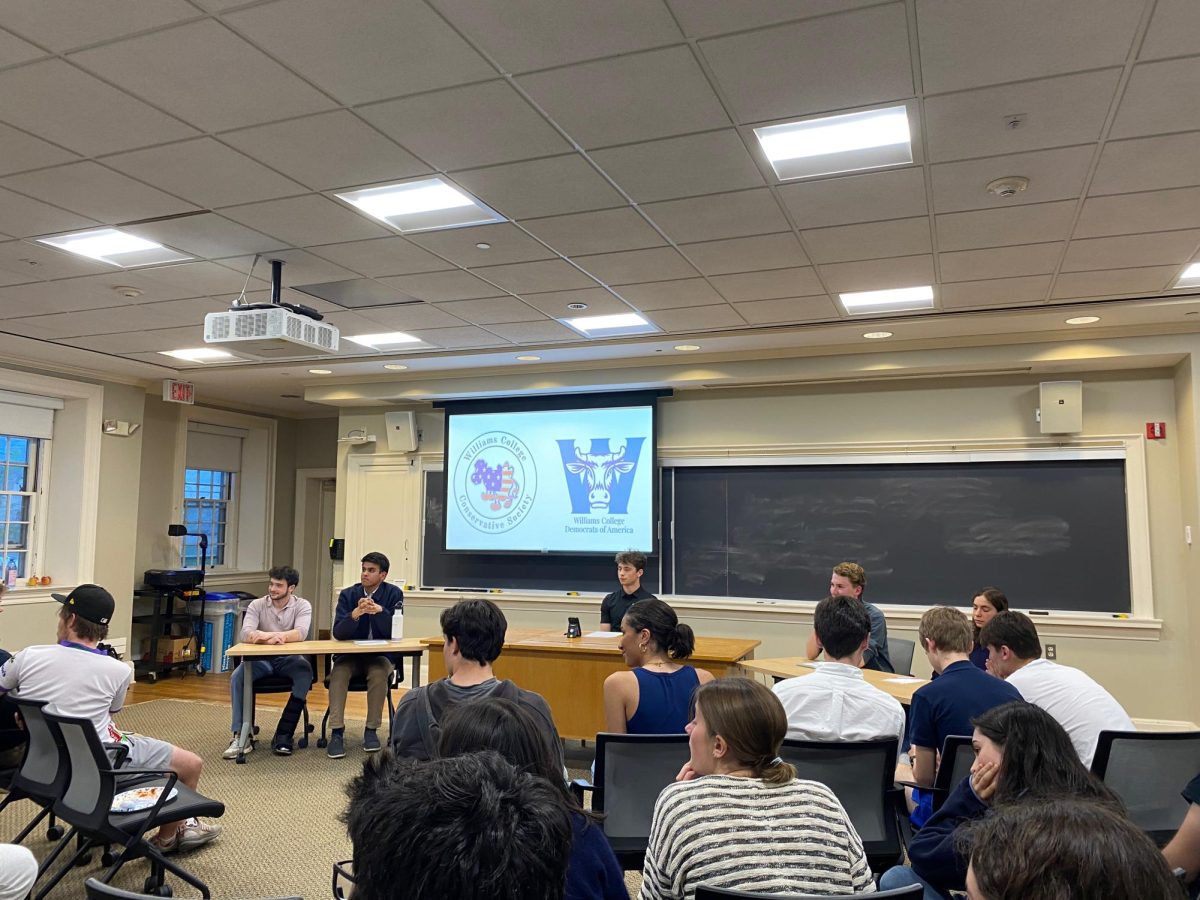
In an interview with the Record, Arjun Patel ’29, who founded the Williams College Conservative Society this fall, expressed excitement about Cass’ vision for conservatism. “[Cass] is one of the one of the most influential living conservatives to graduate from Williams College,” Patel said.
In Patel’s view, Cass’ distinct approach to conservative ideas has a broader appeal than the Republican Party platform. “I think he’s someone that can articulate conservatism in a way that could really appeal to Williams students,” he said. “[His arguments are] not going to be as partisan, [and] he’s going to go about things in a very economic and intellectual way.”
“My hope is that it will foster a larger tolerance for other ideas,” Patel said of Cass’ talk.
Paul, the faculty advisor for the Conservative Society, appreciated Cass’ perspectives on economic issues that are often overlooked in academia.
In an interview with the Record, Paul echoed Patel’s belief that the visit may allow more students to feel comfortable making conservative arguments in their courses, and elsewhere. “[Cass] gives a bit of a window on economic nationalism, [and] I think that that, in and of itself, is intellectually useful,” Paul said.