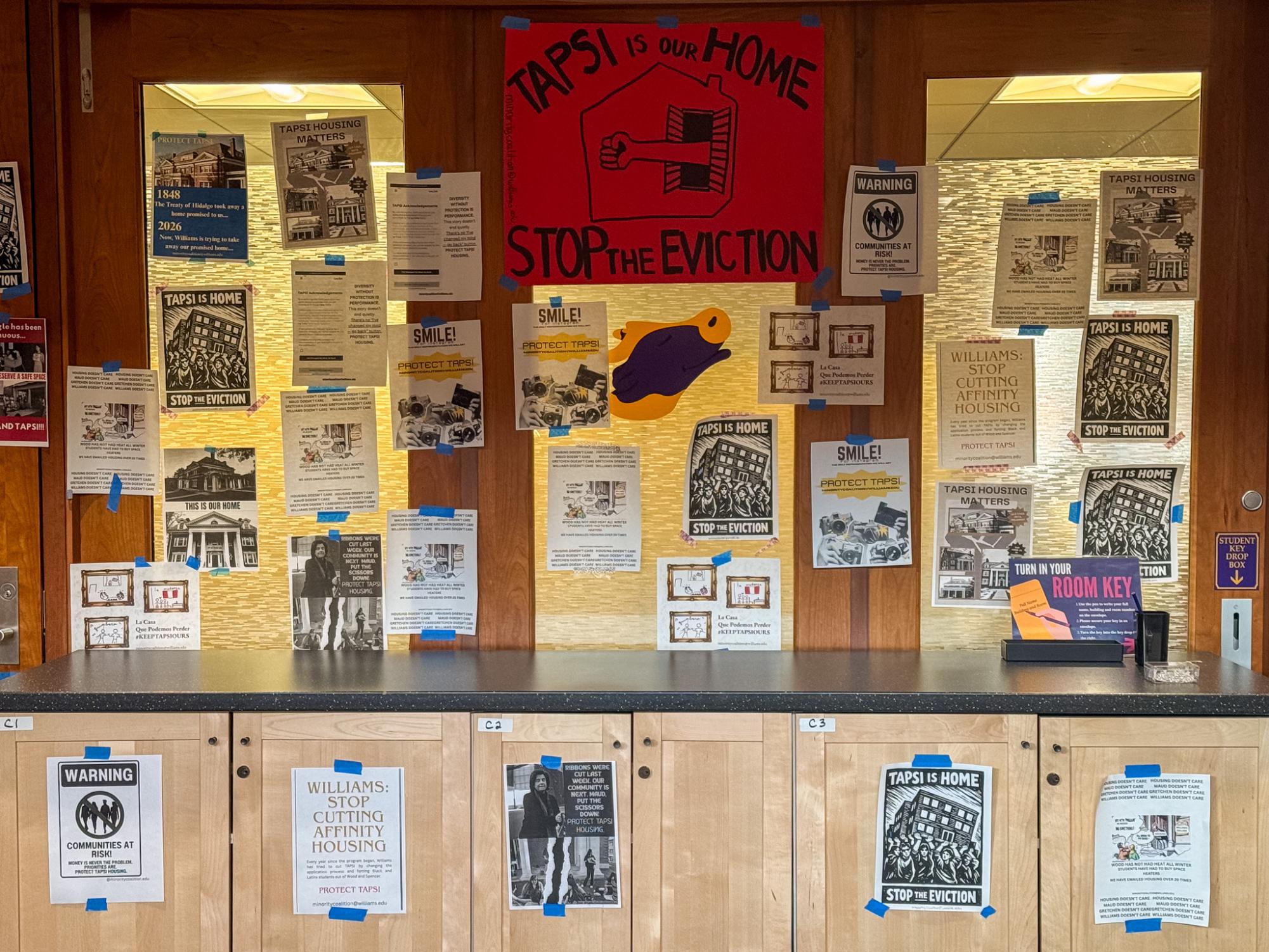
Posters criticizing recent changes to the Theme, Affinity, Program, and Special Interest (TAPSI) housing selection process appeared across campus on Feb. 23. The posters, distributed by the Minority Coalition (MinCo), express frustration shared by TAPSI Community Coordinators (CCs) over the College’s recent adjustments in how the program will function next year, arguing that these changes undermine the purpose of affinity housing.
Olivia Thornton ’28, a CC for Eban House — the Black cultural affinity TAPSI — hoped that the posters would emphasize the uniqueness and importance of the TAPSI program. “[The] Flyers were meant to bring attention to the issues that TAPSIs are facing and to show that these places are more than dorms,” she wrote in an email to the Record. “They are community spaces, and places where people with similar identities can come together and celebrate them.”
Members of MinCo put up the posters after changes were made to the process for joining a TAPSI community, according to MinCo Steering Committee Co-Chair Mariel Baez ’26. “The change of the application process was really upsetting because we want to ensure that TAPSI spaces are for people who are genuinely interested in the community or are part of the community,” she said. “These spaces are integral to minoritized students’ feelings of safety and belonging on this campus.”
Previously, students interested in living in a TAPSI community completed a community-specific application through the housing portal. CCs reviewed applications in collaboration with Housing. If more students were accepted than could live in a TAPSI community, all accepted students were put into a lottery. Once notified of their acceptance into a TAPSI program, students selected their rooms.
Students wishing to pick into TAPSI housing for the 2026-27 academic year will instead select their housing in the general housing lottery selection process.
Due to the relocation of the TAPSI selection process to the general lottery, CCs and Housing will no longer have a say in which students live in TAPSIs. Communities will also only have one CC each, down from two in previous years.
Following the distribution of the posters across campus, MinCo met with Dean of the College Gretchen Long and Vice President for Institutional Diversity, Equity, and Inclusion Leticia S.E. Haynes ’99 to discuss the changes. “We conveyed people’s frustration with these changes, and we were told that these changes have to do with equity in the housing system,” Baez said.
In a joint email to the Record, Long and Haynes expressed a desire to support and maintain TAPSI housing. “The hope is that the changes will make it easier and more equitable for people to propose or join a TAPSI group as part of the general housing process,” they wrote.
The College took information regarding TAPSI down from its website in Feb. 2025 after the Trump administration threatened to revoke funding from institutions that did not eliminate race-based programming. Cadence Li ’26, a CC for the Asian American Affinity Space TAPSI, said she believes that the current political climate may have informed some of the College’s TAPSI-related decisions. “I understand that with the increased scrutiny from the Trump administration, it’s harder for the school to do programming and build structures around a protected class,” she said. “But I don’t think fully excluding students from knowledge about what is happening is helpful or useful.”
Long and Haynes stated that TAPSI housing has always complied with existing law. “College policy as well as State and Federal law have long prohibited racially-exclusive housing options and we have been compliant with the law — every TAPSI group is and has always been equally open to any interested student without regard for their identities,” they wrote. “The changes to the room selection process help reinforce the college’s inclusive approach to community building.”
In interviews with the Record, TAPSI leaders voiced their frustration with these changes and a lack of communication from the College’s offices of Housing and Student Life and Leadership.
Li said that she was blindsided by the changes. “We found out about the changes in a meeting on Feb. 20, three days before the general housing email was released,” she said. “We also found out at this meeting that we were being moved from Morgan to Gladden next year. No one had any idea.”
The Asian American Affinity Space TAPSI first formed at the start of the 2024-25 school year in Prospect, but was relocated to Morgan in fall 2025 when Currier Quad was designated as first-year housing. “The move [of first-year housing] from Mission to Currier Quad was just short of being fully confirmed before they told us, which felt pretty unfair,” Li said. “We lost a place that really became our community in Prospect, and now we have to move again.”
Chris Xue ’28, Li’s co-CC, questioned why the TAPSI process needed to change for next year. “It’s a bit confusing why we even have affinity spaces when they’re now accessible to all with no oversight about who can join them,” Xue said. “The history of marginalized students in the context of the United States prompted the creation of these spaces, and now it feels like we’re reverting back.”
The posters also expressed frustration over other issues in TAPSI communities. Specifically, the heaters in Wood — where Eban House is located — broke earlier this winter.
Thornton said that the heating issue has remained largely unresolved despite students’ attempts to communicate it to Housing. “People have been approved to get space heaters from facilities/CSS for their rooms and then had them taken away with notices put on their room doors, and [the] heaters confiscated,” she wrote. “There have been multiple work orders (over 7) put in on my end as a CC, and multiple work orders put in by my co[-CC] and house members, but we saw very little change.”
Long and Haynes expressed concern upon hearing about the heating issues and said the College is working to improve how maintenance concerns are addressed. “We will work on implementing a clearer system that informs residents where concerns may be routed that need immediate response and also those that are not of an urgent nature,” they wrote. “We appreciated meeting with MinCo student leadership and hearing their recommendations for addressing such a need.”
Next year, there will be non-TAPSI rooms in Wood, another change from previous years.
Li believes the changes to TAPSI demonstrate a lack of care for the TAPSI program from the College. “As a senior, someone who has witnessed these different iterations of TAPSI, it’s hard not to feel that the school’s support for the program is waning,” she said. “The college knows how to use the buzzwords of ‘accessibility’ and ‘making the process more equitable’ but it’s just a bunch of empty promises… Student leaders are losing faith.”
Long and Haynes said they view the TAPSI program as a successful initiative the College plans to continue supporting. “TAPSI housing… is still relatively new at Williams, and it has been a success,” they wrote. “We have made a few changes over the last few years, including adjusting programming requirements, numbers of CCs, and now the application process. The College is committed to the program and it has been working well.”
Some students remain concerned about its future. “Year after year, we are informally guaranteed TAPSI housing, and year after year, we have to advocate against changes that chip away at the integrity of the program,” Baez said. “Many underclass students expressed that the reason they committed to Williams was because of TAPSI. The College cannot continue to promote TAPSI as something that attracts students and then tamper with the very things that stand at its core.”
Correction: A previous version of this article mistakenly indicated that the Asian American Affinity Space TAPSI is located in Spencer. It is located in Morgan. This article was updated on March 11 at 3:18 p.m. to reflect the TAPSI’s correct location.