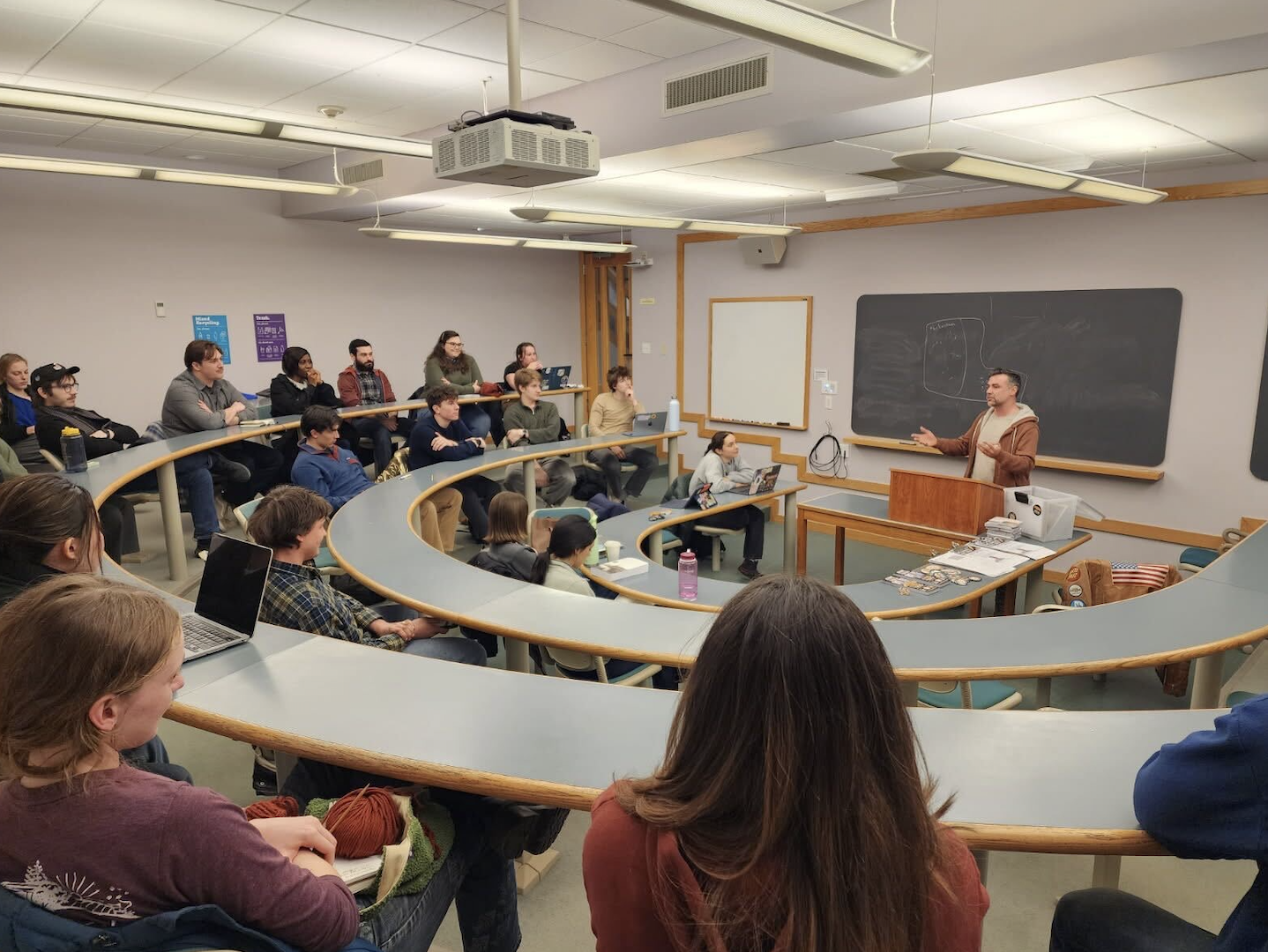
Jeromie Whalen, a Democratic candidate for Massachusetts’ 1st Congressional District, addressed the Williams chapter of the College Democrats of America (CDA) last Wednesday. In September, Whalen, 38, will face 37-year incumbent Richard Neal, 77, in the Democratic primary. Whalen was the first speaker the club has hosted since it formed in the fall.
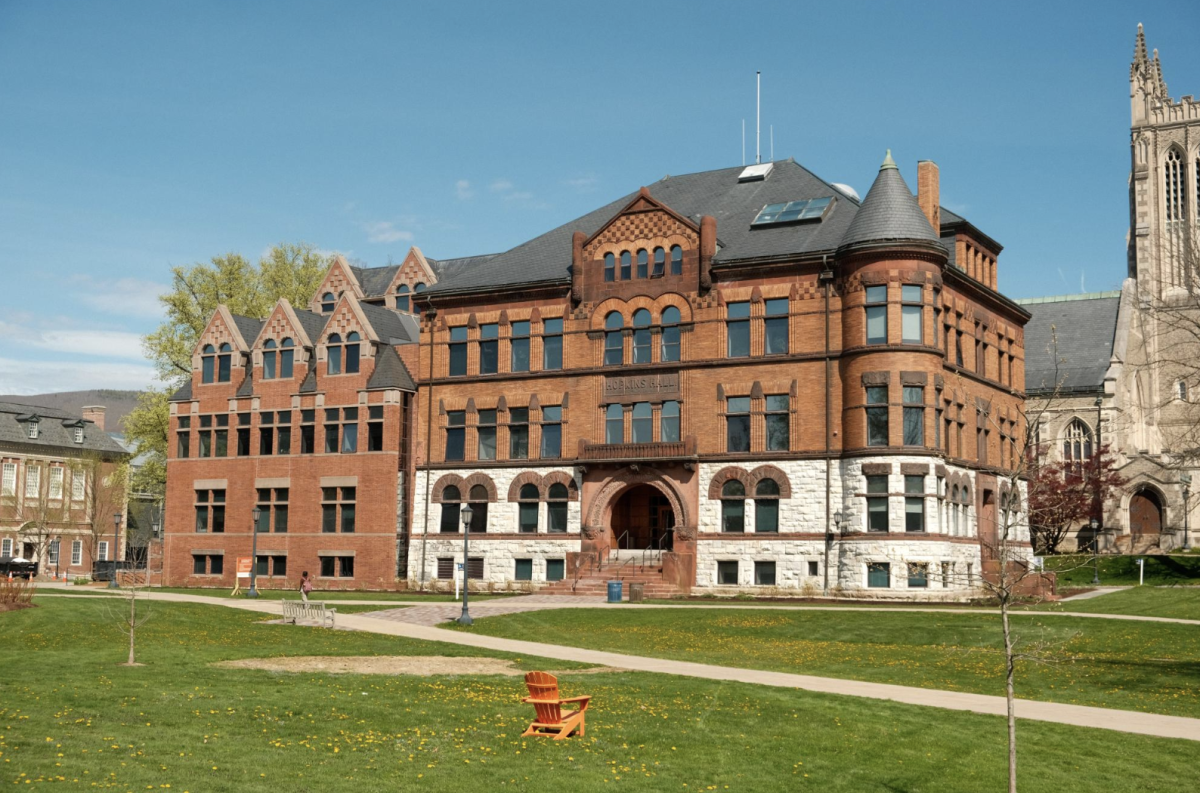
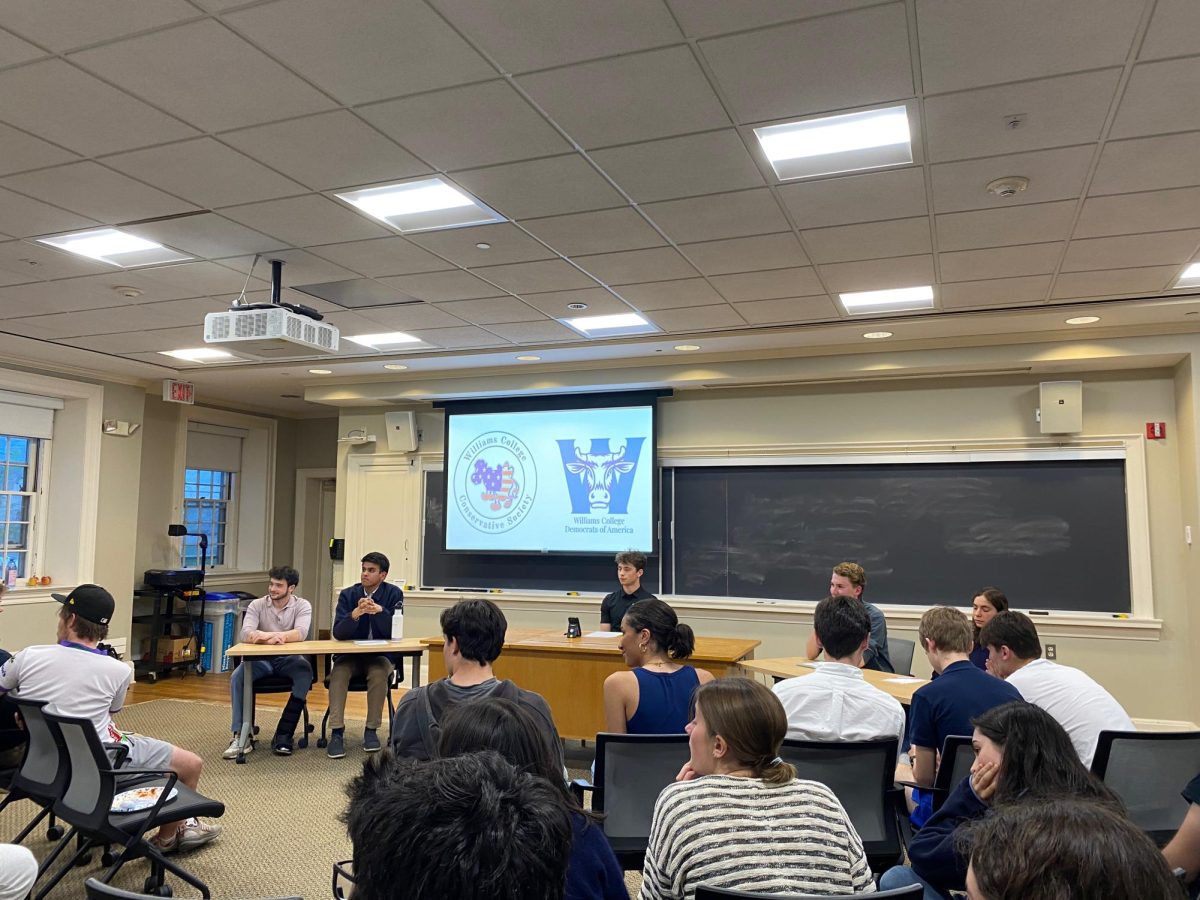
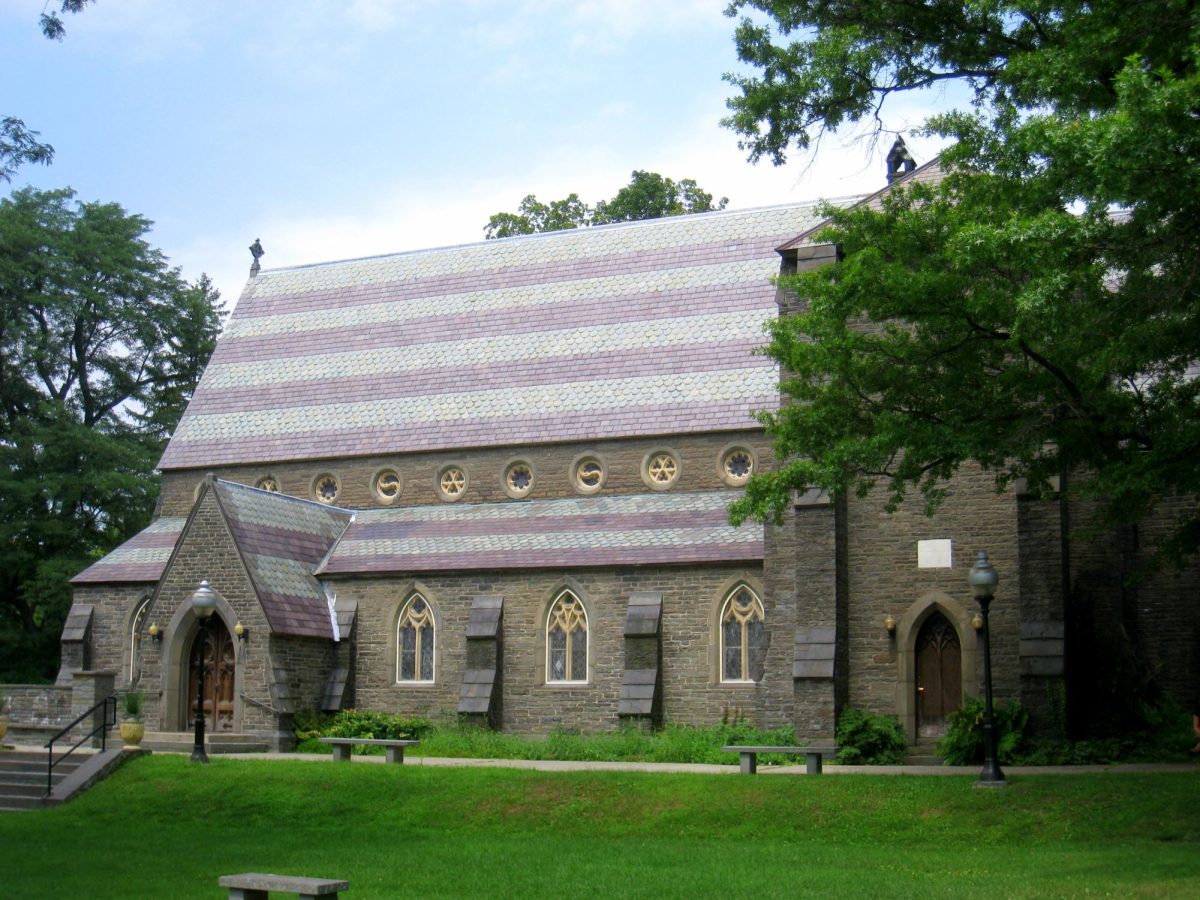
The event was organized by CDA members Eve Kaplan ’29, Charles Hughes ’28, and Caroline Grist ’29, drawing nearly thirty audience members of students, faculty, and community members to Hopkins Hall on Feb. 18. Whalen spoke candidly about how his middle-class background and career in education inform his progressive agenda, before taking audience questions.
Raised in Belchertown, Mass., Whalen grew up around people across the political spectrum, but said that his tight-knit community prevented polarization. “It [was] hard to have that animosity towards another [person] when you know their first and last name,” Whalen said in an interview with the Record. “I think that we’ve lost a little bit of that connectedness, and that’s what I want to bring back.”
After graduating from UMass Amherst with a bachelor’s degree in history, Whalen pursued local journalism before becoming a technology, media, and communications teacher at Northampton High School in central Massachusetts. “Teaching was really profound in my life,” Whalen said. “You develop a level of selflessness and accountability to your classroom, to your community, and that’s really what I think public service is, [it’s] that idea that there is more than just you.”
Over his 11 years of teaching, Whalen noticed that his students had become increasingly disinterested in establishment politics — a detachment that he believes is caused by a generational divide. To bring young people back into politics, Whalen thinks it is necessary for younger leadership to step up. “I’m looking at this generation that is holding on to power without actually mentoring or understanding the perspectives of a new generation, and I’m saying it’s time to give it up,” Whalen said.
Whalen’s platform, focused on universal healthcare, accessible education, and an affordable economy, directly addresses challenges concerning young people, he said.
For Whalen, the Trump administration’s crackdown on free speech, particularly targeting non-citizen student activists, hit close to home. “The first person abducted by the United States government was [Columbia graduate student] Mahmoud Khalil, who is a personal friend of mine,” Whalen said. The two had previously worked together educating Syrian refugees on the border of Lebanon and Syria.
Whalen sees the current administration’s scrutiny of noncitizens as a broader attack on constitutional rights. “I knew that [Khalil] was being targeted because of his stance on Palestine,” Whalen said. “The first cracks in the assault on those First Amendment rights is that [the administration goes] after individuals [without citizenship],” Whalen said.
Whalen also emphasized the dangers posed by the rapid rise of artificial intelligence. “It’s the rise of a new age of robber barons,” he said. “[AI corporations] do not care about the working and middle class, [and] they don’t care about the cutting of jobs,” he said. “They care about shareholders, and they’re going to do whatever it takes to minimize the impact [to] the bottom line at the sacrifice of real people.”
For the CDA, an RSO associated with the Democratic National Committee, Whalen’s visit marked an important milestone. The College’s previous Democratic group, the Williams College Democrats, was not affiliated with the DNC, and dissolved after Donald Trump’s 2024 presidential victory.
Kaplan chartered the chapter in the fall after connecting with Professor of Political Science James Mahon, who suggested reaching out to Hughes for help getting it started. “In this initial phase, we wanted to just get the club known and get more people involved on campus,” Kaplan said.
Hughes emphasized the importance of creating a strong base for the chapter. “We want to build out the infrastructure now so that, come the election season next fall, we’re ready to go, we’re ready to work with candidates,” he said.
Kaplan and Hughes said they were encouraged by the event’s turnout and the conversation it fostered. “I think we’re gonna use [Whalen’s visit] as a blueprint for more,” Hughes said. “[We need to] pop the purple bubble a little bit — I feel like people aren’t challenged here sometimes, or maybe they don’t feel like they’re in touch with the political world around us.”
Kaplan agreed. “Often politics can feel like this big, faraway thing, and we’re really trying to bring it to campus where people can take physical actions on a daily basis,” she said.
As the chapter works to plan events and bring more speakers to campus, its members are collaborating with other student political organizations, such as the Williams College Conservative Society, which was founded last semester. The Conservative Society also plans to bring speakers and political dialogue to the College. Kaplan fully endorses this goal. “The more politics on our campus, the better — we want people of a wide range of views to come to our meetings,” Kaplan said.
Editor’s note: Soren Anderson-Flynn, a news editor with the Record and a volunteer on Whalen’s campaign, was not involved in the writing or editing of this story.