While Amherst and the College have been heated rivals for centuries, we all know they are actually teeming with similarities — both colleges share everything from their signature purple colors to their common origin in Williamstown. Yet, they have one lesser-known trait in common: they are the only two schools in the NESCAC that don’t offer minors.
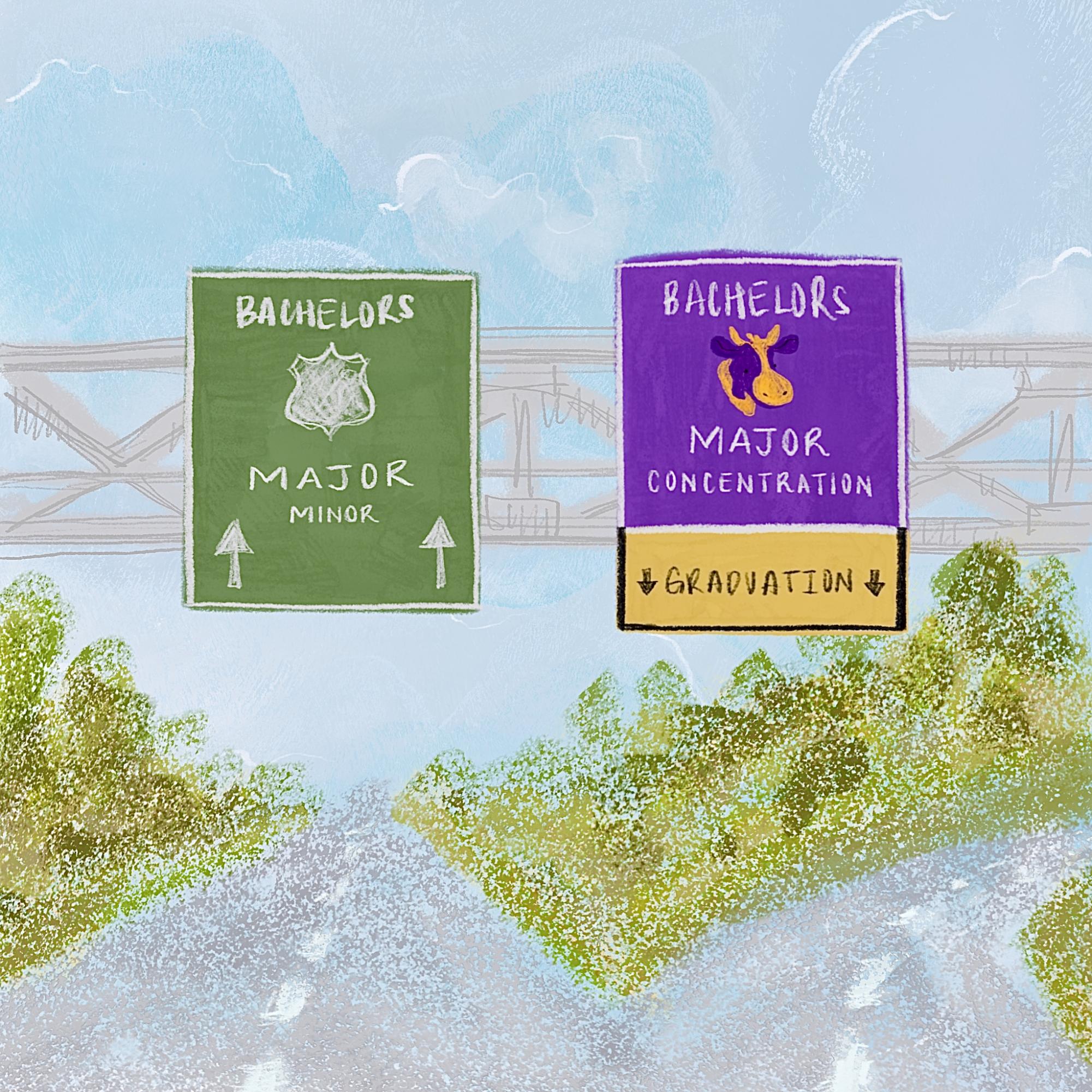
At most of the College’s peer institutions, minors function like a mini major of five to six courses. But at the College, the closest offering is a concentration. While concentrations do require fewer classes than majors, they are only available in a limited number of fields, and students cannot “concentrate” in a field that already exists as a major, such as math or history.
Raffaella Rascoff ’29, for one, wishes this wasn’t the case. “[Minors] would allow me to explore the interests that I’m somewhat interested in, but don’t want to devote too many classes to,” she said.
Rascoff also noted that minors fulfill a common student desire to demonstrate expertise in a given topic. “Because we don’t have minors, people put on their LinkedIn profiles, ‘Did considerable coursework in X,’” she described. “[A minor] shows the person who’s considering you for a position that you take that subject seriously, even if you aren’t devoting your whole college academic career to it.”
According to Dean of the Social Sciences at Wesleyan University Mary-Jane Rubenstein ’99, minors may also appeal to faculty.
Wesleyan followed a similar major and certificate plan — certificates being essentially the same as concentrations — to the College until 2012, at which point they began offering minors, Rubenstein said. “The problem that minors were trying to address was kind of threefold,” she said. “One problem was nobody knew what certificates meant. So why not call it a minor?”
Secondly, Rubenstein noted that Wesleyan faculty had hoped to improve student distribution among departments by introducing minors. Departments like economics and film were consistently overburdened with majors, so minors offered an avenue to allow students to take fewer courses in those areas. On the other hand, smaller departments like religion and feminist studies anticipated more students engaging with their programs through minors. “Maybe there are students who love those things, but feel like, ‘What the hell am I going to do with a degree in religion? So I’ll minor in it instead,’” Rubenstein said.
Adding minors didn’t solve all these problems — popular departments still face overenrollment, and smaller departments haven’t increased interest. Still, Rubenstein emphasized that allowing students to minor in a subject is a positive change. “Some students seem to be very happy that they have a minor… they’re able to commit themselves to something in a serious way without necessarily taking on a third major,” she said.
The College has not considered adding minors to the curriculum since 2016, when students on the Williams College Council, a precursor to Williams Student Union, discussed the issue and voted not to pursue them. Dean of Faculty Lara Shore-Sheppard said that students might be hindered from exploring more broadly if the College introduced minors. “We want to ensure that students really feel like this is a time to explore a variety of intellectual passions and interests, and as a result, there is always this tension between not wanting to have too many opportunities for credentialing,” she said.
Even before 2016, the addition of minors was discussed by the administration. According to faculty meeting minutes from the College archives, in 1986-87 faculty voiced similar concerns about minors not fitting in with the spirit of a liberal arts education, eventually leading to the group voting against them.
There are a few departments at the College that offer more opportunities for credentialing. Environmental studies, originally just a concentration, became the only department at the College to offer both a major and a concentration in 2010. “It started out as a very interdisciplinary enterprise, and over time, environmental studies has become a discipline in and of itself,” Shore-Sheppard explained. “And so as it established itself as a discipline, the addition of a major made sense.”
Aside from environmental studies, several language programs at the College offer certificates in addition to a major: Arabic, French, German, Russian, and Spanish. These certificates require fewer courses than a major, typically seven, but still outline a list of required core classes.
Other departments offer ways to specialize in a discipline without receiving a formal credential. The computer science department has a webpage called “Advice for Non-Majors,” which outlines suggestions for seven courses that constitute an unofficial minor. Professor and Chair of Computer Science Jeannie Albrecht said that many students inquire about the informal minor after taking a few classes in computer science during their junior or senior year and realize that they enjoy the discipline but do not have enough time to complete the major.
Albrecht emphasized that there’s a reason why the minor is unofficial. “College is a unique time where you get to take a course from some expert in some very random thing that you will never have the opportunity to do again,” she said. “And I do sometimes worry that when students are so focused on credentialing and completing two or three majors, that it takes away from that exploratory notion.”
Other faculty take a different perspective. According to Rubenstein, minoring could actually serve to increase curricular exploration if students choose to replace a second major with a minor. Rubenstein, who majored in English at the College to add a “practical” degree to her religion major, said she feels that she missed out on quintessential courses. “Had there been a minor, I might have been an English minor,” she said. “And then I would have been able to take an art history class, which I idiotically never got to take at Williams.”
Atticus Ross ’27, who is a math major, said he shares similar concerns about having the chance to explore different areas of study. “At a place like Williams, you only get 32 courses,” Ross said. “So you have to be quite calculated in order to make sure everything fits in a way that you’re not tripling up or having really restricted classes your senior year.”
If the College offered minors, Ross said he would have been eager to pursue the opportunity. “I’ll end my years here at Williams probably taking at least five history classes, probably three Spanish classes, and … maybe even six computer science classes,” he said.
Ross added that he would have appreciated getting credit for that coursework. “I definitely would have [minored] if every department, or a vast majority of departments, had [minors] that were accessible and more importantly, were marketed towards students like, ‘Hey, come be a history [minor]. You don’t need to take 10 history classes. We want you to take five and do a winter study project.’”
Students at other NESCAC schools have appreciated the lower-stakes commitment that minors provide. Reese Hillman, a political science major and history minor at Bates College, has particularly valued the guidance that her minor program has provided. “[History] just feels like something I have expertise in, even though it’s not my major,” she said. “I think it just forces you to step out of your comfort zone a little bit. And for me, it’s led to some classes and relationships with professors I really loved.”
Rascoff argues that having minors at the College would also enrich class discussions by adding different perspectives to the conversation. When a class is composed of primarily majors, the students all have taken similar prerequisite courses and have learned discipline-specific ways to consider material. “It’s usually a more uniform perspective,” Rascoff said. “If minors aren’t primarily studying the field, they come to the field with different experiences.”
Shore-Sheppard urges students who have strong opinions on the curriculum to take advantage of the influence that they do have through joining the Committee on Educational Affairs. The committee, made up of seven faculty, five staff, and six students, monitors and manages the College’s curriculum. “It is probably the most powerful committee that students are on,” Shore-Sheppard said. In order to secure a place on the committee, students can self-nominate and then are elected by a campus-wide online vote.
Regardless of title or degree, Rubenstein said she has come to realize that the best way for students to use their education to prepare for their futures is simply for them to follow their passions.
“The really important thing to do is to follow the thing that you love, and then you’ll find a way to make it work,” she said.