
The College’s French program, with its dozens of diverse course offerings and strong faculty, shows no signs of its tumultuous history. However, over the course of 50 years after the College’s founding, French knowledge at the College went from criteria for admission to a lost art — completely disappearing from course catalogs — before returning stronger than ever in 1840.
In 1795, the College required students to pass an examination in Greek or French in addition to Latin for admittance, according to the original Laws of Williams College, found in Sawyer Library’s Special Collections.
The laws also included French as a required subject for all students, driven by the College’s inaugural professor, Samuel Mackay. An immigrant from Québec, Mackay began teaching French at the College in 1795, securing the discipline’s inclusion at the College.
According to sources in Special Collections, some historians say that Mackay’s hiring could have been intended to attract French-speaking students from Canada, while Professor of French Brian Martin said he believes that enthusiasm for French at the College was likely related to the onset of the French Revolution.
In its early stages, Martin said, the French Revolution was perceived positively by Americans who felt a sense of camaraderie with the French after the soldiers fought together in the American Revolution. Both countries also shared an anti-monarchy sentiment. The College was founded in 1793, four years after the start of the French Revolution.
“There’s an idea that French became more popular, even for a young man’s school, because of an enthusiasm around the French Revolution — because they shared our ideals for democracy,” Martin said.
Over the next few years, however, new fears about the French Revolution sparked growing anti-French sentiment in the United States. In 1799, Mackay was removed by the board of trustees, according to sources in Special Collections.
Martin cites the rise of Napoleon, who took power in 1800, as a driving cause of concern over the French program for faculty at the College. “My guess is that [faculty] were afraid of Napoleonic aggression,” Martin said.
Faculty members at the time might have also worried that the the French Revolution’s hostility to religion contradicted the religious values of the College, according to Martin. “Williams faculty got very nervous that students were so excited about … the French Revolution, liberty, and democracy that they were also willing to throw out the baby with the bath water: in other words, throw out belief in God and religion,” he said.
After Mackay left, the College did not offer French classes again until 1840, when they reinstated introductory French as an offering for spring-term Juniors in place of Hebrew, which had been added in the intervening years.
The re-introduction of French also coincided with an influx of immigrants from Québec to New England, according to Martin. “In the 1800s, over half a million people left Québec, the French-speaking province in Canada today, because [folks were] looking for more economic opportunity in the United States,” Martin said.
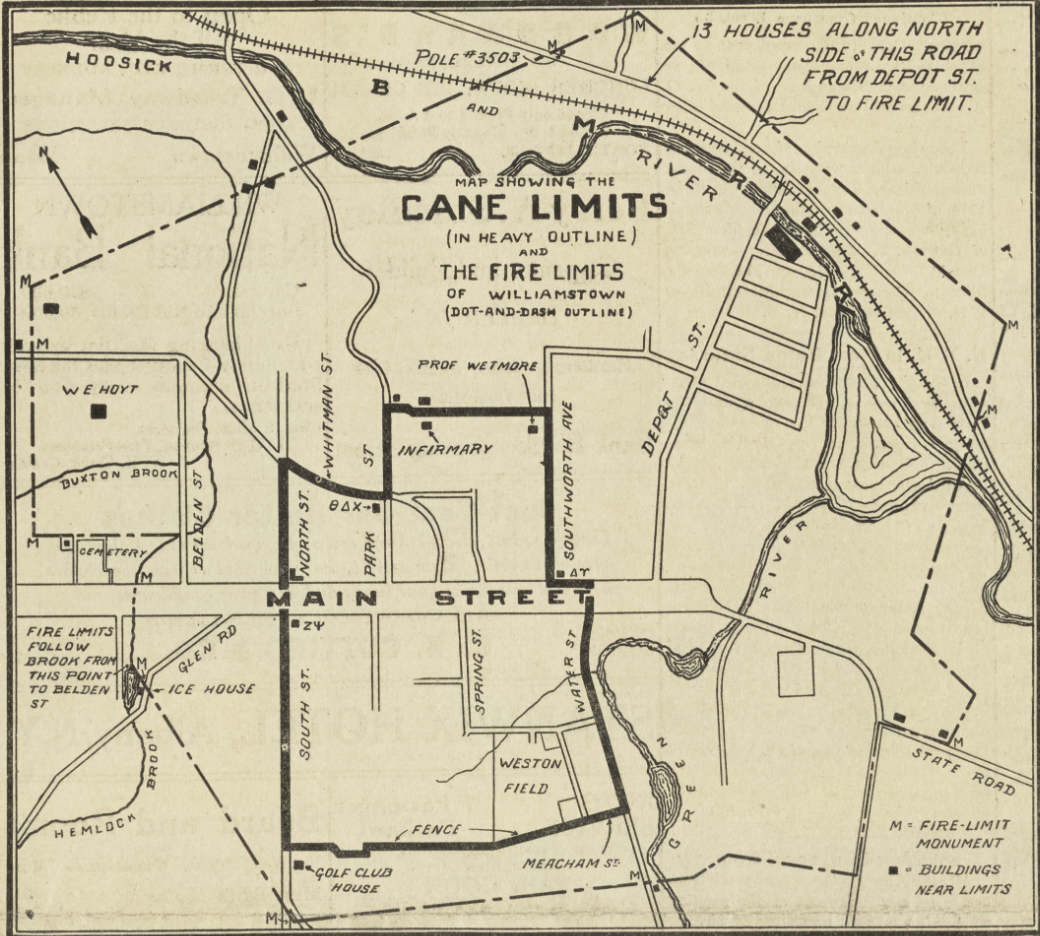
During the Industrial Revolution, factories and mills popped up across the United States, providing work opportunities for Québécois immigrants. “A lot of those factories were right here in Williamstown and North Adams,” Martin said. “[Today], you see these red brick factories that have been turned into condos or restaurants … [They] were built in these rural areas because all the waterways here would create power and turbines to work machinery.”
The Québécois population continued to grow in the second half of the 19th century, which cemented the presence of spoken French in the Berkshires. “If you were here anywhere from the 1850s through the 1950s or 60s, you would have heard French being spoken all over Williamstown and North Adams,” Martin said.
Benoit Gosselin, who owns Spring Street Market with his wife, Karen, is one of the few French-speaking locals from a Québécois family still in Williamstown today. The youngest of twelve, Gosselin was the second of his siblings to be born in the United States after his family moved from Québec to Bennington in search of better work opportunities.
Gosselin’s father worked as a logger. “He cut wood for a paper company,” Gosselin said in an interview with the Record. “So that’s why he moved to the U.S. — because the U.S. was the country to move to. There’s more opportunity. He definitely could make way more doing the same thing.”
Gosselin remembers struggling to learn English in second grade and spending a lot of time with other Québécois families that his father recruited to come work in Bennington. “There were quite a few,” he said. “And we hung out with them a lot.”
Although the area’s French-speaking population has diminished, many Québécois families remain, and Gosselin said that he still notices French surnames in the area.
The College’s French curriculum continued to grow after 1840, becoming the first robust modern language program at the College. It wasn’t until the early 1860s that course catalogs, found in Special Collections, show the addition of another language — an introductory German course. By the 1920s, the College offered courses in Latin, Greek, French, German, Italian, and Spanish. In subsequent decades, Russian, Arabic, Chinese, Japanese, and Swahili followed suit.
While the French department in recent years has been thriving, its faculty are still concerned about cultural changes affecting the program.
Martin said he worries about the decreasing interest in foreign languages amid the rise of AI. “The problem is that colleges and institutions have to decide what’s the future [and] what are the priorities,” he said.
Still, Martin is hopeful for the future of the program and proud of its impact on past students. “[Students have gone] out into the world and ended up living in French speaking countries, working for the State Department, doing diplomacy, or becoming teachers,” he said.