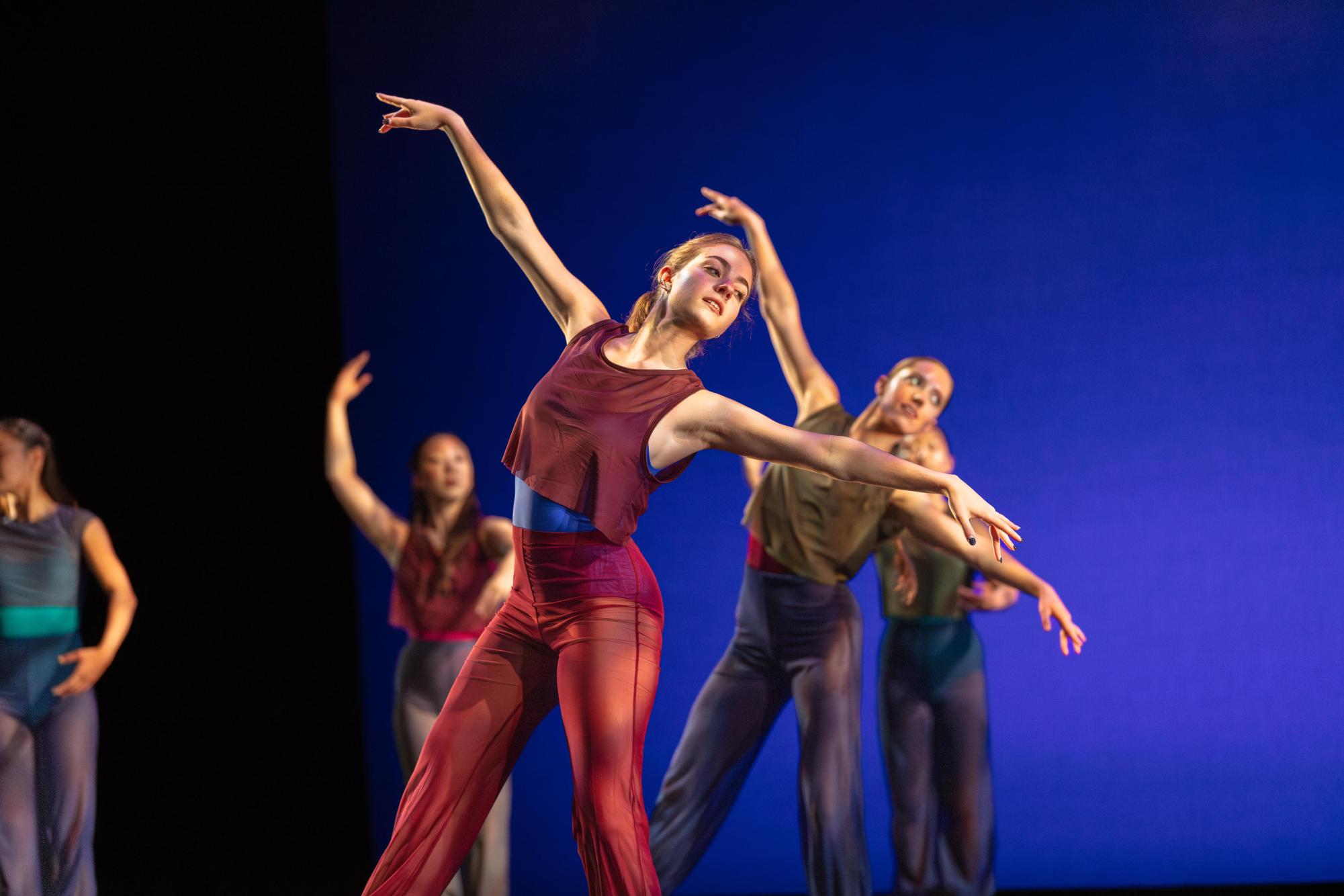
While the College’s dance department is no conservatory, it’s home to many pre-professional dancers who spend hours each week perfecting their craft. Although small, the department offers a mighty selection of courses and ensembles suited for a wide range of dancers. However, in a department that toes a unique line between arts and athletics, dancers say that they lack sufficient access to important health resources given to athletes — particularly athletic training and physical therapy.
“It’s a little disappointing that we don’t have access [to resources],” said ballet dancer Ella McFarlane ’28, who danced pre-professionally at the Boston Ballet School and Ballet Rhode Island before coming to the College. “We are training just as hard as the athletes on campus, and when we do need access to physical therapy or an athletic trainer, that’s just not an option for us.”
The College offers courses in ballet, modern, and African dance for academic credit, as well as four ensembles and numerous student-organized performance groups. Dancers expressed appreciation for the artistic resources the department has access to — professional costume shops, production teams, and live musical accompaniment. Some pre-professional dancers, who grew up training up to 40 hours per week in competitive, often toxic dance environments, have found comfort in the College’s uplifting dance community. “Our teachers care so much about us as human beings outside of dance, which I think is sort of new to us,” said ballet dancer Lucy Everett ’27, who began training at the School of American Ballet in the first grade. However, dancers struggle to find support for their physical health.
Last spring, McFarlane sprained a muscle in her foot while landing a saut de chat, a type of ballet jump. After leaving campus for an X-ray, she came back in search of physical therapy help. “‘How do I get exercises or support that I need to get back to dancing faster?’” she asked. “I reached out to a couple athletic trainers, and they said, ‘No, sorry, we don’t take dancers.’”
Even in periods of intense training leading up to performances, during which many dancers at the College spend as much time in the studio as professional dancers do, they don’t have access to self-service recovery treatments such as ice baths and heating.
“We were performing and teching for three weeks straight, and it was tough to not have therapeutic resources,” said ballet and contemporary dancer Casey Cai ’27, reflecting on the weeks leading up to her Ritmo performance last year.
Cai, McFarlane, and Everett said they were used to having extensive physical support from experiences dancing before they arrived at the College. “I used to see a physical therapist pretty much once a week,” Everett said. “I don’t have anyone to go to just for a casual, ‘Hey, I did this. Can you tell me if there’s something wrong or if there’s something I should do?’”
While many dancers come to the College expecting to cut back on their training hours, their bodies still end up under physical stress, and the health impacts are apparent to the department. Dance professors struggle to rehabilitate their dancers without professional assistance.
“Every semester there are at least one or two dancers in a class that I’m teaching who have an issue with their ankle or something else,” said Erica Dankmeyer, artist-in-residence in dance. “It falls to us to try to advise them by telling them to get ice or show them how to wrap it. And we’re not experts — we just know from our own experience of having a lifetime in the field.”
While the dance and athletic departments intersect in some ways at the College — students can take dance classes or participate in ensembles for physical education credits — the departments maintain separate resources. Head of athletic training Rodd Lanoue said that there is no structural relationship between dance and athletics.
“Athletics feels like a whole different side of the campus that’s completely removed [from dance],” Everett said. “I think there’s not enough coordination with the athletic art form that we do.”
Senior lecturer in dance Sandra Burton, who has taught at the College since 1983 and chaired the department since 2009, has watched dance and athletics drift apart over the years. “Originally, there was a trainer who worked with the dancers in the department, and this ended the first or second year after we moved into the ’62 Center [for Theatre and Dance] in 2005,” she said.
Since then, the dance department has made efforts to regain support from athletic training at the College, according to Burton. “We’re not just looking at the person’s body, we really try to see the whole person,” Burton said. “We asked wellness, the athletic department, Student Life, and brought them all together to talk about our concerns, to hear what their concerns were, and to see if there was a way of addressing wellness on campus in a holistic way.”
In an effort to address this lack of support, the dance department created its own Dancer Wellness Initiative in 2021, bringing in outside resources with department funding. “We’ve occasionally brought in experts in dance medicine specifically to meet with our dancers,” Dankmeyer said. “We don’t have the opportunity to do that very often, and it’s not in a sustained, ongoing way that an athlete would have.” Dankmeyer explained that the program has declined due to budget, staffing, and scheduling challenges.
Both Dankmeyer and Burton agreed that access to trainers would be a game-changer. Ideally, the department would have a trainer specialized in treating dancers’ bodies, but given the previous lack of support for dance physical therapy as a whole, the next best option is support from the College’s regular athletic trainers. “If we were to have somebody who is available to us a couple of times a month or once a week in some capacity, it would make a difference for sure,” Dankmeyer said.
While the reasons behind dancers’ insufficient treatment options is unclear, one possibility is that, without the distinction between varsity and non-varsity athletes, there’s no obvious way to determine which dancers would receive access to training resources. “The use of ‘elite’ is a distinction that physical education has made in naming varsity athletes the priority in their department. We’re not organized that way,” Dankmeyer said. “We have dancers, musicians, visual artists, actors who come here with a high degree of training, but they come here knowing that they’re going to be in the salad bowl with a lot of other people, and that is a part of the beauty of the experience.”