“Tu as bien dormi?” the professor asked me, pushing up the sleeves of his yellow-striped turtleneck. I looked to the student sitting next to me. “No hablo francés,” I responded meekly.
I was at my first class at Bennington College: “Insider Perspectives on the Francophone World.” Aside from the unfamiliar classroom and new faces around me, I was also confronted with the task of learning a new language. What had I gotten myself into?
A few weeks prior, I had reached out to the editors of The Bennington Lens, Bennington College’s student-run newspaper. Another small liberal arts school just 25 minutes north of Williams, Bennington has piqued my curiosity for years. A school with no grades? No majors? We live so close, and yet we hardly interact with the 797 undergraduates who call southwest Vermont their home. Founded in the 1930s as an all-women’s college, Bennington’s mission is to center self-directed and experiential learning. It’s known for its excellence in the performing arts, visual arts, and creative writing. After sending a few emails, I was delighted to find that the Lens editors were excited to engage in a collaboration. They allowed me to follow one of their reporters, sophomore Angie Hund, for a day. In exchange, Angie joined me for a day at Williams later that week.
After a quiet, drizzly drive up Route 7, I arrived on campus in time for Angie’s 8:30 a.m. class. We walked through The Commons, Bennington’s multi-purpose dining hall and classroom space, up several flights of stairs into a cozy seminar room. The professor, Steven — at Bennington, all professors are addressed by their first names, Angie told me — was already striding across the room, asking students how they slept. I froze when he got to me, but he kindly explained the correct sentence structure, and I eventually strung together an answer.
The rest of the class was packed with bingo-playing, Biscoff cookies, and partner discussions. I learned how to say I’m bored, that a park bench is a piece of erotic technology used to facilitate sexual encounters, and that learning French is actually a lot of fun.
After an hour and 15 minutes, I began to lose steam. Imagine my surprise upon learning that this hour-and-a-half-long class was the shortest that Angie has ever taken.
Angie’s next class, which was a course on child development, would last two hours. In the meantime, Angie explained that many Bennington students take more than the typical Williams courseload of four classes. This semester, Angie is taking seven courses: French, child development, dance, literature, improv, Visual Arts Lecture Series, and a tutorial on the Lens. At Bennington, tutorials often take the form of nontraditional classroom experiences and are personalized to the student’s interests. For Angie, this means that she can earn course credit for writing for the Lens.
Child Development turned out to be two hours of midterm presentations. As a psychology major, I was excited to learn about the developmental disorders that each group chose, including pica, Down syndrome, and attention deficit hyperactivity disorder.
At the end of class, the professor, Emily, spoke about the upcoming research paper. After she outlined the guidelines, students eagerly jumped in with their own suggestions for useful resources like citation tools, writing tutors, and librarians. Emily casually described her approach to AI: “If you write a paper on ChatGPT, I will give you feedback on ChatGPT,” she said. “I’m pretty good at giving writing feedback, so this would be a good use of your thousands of dollars of tuition money.”
By noon, I was ready for a break from class. Thankfully, Angie said our next stop was lunch.
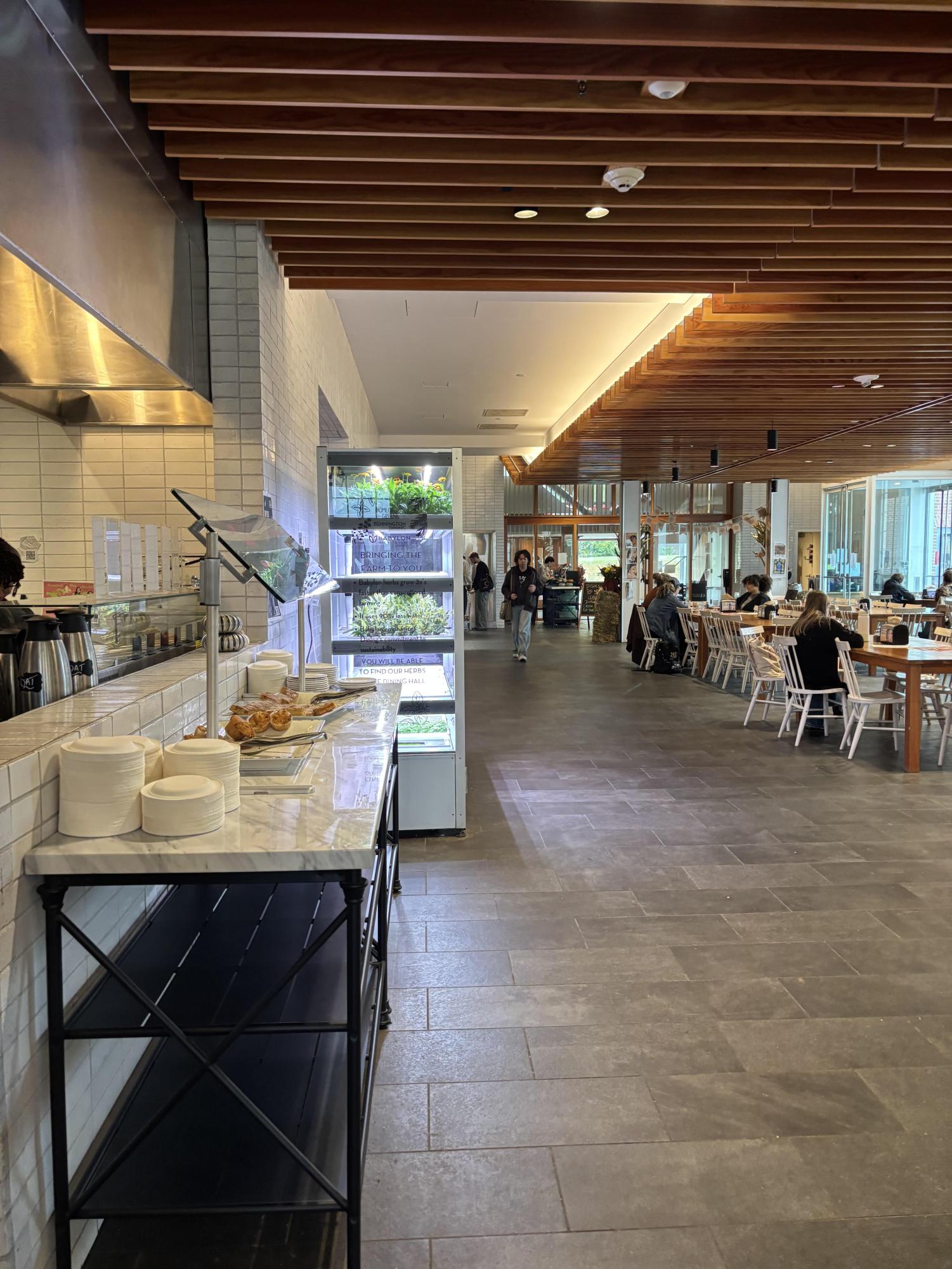
There’s only one dining hall at Bennington, but it is spacious and airy, with several rooms offering a variety of seating options, wood-paneled ceilings, and stainless steel appliances. As I sat down with my Impossible burger and salad, I was immediately drawn into the familiar chaos and banter of a college dining hall — with a Bennington twist, of course. “Yesterday, some guy just peed himself,” said sophomore Connie Birch, a classmate from our earlier psychology class. “There were flyers around here that were like, ‘Watch me pee myself.’ It was art, I don’t know.”
Such displays of “performance art” are not uncommon on Bennington’s campus, according to Connie. “I was walking to class the other day, and I saw this chick slow-motion walking through the grass, and I was like, ‘This feels like practice or something,’ because she seemed a little nervous to be doing it outside,” Connie said.
Quickly, we moved on from art to another vital form of student expression: parties. “The parties aren’t just parties,” Connie said. “There has to be a theme, okay? Like, it’s required to have a weird theme.” Many student houses, called Colonial Houses, have the responsibility to host a few parties each semester, which they plan during their weekly “Coffee Hour” on Sunday evenings. Some iconic parties have included the sapphic-themed “Fells in love with a girl,” hosted by Fells House, and the annual “St. Kilpatrick” hosted by Kilpatrick House in March. However, students with physical or mental health accommodations often live in the Woo Houses, which contain single rooms as well as elevators. Without the large common spaces typical of Colonial Houses, Woo Houses often aren’t part of the Colonial party circuit.
Another integral element of life at Bennington is students’ refusal to be silent in the face of wrongdoing. “As a culture, we don’t have a problem calling out issues on campus, and a lot of that will be through posters,” Connie told me.
Angie added, “And you’ll get support from staff too, administrative people will support you on that.” All of the students at our table were quick to chime in with praise about their professors. “They’re well known in their field and their practice. They’re like practicing artists,” Connie said.
Angie noted that their professors’ connections bring talented people to speak at Bennington. “We do VALS — Visual Art Lecture Series — on Tuesdays, like every week. They get artists from all around the world to come and give lectures — it’s beautiful,” she said.
Eventually, students began to disperse from Commons, slinging their tote bags onto their shoulders and discarding leftover fries into the compost bins. I followed Angie out the doors, and as we staggered through the bracing wind toward her house, she explained that she doesn’t mind the small school environment. “I’m from a very rural area that’s more rural than Bennington,” she said. “So, I don’t really know anything different. To me this is big.” She noted, however, that the college’s four-mile distance from the town of Bennington adds to a sense of isolation that’s not abated even by the shuttle that brings students to town from 8 a.m. to 10 p.m. daily. “Even though we do live in the town of Bennington, we primarily stay on campus,” Angie said.
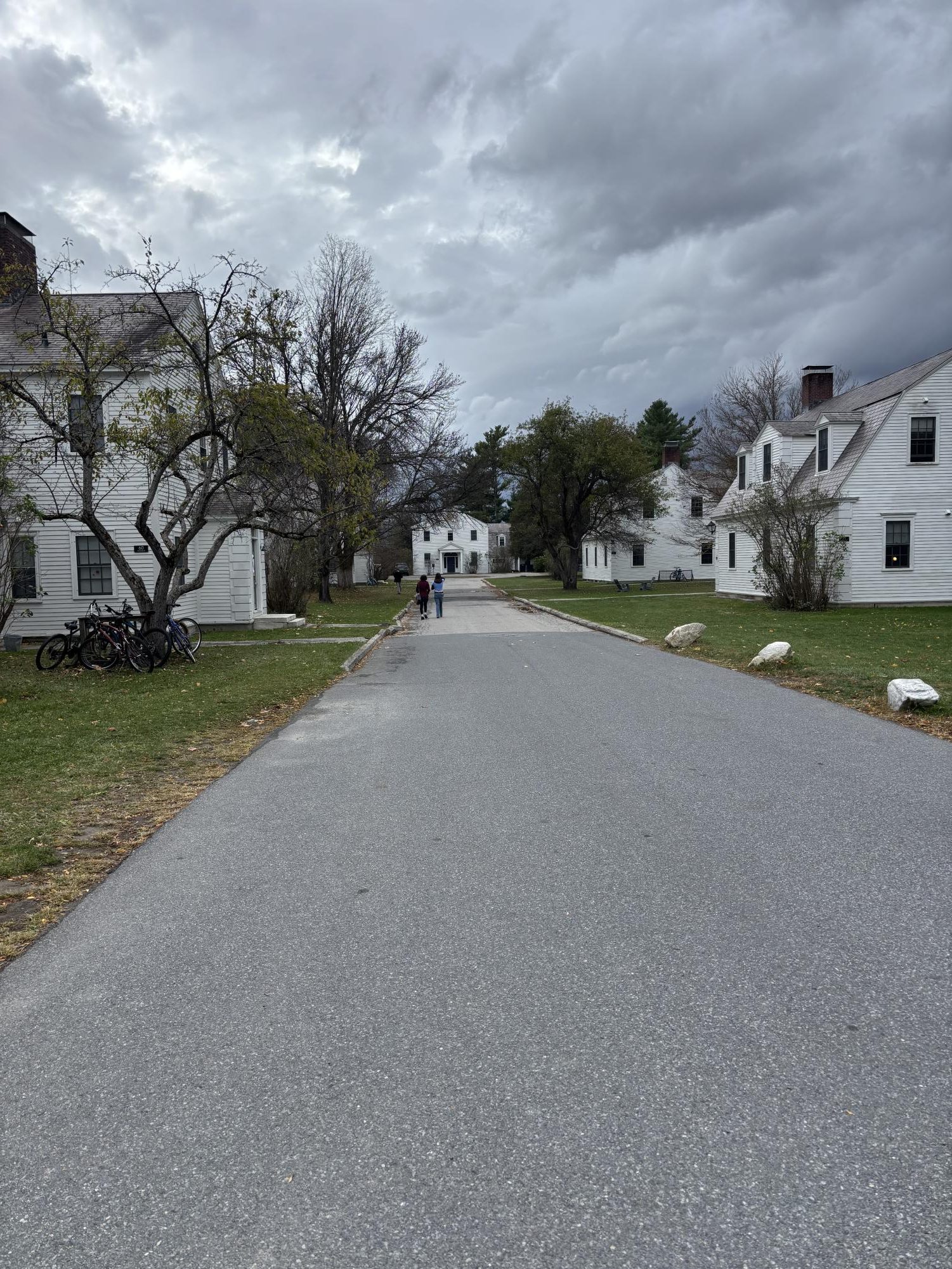
Soon, we turned onto a charming row of old wooden houses, which Angie called “the Colonial Houses.” Many students live in these community homes rather than in traditional college dorms. Angie is one of the lucky students who resides in an apartment attached to a Colonial House, so she gets the benefit of a shared living space while maintaining privacy. As we stepped inside her foyer, she handed me a pair of soft slippers and pulled up a chair so that we could talk. Before we began, though, she pointed out the key elements of her apartment: her own room that she shares with a roommate, the single next door, the semi-private bathroom, and — most exciting — the snug kitchen that comes with its own oven, full-sized refrigerator, and stove. An oven? In a dorm room? I sighed. Williams could never.
As we sat down, I knew it was time to finally get to the heart of the Bennington experience: the Plan.
The Plan is, essentially, an annual essay that Bennington students submit to faculty advisors that outlines their academic, personal, and professional goals. Rather than majors, the Plan allows for greater academic freedom than can be found at most traditional colleges. Angie emphasized that its flexible nature is key to the Bennington philosophy. “If your Plan’s the same [every year], you’re doing something wrong — you haven’t grown, or strengthened any of your abilities or skills, or fed your curiosity,” she said. “Bennington is just open-ended.”
The Plan isn’t the only unique aspect of Bennington’s academics. “For the longest time, Bennington was pass/fail,” Angie said. “Instead of getting a letter grade, you get personal evaluations from your teachers, and they’ll talk about you and your work.”
“And then as of recently, they introduced letter grades because people want a GPA to go to grad school with,” she continued. “So you can request certain classes that you want to get a letter grade in.”
Besides coursework, students are required to fulfill four terms of “Field Work” in order to complete their yearly Plan, which is a seven-week winter term during which students complete 160 hours of field experience related to their Plan.
While the Plan certainly involves a large commitment, Angie has found the workload at Bennington to be reasonable. “The workload is pretty manageable,” she said. “I don’t feel swamped. I don’t feel like I can’t do things because I have work. I have a good social balance.”
Much of the social scene at Bennington revolves around queer culture, Angie told me. When asked about the queer population at Bennington, Angie said, “The population is queer.” Angie noted that the only exception to that is a handful of cis-gender, straight men, but they are largely in the minority — in fact, men are in the minority in general, with 73 percent of the student body identifying as female, and many who are non-binary. This doesn’t come as a surprise, since Bennington was an all-women’s college until 1969.
“Even our teachers are all queer,” Angie continued. “It’s the norm, it’s the standard — it’s kind of just assumed on this campus.”
Before we left to get to Angie’s 3 p.m. job, I had to ask one more burning question: What’s the deal with The Secret History?
Much to my disappointment, Bennington is not a carbon copy of the college as it’s portrayed in the haunted murder tale written by alum Donna Tartt in the 1990s. However, its influence can still be seen on campus. “[We’ve] kind of aestheticized, or romanticized, that book here,” Angie said. “And people come here and they’re like, ‘I’m Donna Tartt-coded.’ People dress like her and like to have their fun with it.”
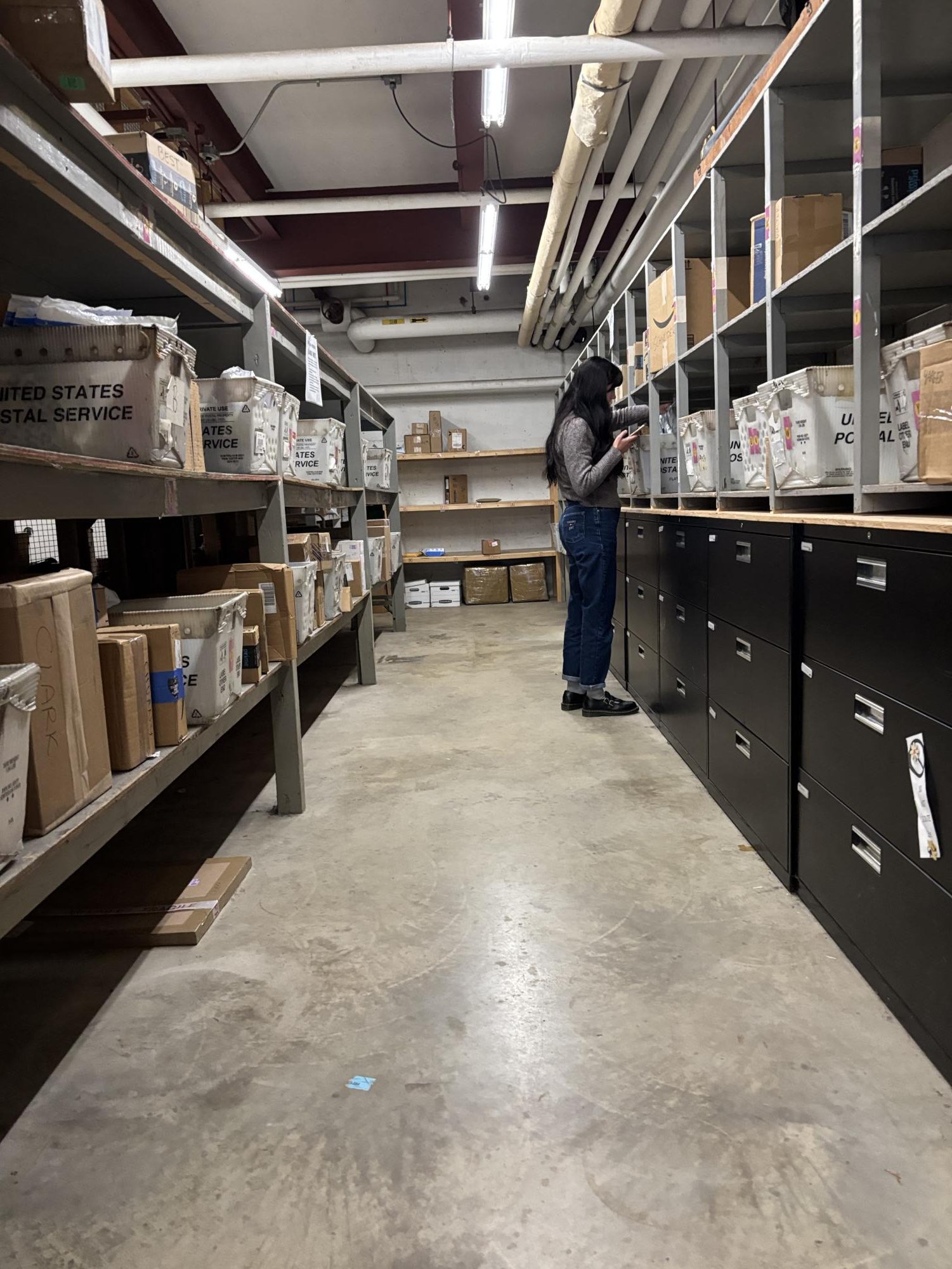
Satisfied with her answer, I followed Angie across campus to the Bennington College post office, where she retrieves packages for students who stop by. Between customers, Angie and I exchanged cute photos of our dogs and compared our student newspapers. Before we knew it, the hour was up, and we headed to our last stop of the day: her First-Generation, Low-Income, or Working Class (FLoW) internship, where she hosts weekly open hours to offer guidance and support to FLoW students.
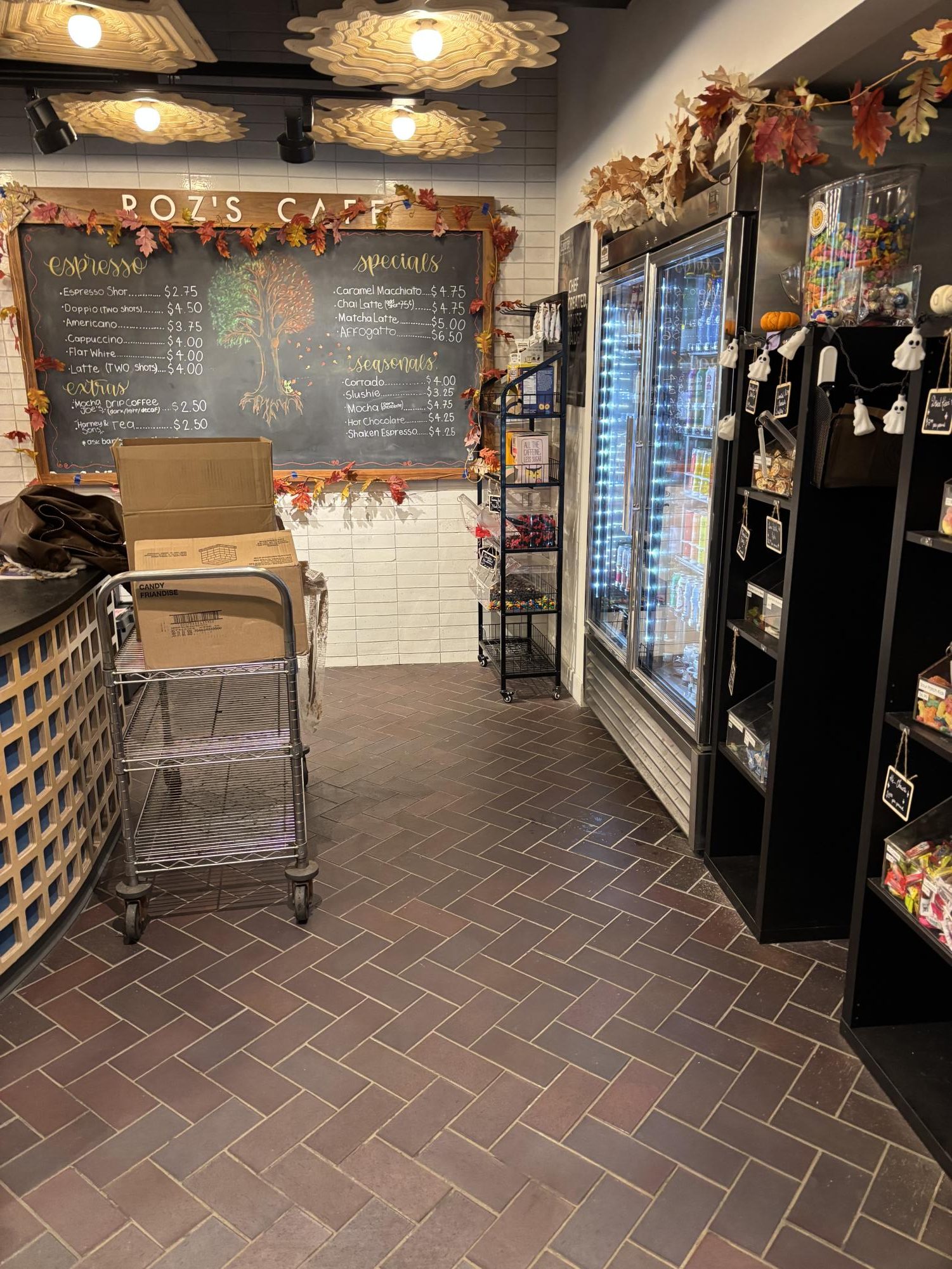
I was excited to hear that her FLoW open hours would take place in Roz’s, Bennington’s student-run coffee shop. As we sat waiting for students under the warm light of the café, Angie and I prepared for her upcoming visit to Williams. Perhaps, we mused, our newspaper collaboration wouldn’t end with the publication of our articles. A Record-Lens function? Williams could take a few notes from the Bennington party scene.
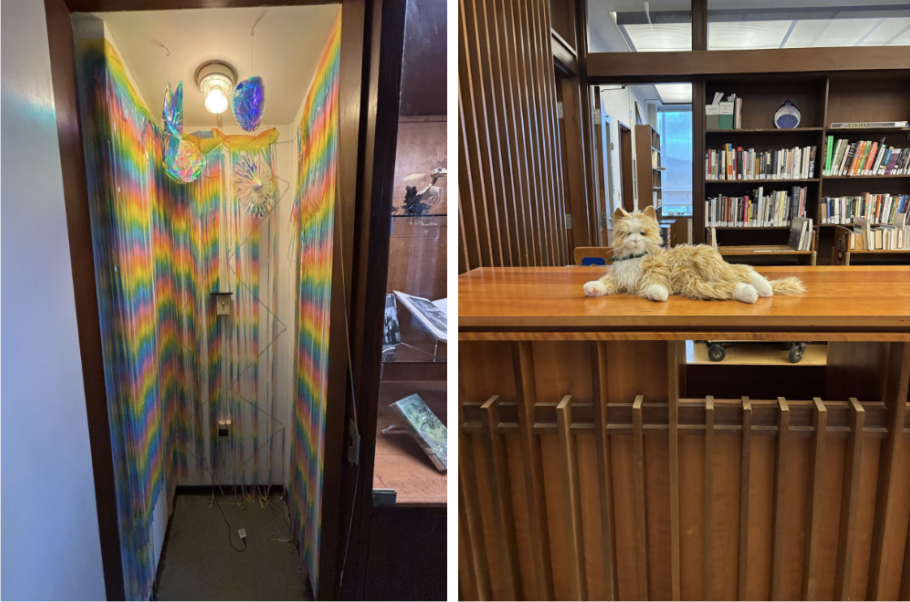
The day was almost done, but I couldn’t leave before seeing the library. We walked through the science building where I saw the resident bumpy fish that Angie swears is not sick, past the freshly baked banana bread outside of Joyce’s (the beloved custodian) office, and through the library doors to greet the stuffed tabby cat on the front desk. Angie showed me the “party closet” on the first floor of the library, a rainbow-wallpapered space just big enough to hold two students mashed together and pointed out the glitter duck machine, which rewarded me with a tiny duck and book recommendation after twisting the knob.
Eventually it was time for my day as a Bennington student to come to an end. As I backed out of the gravel driveway, I looked over my shoulder a few times, just out of caution. Despite Angie’s reassurance, you never know which Classics student in a trench coat may be waiting to push you off a cliff in a Tarttian twist of fate. But hey, the trip to Bennington might have been worth it.