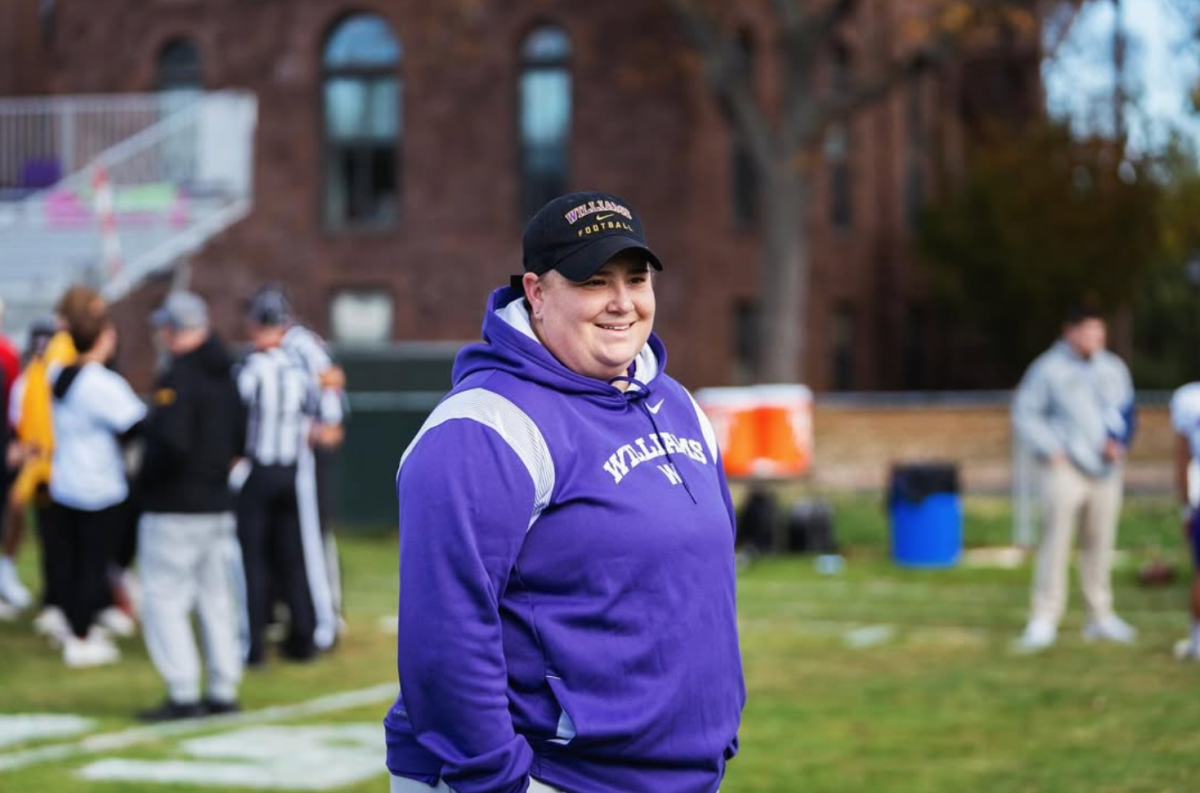
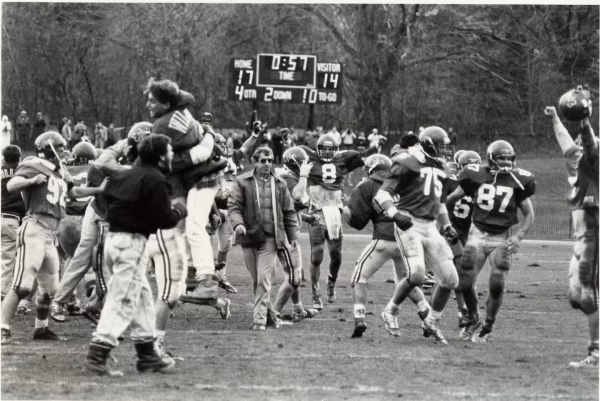
Dick Farley, former head coach of football and track and field, passed away on April 1 at age 79. In his 42 years at the College, he built the football team into one of the most successful Div. III programs in history, leading the Ephs to their first perfect season in 1989 and to four more in 1992, 1994, 1998, and 2001. Every football player who spent four years under Farley experienced at least one undefeated season.
Farley’s athletic career started long before his time at the College. Born on May 30, 1946, in Danvers, Mass., Farley was an All-American athlete at Boston University, where he captained both the football and track teams. Following his graduation in 1968 with a bachelor’s degree in physical education, he was drafted by the American Football League’s San Diego Chargers, opening their 1968 season as a starting defensive back. After two seasons with the team, a herniated disk ended his time with the Chargers. Farley then returned to Danvers to teach physical education at Holton-Richmond Middle School. Although he attempted a football comeback with the New England Patriots in 1971, that effort was cut short by hamstring injuries, which were compounded by his previous back surgery. Later that year, Farley became an assistant football and track coach while also teaching physical education at Danvers High School.
After learning about open coaching positions at the College from newspaper advertisements, Farley arrived in 1972 as head track coach and assistant football coach. What started in his mind as a short step towards coaching in the NFL became a four-decade commitment to the College, according to Farley’s 2021 book, “Why I Never Left Williams College,” that he co-wrote with former Sports Information Director Dick Quinn.
In 1987, Farley was promoted to head coach of football and quickly transformed the program into one of the nation’s most consistent winners. After opening his first season with three straight losses, he led the Ephs to 128 straight games without suffering back-to-back defeats. By the time Farley retired in 2002, he had compiled a 114-19-3 record, good for a .849 winning percentage, and a 14-2-1 record across each “Biggest Little Game in America” against Amherst.
Farley’s success brought him widespread recognition. He was named New England Coach of the Year four times, NESCAC Coach of the Year twice, and the All-American Football Foundation’s Div. III Coach of the Year in 1996. In 2006, he was inducted into the College Football Hall of Fame, and in 2019, he was named to ESPN’s list of top 150 coaches in college football history.
Former defensive end Ken Dilanian ’91 highlighted Farley’s character as a key factor behind his remarkable coaching success. “None of us who played for him will ever forget his dedication, integrity and humility, coupled with a steely, relentless drive that propelled us to almost unimaginable success,” Dilanian wrote in a message to the Record.
Despite the team’s accomplishments, Farley kept his athletes grounded with his legendary catchphrases, which became known as “Farleyisms.” These included “Be on time and don’t be a jerk” and “If you can’t play here, you can’t play anywhere, there is no Div. IV.”
“He had this way of distilling the world down in a way that would bring all of us highfalutin kids down to reality,” former hurdler Dawn McGee ’89 said in an interview with the Record. “He did not play games. He would tell you how he saw things. That honesty, coupled with his sense of humor, was his superpower.”
To former cornerback John Berry-Candelario ’00, Farley’s lessons extended far beyond the field. “I started to understand that that just wasn’t about football, it was about life,” he said. “Live your life to a certain standard that allows you to give service to the people around you, and just be the best version of yourself.”
Although Farley’s successes created many opportunities to coach at other schools, he chose to stay at the College because of its balance of strong athletics and academics. “He could have scaled the ladder of coaching jobs with its commensurate salary differential,” McGee said. “He didn’t want it. He loved Williams … He loved the purity of coaching Div. III and its scholar-athletes.”
Farley announced his retirement from football at the team banquet following the 2002 season, capping 32 years with the Ephs. However, his retirement from football did not mean he left the College. After stepping down as head football coach, he remained active on campus as co-head coach of men’s and women’s track and field and as director of club sports. He continued volunteering with the track teams even after leaving his formal head coach role, before his official retirement from coaching in May 2014.
Former track and field athletes highlighted the unique connection Farley had with the sport. “Coaching track was the purest expression for him because… there wasn’t a huge limelight or burden like football,” McGee said.
Lindsay Irvin ’85, who joined the College’s track team less than a decade after the passage of Title IX, recalled training on a small women’s team with a cinder track that had to be carefully leveled before use — a task that Farley unilaterally took on for his athletes. “I can’t say enough about how much it meant to me that Coach Farley respected me as an athlete, in a time when women weren’t entirely being taken seriously,” Irvin wrote in an email to the Record. “But he didn’t just support me with words. He quietly went out and got that track perfect for me to be able to train. He would have done it for any athlete.”
Although Farley is recognized for his coaching accomplishments, his athletes remember him for his impact on a personal level. “His legacy is about a lot more than winning,” Dilanian wrote. “He set a tone that made us feel like a family. The camaraderie we developed was unlike anything I have experienced before or since.”
Those who knew Farley say that, in the decades he worked at the College, few people had a greater direct influence on students. “He has impacted so many people, and I believe that for him, each of them was special and unique,” Berry-Candelario said.
The distinctive ways Farley took pride in his athletes have long stuck with them. McGee, the College’s first four-time All-American in track, recalled that in her senior year, Farley gifted her a Payday candy bar, referring to her accomplishments as his “payday.” “It’s not because he made more money, it’s not because he got more accolades, but he was so proud to have contributed to me being the best athlete I could be,” she said. “I still have that candy bar. That subtle little celebration was everything.”
In the final game of the 1989 football season, Ted Rogers ’91 stripped an Amherst player of the ball, and Dilanian recovered the fumble that secured the Ephs’ first-ever perfect season. Decades later, Farley would still recount how he honored the players who shaped those early championship teams. According to Dilanian, Farley would recurrently tell a story about how his wife, Suzanne, helped him remember his phone number by changing the last four digits to 6299 — the respective jersey numbers of Rogers and Dilanian. “That story never got old because it always made me proud,” Dilanian wrote.
Berry-Candelario recalled the lasting force of Farley’s quiet encouragement even off the field. After donating a kidney to his brother in his penultimate year at the College and subsequently receiving the NCAA Award of Valor, Berry-Candelario traveled with Farley to San Diego to receive his award. Amid a room full of prominent athletes and public figures, Farley turned to Berry-Candelario during dinner and simply reaffirmed that he deserved to be there, a compliment that carried special weight coming from him.
“There is this brusqueness that just hits you like a ton of bricks,” Berry-Candelario said. “This man, whom I admire, was saying something to me that was revelatory and made me feel like, wow, I actually had made him proud. It was such a powerful moment that I’ll never forget.”
For the many athletes he coached, across football and track, Farley’s legacy endures not only in undefeated seasons, championships, and honors, but in the standards he set and the lives he shaped. “Dick Farley was an American original,” Dilanian wrote. “He left the world a better place than he found it.”