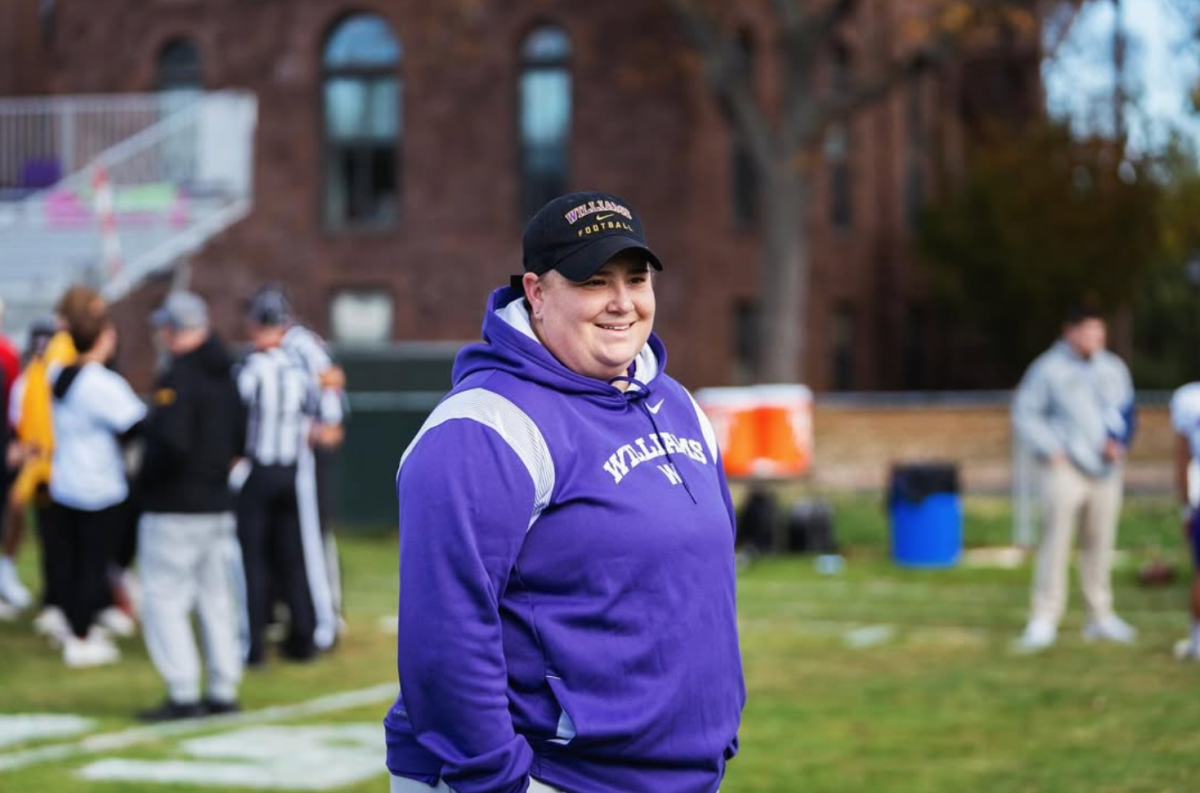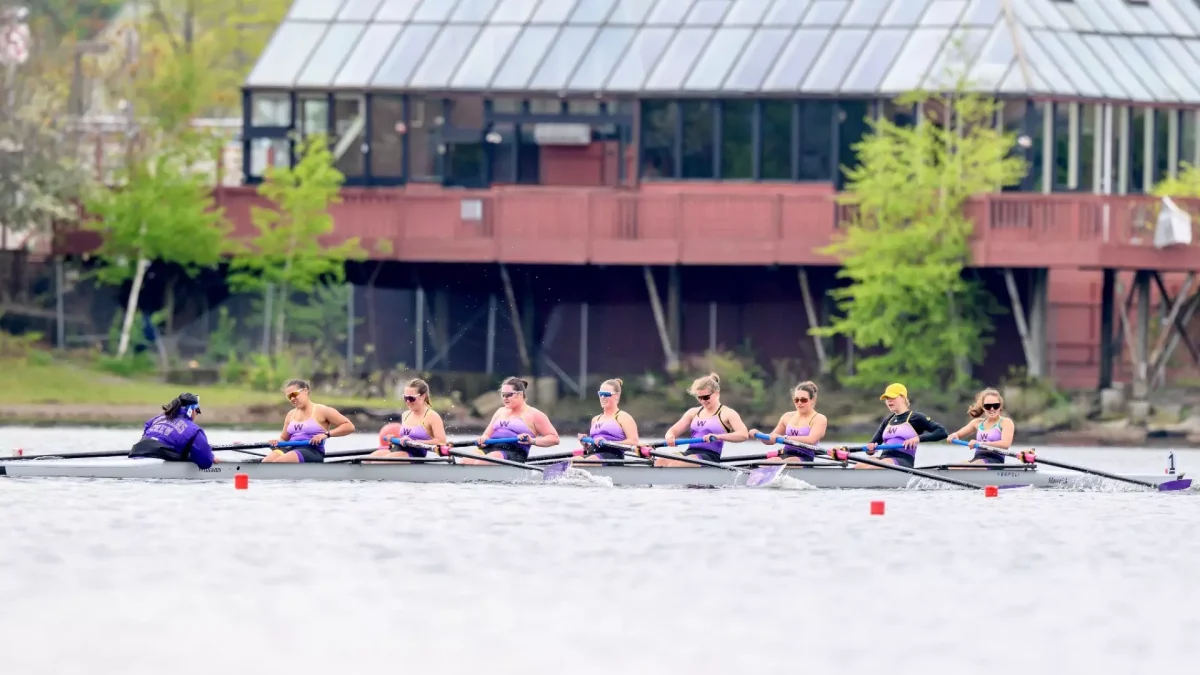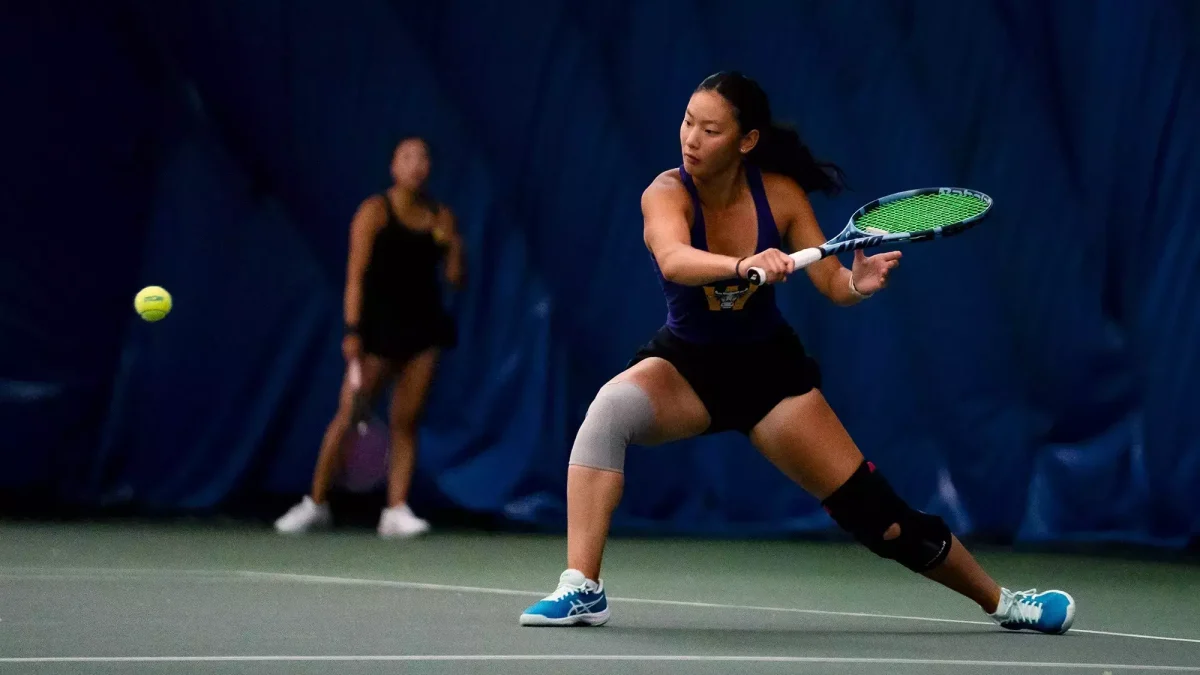

Before they were college teammates, captains, starters, and NESCAC champions, they were athletes who loved, lost, and found their way back to the sports that have shaped them.
For most athletes, the journey to the College’s varsity athletics programs follows a typical recruiting path. But for Peter Laino ’26, Onyeraluobu Chibuogwu ’26, Charlene Peng ’26, Benham Cobb ’26, and Michael Ma ’26, that path was not traditional. These five seniors walked on to varsity teams across four sports at various points in their time at the College, ranging from their first to last years. Despite their differing journeys, each of their walk-on stories ended in the same place: with a deep sense of belonging on a team they once only hoped to join, and an equally deep gratitude for the sports that brought them there.
In several cases, the decision to walk on was defined not by a single moment, but by years of persistence. Laino, captain of men’s Alpine ski, grew up skiing in Switzerland before attending an elite ski academy in Vermont. He spent two gap years continuing with skiing, hoping to join the College’s ski team, but a full roster and a change in the coaching staff left him arriving at the College still without a roster spot.
During his first two years at the College, Laino followed a self-started, independent training plan. He individually entered and raced in over 20 competitions each season, hoping to improve his skills enough to eventually join the team. “I organized my own training, hired a coach, and was pretty much doing everything solo,” Laino said. “It was very self-driven the first two years.”
After repeated communication with the ski team’s coaches, Laino was finally offered the chance to join during his junior year. “My junior year, I went to [Coach Amber McHugh] again, kind of my last shot,” Laino said. “She was like, ‘I’ve seen you working hard, and we have a spot on the team this year, so you’re in.’”
Despite joining later than most athletes, Laino said his transition onto the team was seamless. After McHugh sent out an email to the team announcing that Laino had earned his roster spot, he got five congratulatory texts from his teammates within 10 minutes. “[My teammates] were extremely welcoming,” Laino said. “It was helpful that they knew about my situation and that I worked hard to get where I was.”
Much to his surprise, Laino was voted as captain only one year after walking on, a testament to his dedication to the sport and the team. “As much as I knew that the team really was welcoming [me] with open arms, I was definitely surprised that they entrusted me with the team,” he said. “I like to think that I bring good energy and determination to the team.”
Chibuogwu, who walked on to the men’s basketball team his junior year, similarly had to prove himself to the coaching staff after multiple knee injuries limited his recruiting opportunities coming out of high school. “My journey to Williams basketball was me just continuously bugging [Coach Kevin App],” Chibuogwu wrote to the Record. “Without the knee surgeries, I believe I would have been a recruited athlete. Getting the coach to see that was the real challenge.”
Chibuogwu’s time away from the sport carried a weight that extended beyond the court. “Basketball had been a part of my life for as long as I can remember,” he wrote. “The only stretch I wasn’t playing was my first two years of college, and that absence hit me harder than I expected. It affected my mental health in ways I’m still processing.”
Chibuogwu did not let these challenges stop him from making an impact, eventually becoming the starting point guard his senior season. “Being the starting point guard is like being the coach on the floor, so my coach did a lot to put confidence in me and challenge me to be my best,” he wrote. “I gave everything I had [and] I always had my teammates’ backs.”
For cross country and track captain Peng, who also faced injuries in high school, time away from competition helped her rediscover her love for the sport. Despite originally planning to take a break from the intense competition after dealing with stress from her injuries, Peng found herself returning to the sport. “This is [just] such a beautiful place to run,” Peng said. “I decided to try out [for the team] the next year.”
After training over the summer and successfully walking on during her sophomore year, Peng has become an invaluable asset to the team. She joined the varsity lineup her sophomore spring, contributed to strong Nationals cross country performances her junior and senior seasons, and recently won the NESCAC title in the 3000m steeplechase. She expressed gratitude for the opportunity to continue her competitive athletic career. “Every race is a bonus because if I hadn’t … actively made the decision [to walk on], I wouldn’t be able to race,” she said. “[I remembered] that this is something I want to do, that it’s something I love to do.”
Cobb, a swimmer who walked on to the men’s swim and dive team his senior year, also felt burnt out after high school. “I was kind of losing passion for the sport,” he said. “So, toward the end of high school, I decided I didn’t want to go down the recruiting path.”
For Cobb, rediscovering his love for the sport happened unexpectedly while abroad, when he joined a club team during his time at the Williams-Exeter Programme at Oxford. “It was a wonderful experience getting back into swim, rekindling my relationship with it and working through it in a positive way,” Cobb said.
Ma, also a swimmer, walked on during his first year at the College. But for him, joining the swim team as soon as possible was always the goal. When visiting the College for previews, he spoke with Coach Steven Kuster and met the team. “I really clicked with the team,” he said. “I could tell these people operate on a familial level … It would be a great thing to be a part of.”
Despite being the only one of the five walk-ons to not have taken time off from his sport, Ma feels a similar newfound appreciation for swimming now that he’s completed his final season of competition. “I got back to seeing swimming for exactly what it is, which is moving through the water,” Ma said.
Each athlete’s walk-on experience became less about how they arrived on the team and more about the lessons they learned in choosing to stay with their sport. For Laino, that meant approaching each day with gratitude. “Being on this team was a real privilege to me,” he said. “I think sometimes at Williams, you can lose sight of the small things… A zoom-out is what I recommend to people to really recognize how privileged they are.”
For Chibuogwu, it was the refusal to step away from a goal, even in the face of uncertainty. His walk-on path taught him to go after what he wanted, even when the people in charge first told him no. “I never stopped trusting myself and the work I had put in,” he wrote. “The biggest lesson is that you have to write your own story, no matter how much professional advice you receive or how many people doubt you.”
Across all five Ephs, the common thread was not the obstacles themselves, but the decision to keep returning to something they could have left behind. “I wouldn’t change anything about it,” Ma said.