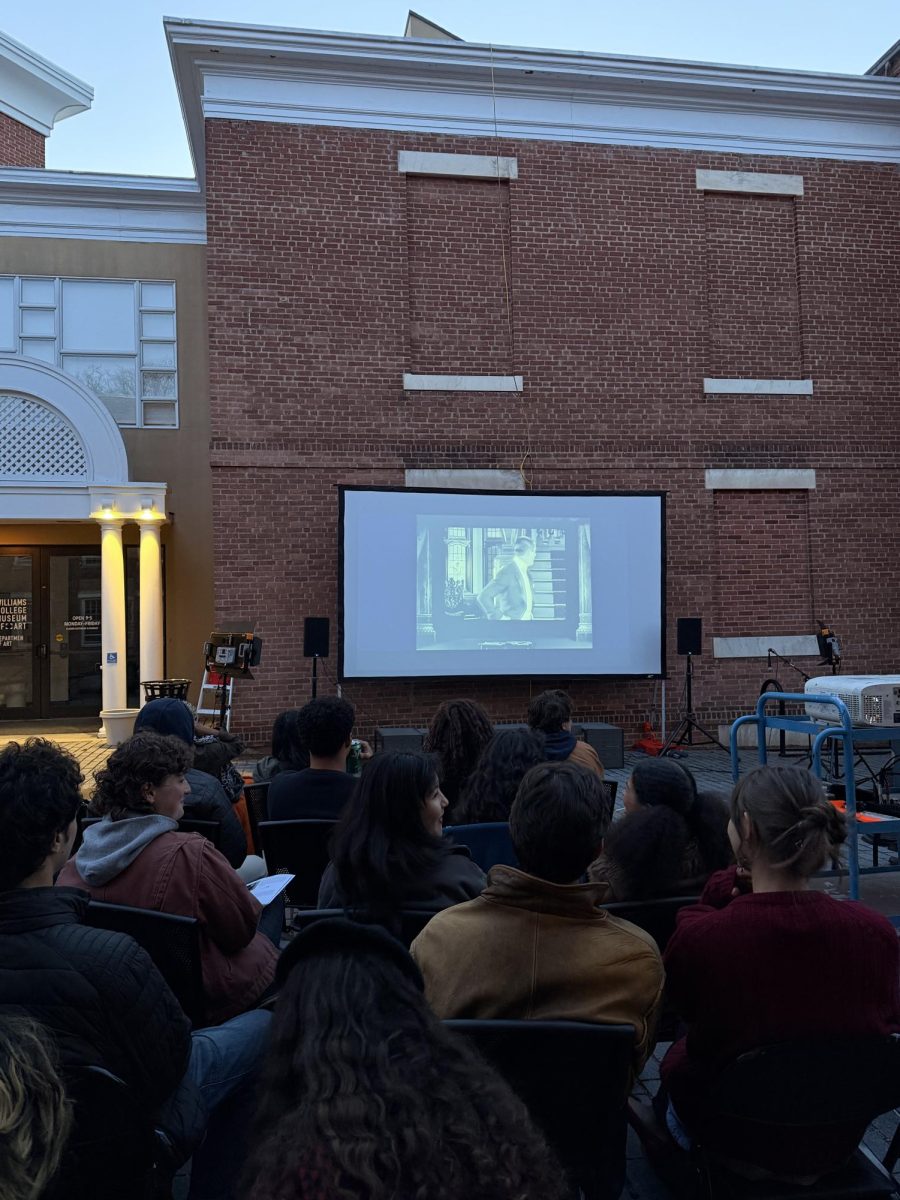

The Queer Kahaniyaan Film Series, a student-curated program seeking to offer the College community portrayals of South Asian queer identities, will conclude this evening at Images Cinema. The series, organized by Tashfa Zafar ’27, a Williams College Museum of Art (WCMA) student program assistant, brought together three films screened at Images over the course of three weeks. Presenting two feature films and one documentary, the series debuted with Joyland, followed by the documentary Trans Kashmir, and will close with The Queen of My Dreams, which will be screened tonight at 7 p.m.
Early in her time at the College, Zafar, who is originally from Lahore, Pakistan, felt that the College had a curricular blind spot when it came to South Asian stories. “I am really interested in South Asia … and part of what [I wanted] the series [to do] was to fill that gap for myself,” she said.
Zafar explained that, as an international student, leaving home and coming to the College provided her with a unique opportunity to express herself. “Being in Williamstown is the first time where I can be openly queer and South Asian,” she said.
Still, according to Zafar, the College lacks spaces where she can fully embrace both identities at once. “I think there is little going on with the intersection of queer and South Asian experiences here, and as someone who is queer and not from the U.S., I have a tendency to compartmentalize those parts of my identity,” she said. “I can either be queer or South Asian on campus.”
Zafar has served both as a student program assistant at WCMA and a community engagement fellow at the Davis Center, all while volunteering at the Images concessions counter since her first semester at the College. While at WCMA, Zafar started to consider putting together a film program of her own, in collaboration with the museum. “Sometimes you really have to take it upon yourself to create something that keeps you going,” she said. “I appreciate the people who create those places where I feel safe.”
At WCMA, offering students opportunities for creativity is part of the mission, Zafar’s supervisor and Associate Curator of Programs Roz Crews explained in an email to the Record. “Tashfa is so passionate and knowledgeable about films, and I’ve learned a lot from working with her,” Crews wrote. “It’s been rewarding to watch her explore the process of making a film series rooted in her expertise and interests, and this kind of experiential learning is exactly what I hope WCMA can offer students.”
The first film of the series, Joyland, was removed from theaters in Pakistan before its scheduled release, due to the government’s objections to the film’s portrayal of a relationship involving a transgender woman. The film takes place in Lahore, Pakistan, Zafar’s home city, which makes the experience of screening it particularly surreal. “The first time I watched [Joyland], it was like a year after it came out [and] I was in Williamstown,” she said. “It was pretty crazy because people back home still can’t watch that movie, and I’m watching it in the middle of nowhere.”
Zafar hopes that last week’s screening of Trans Kashmir and tonight’s screening of The Queen of My Dreams together provide unique and diverse perspectives of queer South Asian narratives. The former traces the lives of transgender people living in Kashmir, who navigate severe marginalization in a socially conservative society, and the latter, another Pakistani feature film, recontextualizes Bollywood cinema in a queer-inclusive way. “There is so much that those films have done for me that I wanted to share with people,” Zafar said. “I was really interested in choosing films that were about different intersections of oppression that queer people face.”
Zafar acknowledged that, while the project may have been small, her goal was to start conversations and create spaces for people to come together. “I am painfully aware that showing three Queer South Asian films in Williamstown, Massachusetts, isn’t going to change the world or fix queer problems everywhere,” she said. “So it is very much just a time for me to find a community for myself and anyone who’s looking for something like that.”
Zafar explained that while it was important to her that she was giving a Western audience the opportunity to interact with South Asian queer films, in her curation she also tried to avoid exoticizing her people. “Joyland and Trans Kashmir, they are very much rooted in the regions they’re set and filmed in, and it was really important for me that I didn’t choose something that makes a spectacle out of queer South Asian lives,” Zafar said. “I want this to be a first step for people to learn about these things.”
After the first screening, Zafar was approached by an individual who shared that the film reminded them of home, a perspective she was not expecting. The series also gained traction beyond the boundaries of Town: A Bennington College professor brought a group of students studying critical Kashmir studies to one of the screenings at Images.
Recalling the screening of Joyland, Zafar emphasized how rewarding it is to share beloved films with others. “There were a lot of very audible reaction moments, which I thought was really beautiful,” she said. “All of it felt like we were coming together, however temporarily, to watch this thing and talk about it and connect with it in our own different ways.”