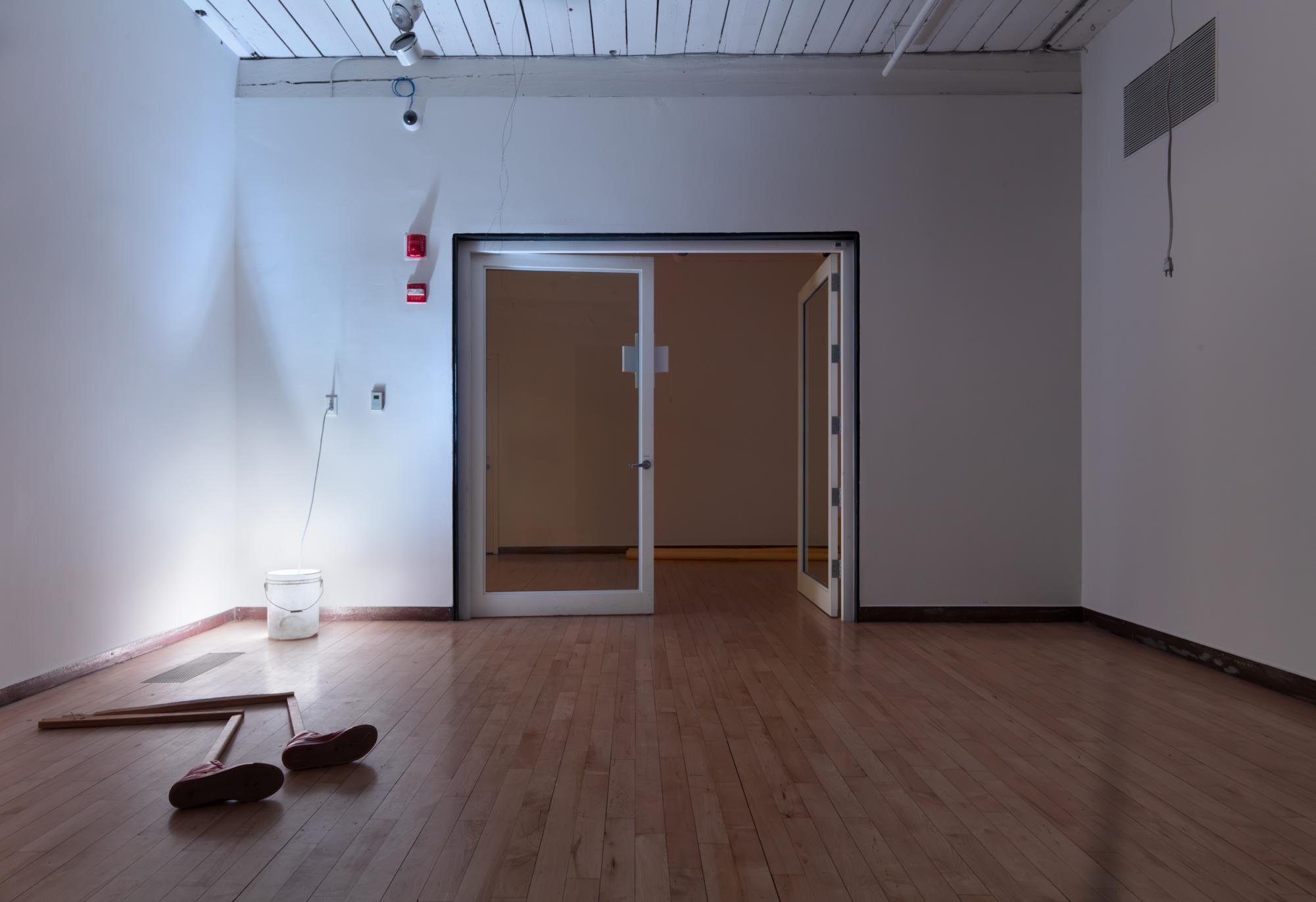
An empty bucket, an unplugged lamp, and glass bowls. What one may have initially thought was a backroom at MASS MoCA is really artist Michael E. Smith’s exhibition, The makings of you. The exhibition, which was curated by Emma Poveda (Grad Art ’26) opened on May 2 and will remain open until April 18, 2027.
Smith, who is based in Providence, R.I., is a sculptor and installation artist known for creating stark works using found, everyday objects. His art has been featured in the Contemporary Art Museum St. Louis, Mo., the Whitney Museum of American Art in New York City, and the Walker Art Center in Minneapolis, Minn.
The exhibition begins in a foyer, with large construction paper tubes and sheets placed seemingly haphazardly on the floor by the door. The lights on the ceiling hang low, with their wires extended.
Turning out of the foyer and into the main exhibition space, one finds two paper-mache sculptures of car washes, each approximately the size of a park bench. The sculptures are references to the Best Way Car Wash at 202 River St., which neighbors MASS MoCA. According to Poveda, the car wash became a muse for Smith during the making of the exhibition, despite not being from the Berkshire area. “Michael is interested in that car wash, and in the labor and Americana it represents,” Poveda wrote in an email to the Record. “In many ways, the car wash is linked to the role of an artist, like a service provider expected to function in full transparency, but they also act as stand-ins for the museum — another place objects and people pass through.”
The main room is otherwise barren, aside from a few seemingly arbitrary objects, such as a rag resting on an empty bucket and a pile of glass bowls. These objects draw on Smith’s interest in the car wash, alluding to cleaning, bubbles, suds, and spheres, Poveda explained.
After passing though the main exhibition space, one enters a dark, secluded room, lit by blue strobe lights. The flashing lights are projected onto the far wall of the space, in front of which sits a ceramic bowl filled with green slime and an arrangement of moss. “The TVs, the cables, and that arrangement of moss … create an atmosphere that feels both natural and artificial,” Poveda wrote.
The bowl, which was made by Smith’s daughter, was crafted to emulate the colors of the Earth, adding a surreal ambiance to the exhibition, according to Poveda. “The pairing is tender: the nature from just outside brought into the air-conditioned museum, the planet held in a child’s hand,” she wrote. “Against the dark screens and the cabling, the arrangement seems almost post-apocalyptic, like the Earth has been emptied of its contents and shrunk to the size of a cereal bowl.”
Poveda developed this project through a MASS MoCA curatorial fellowship, which is funded by the Clark Art Institute and given to one member of each cohort from the College’s Graduate Program in the History of Art. Poveda, who has helped to curate exhibitions at the Hammer Museum in Los Angeles and the Institute of Contemporary Art in Philadelphia, reached out to Smith after studying his work in an academic context. Together, they have been working on The makings of you since last May.
In preparation for the exhibition, Smith spent a year studying the gallery space at MASS MoCA. He chose to leave many parts of the gallery unchanged from how the previous artist — Vincent Valdez — used the space. Most notably, Smith kept what used to be a screening room. “Michael’s practice is responsive to the site where he installs, and he wanted to consider what was already there,” Poveda wrote. “It’s a way of letting the existing conditions set the parameters, rather than erasing what made the room specific.”
Because the exhibition had an intentional interplay between sculptures and the space that they inhabit, collaboration between the artist and curator proved central to its success. “[Smith] pushed me toward the scenario where curators are artists too: co-creators, active participants shaping how a show feels and how it reaches people,” Poveda wrote. “[Working on this exhibition] clarified for me that a curator is a mediator between the artist and the institution, holding the imaginative possibilities of a show on one side and the museum’s logistical needs on the other.”
Although the exhibition provokes questions about discomfort, Poveda is not worried about a lack of engagement, she explained. In fact, the exhibition’s subversion of the viewer’s expectations is part of what makes it interesting. “I’m still watching how people move through it,” she wrote. “Some walk right out, others are drawn into the blue light and stay a while.”