
The Clark is renowned for its collection of impressionists: Sargent, Renoir, Monet, Degas. Now, they have a collection of the works of impressionables: high school students.
How Shall We Live: Berkshire Youth Artists Explore Their Relationship with the Earth in the Time of Climate Change is a curated exhibition of high school student art responding to the climate crisis on display at the Lunder Center at the Clark. The exhibition debuted last Saturday and will remain open until April 26.
The project was spearheaded by Uli Nagel, the co-founder and director of programs at Cooler Communities, a nonprofit that works to bring lessons about climate change to K-12 education, and Anne Legêne, a member of Living the Change Berkshires, a volunteer organization that plans local activities to address climate change through projects such as community discussions on environmental issues.
Although Cooler Communities and Living the Change Berkshires have selected and featured student art in previous iterations of How Shall We Live for the past three years, this is the first time that they collaborated with the Clark.
The Clark’s School Specialist Dana Schildkraut and Head of Gallery Education Kristin Bengtson initiated the project by reaching out to Nagel and Legêne with the hopes of engaging with local students more deeply. “We have [high school] students going outside, being on the [Clark] trails, and then coming inside to the galleries, but how can we make that more robust?” Schildkraut said in an interview with the Record. “To really make it a high impact experience, it kind of has to come full circle. Students have [to have] the chance to make art too.”
Because they have maintained contact with dozens of art teachers in the Berkshire area who collaborated on previous How Shall We Live projects, Nagel and Legêne were able to help realize Schildkraut and Bengtson’s goal.
Together, the four of them planned a year-long course of study for the high school students, beginning with a professional development workshop for local art teachers in August 2025. There, art teachers could experience a slow-paced guided walk through the grounds and galleries of the Clark, before trying their hands at making art using only items from nature. The Clark also encouraged the teachers to incorporate themes of nature and climate into their curriculums and support students in submitting work to How Shall We Live.
Making art for How Shall We Live challenged students to address prompts such as: “What does nature provide?” and “In the age of climate change, what matters most?” Bonnie Capogna, an art teacher at Wahconah Regional High School in Dalton, Mass., used these prompts to gently guide students as they created projects to submit to the gallery. “We found that students were generally hitting the themes, because we’re doing something about our hopes for the earth.”
By February 2026, over 180 high school students submitted artwork to the program. A team of jurors at the Clark then selected 72 pieces that they found particularly captivating to be displayed at the Lunder Center. The process of selecting work from such a talented pool of applicants was not always easy, according to Schildkraut. “We [got] a huge diversity in the responses,” she said. “As a jury, we looked for variety. We had also urged people not to use cliché images like the globe, because in the past, we got like 50 burning globes.”
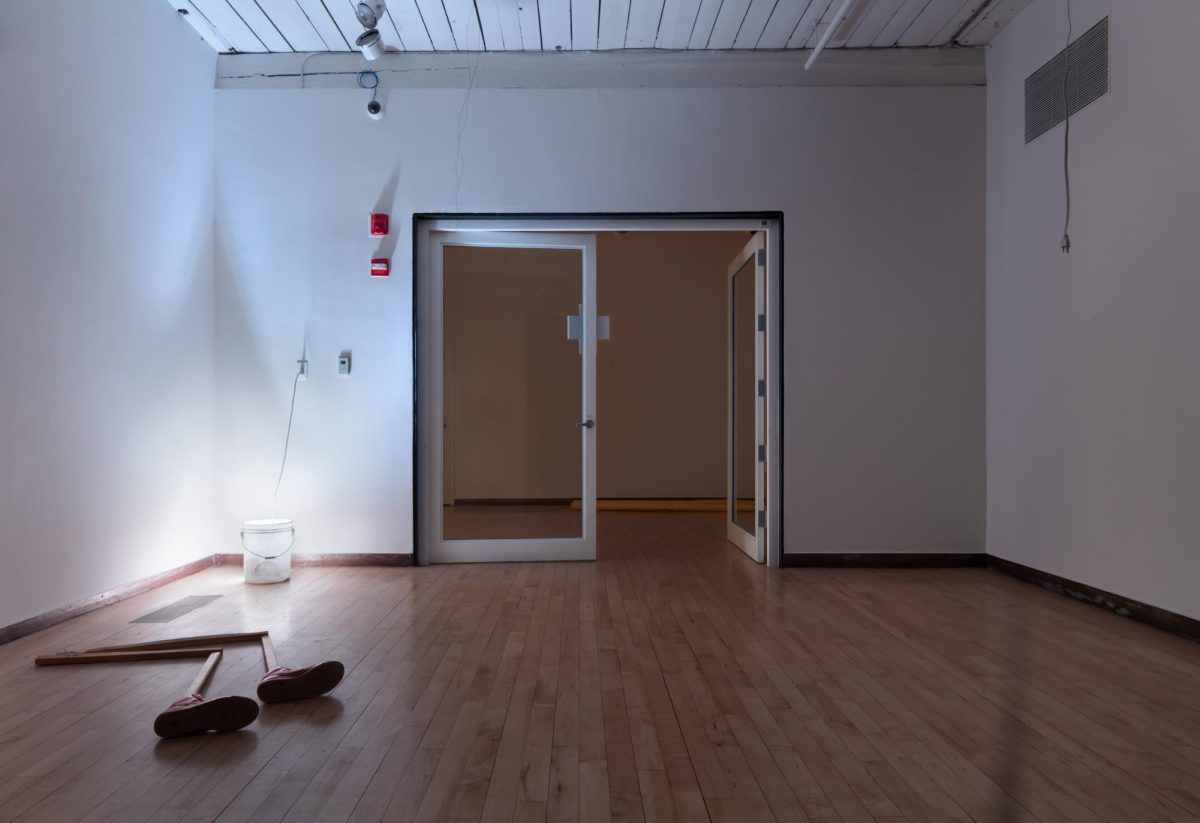
The jurors certainly fulfilled their goal of variety: How Shall We Live features watercolor, oil pastels, collages, beadwork, ceramic tiles, mosaics, photography, acrylics, origami, and even a sculpture made from plastic waste.
Stella Carnevale, a junior at Pittsfield High School, created a large collage, titled The Three Fishes, which was ultimately selected for the exhibition. She began with a base layer of mod-podged newspapers, over which she painted three fish to represent her best friends. Her art teacher was deliberate in making sure that students related the piece back to climate change. “When we picked what we wanted to do, we read about climate change and how it relates [to the piece], and we had to say why we chose the subject matter,” Carnevale said.
Krishiv Malhotra, a senior at Mount Greylock Regional School, created a collage titled Mira Desh, My Country, featuring an air quality index map of India with photos that he took of Amritsar, Punjab and news headlines about declining air quality in India. Malhotra said he hoped to take the audience out of the Berkshires and highlight the global impacts of climate change. “I think a lot of people in the U.S. are desensitized to the actual impacts of climate change,” he said in an interview with the Record. “I wanted to bring those problems to the forefront in a place like the Clark.”
Capogna, who has supported student submissions to How Shall We Live for the past three years, was also particularly touched by this year’s venue. “I just think that getting our students artwork out there is really important, and these opportunities for our students is what we need,” she said. “I hang [student artwork] up in the classroom. I hang it up in the hallway. But when we can get it into a place like the Clark or any local museums, it’s just so meaningful.”
In an effort to ensure that all high school student artists will have the opportunity to see the exhibit, the show will move to Pittsfield’s City Hall from May 1 to June 8, and then to Sheffield’s Dewey Hall from June 12 to 21.