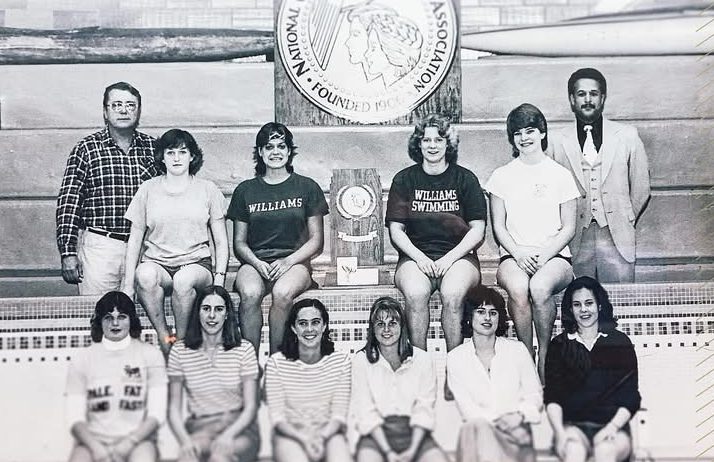
Former head coach of swimming and diving, Carl Samuelson, died on Feb. 24 due to complications from kidney disease. He was 94. During his 33-year career as coach at the College from 1966 to 1999, he built one of the nation’s most successful Div. III swim and dive programs and mentored generations of student-athletes.
Under his leadership, members of the swim and dive team earned 340 All-American honors and captured 39 individual and 23 relay NCAA titles. His teams also claimed 27 New England Championships, including an 11-year stretch in which both the men’s and women’s teams won the title every year. In 2022, Samuelson was named to the College Swimming and Diving Coaches Association of America’s (CSCAA) list of the 100 best coaches. Two years later, he was inducted into the inaugural class of the Div. III Hall of Fame.
Born in 1931, Samuelson grew up in Middletown, Conn., where he was active in YMCA junior swimming and helped found his high school’s swim team, according to records from the College’s communications office. He then went on to swim at Springfield College from 1950 to 1952 and 1954 to 1956, taking a two-year break to serve in the military. After earning a bachelor’s degree in physical education in 1957, Samuelson remained at Springfield to coach the freshman swim team from 1957 to 1966, while pursuing a master’s degree in physical education.
Samuelson came to the College in 1966 as the new head coach of men’s swimming and diving, succeeding legendary Head Coach Robert Muir and continuing the program’s legacy of success. When the College began admitting women in 1970, Samuelson helped rewrite the school’s physical education programs to include women in once all-male activities. He also established new programs in dance and yoga. After being named coordinator of aquatics in 1975, Samuelson also oversaw the creation of a lifeguard program and helped design a new pool in the Chandler Athletic Center. At the pool’s opening in 1988, Samuelson celebrated by diving off the 3-meter board in a tuxedo.
In 1975, Samuelson helped establish women’s swimming as a varsity sport at the College, while simultaneously continuing to coach the men’s team. Seven years later, in 1982, the Ephs won the inaugural women’s NCAA meet, and then repeated their success with a victory in 1983. Samuelson was named the CSCAA Div. III Coach of the Year both years, while again taking home the award in 1995, the same year he was featured in Sports Illustrated magazine.
After Samuelson and his wife, Nancy, who served as the College health center’s medical secretary, both retired in 1999, swim and dive alums established a scholarship fund in their name. In 2000, Samuelson was honored in a ceremony in which the Chandler Athletic Center pool was formally renamed the Carl R. Samuelson and Robert B. Muir Pool, and a surprise donation of more than $1.5 million was made to the Samuelson fund, according to the Berkshire Eagle.
Outside of coaching, Samuelson was deeply involved in the broader community. He served as the chairman of the Williamstown American Red Cross Bloodmobile Drive from 1972 to 1982 and was on the Williamstown Community Chest Board of Directors from 1975 to 1983. In addition to other community endeavors, he was also elected president of the New England Intercollegiate Swimming Association in 1968 and has lectured in Florida and Rhode Island, and internationally in Beijing and Shanghai on his philosophy for developing competitive men’s and women’s swim programs.
Former swimmers say that Samuelson’s impressive accolades don’t tell his full story. “I could recount his prodigious swimming stats, but what distinguishes Coach Sam is what so many Williams swimmers discovered after we graduated,” James Cornell ’72 told the Record. “The depth of his friendship, heart, and wit. No one could have a better friend.”
Dennis O’Shea ’77, who served as a manager for both men’s and women’s swimming and diving teams, said that his relationship with Samuelson lasted long past his time at the College. “I think many people made it a point during their visits to Williamstown to stop by the house and see him and Nancy,” O’Shea said. “He would come to our weddings. When he came to the town where I live, we would go out to dinner. He was a near constant part of our lives, starting from the day I stepped into his office.”
For Elizabeth Jex ’83, a swimmer who led the Ephs to two NCAA Div. III team titles and won 12 individual NCAA Div. III events during her collegiate career, the decision to join the Ephs was obvious from her first meeting with Samuelson as a recruit. “After that weekend, I didn’t look seriously at any other schools,” Jex wrote in an email to the Record. “I knew what I wanted, which was to go to Williams and swim for Sam.”
Samuelson imparted a lasting mentality through his coaching. “The quintessential moment pretty much everybody would talk about would be his pre-meet talks to the team,” O’Shea said. “He believed that people performed at their best when they are stress-free, when they’re serene, and he did his best to take the pressure off and make everything we did fun.”
Jex emphasized that Samuelson’s inspiration went far beyond individual swim meets. “I think … something maybe folks don’t realize is [that] we all swam for Sam, and for each other,” Jex wrote. “He was like a father and a swim coach rolled into one. And each of us swam or dove to make him and our teammates proud.”
Alums also fondly remembered some of Samuelson’s pre-meet catchphrases. “Four favorites are ‘Be cerebral,’ ‘Be inertial,’ ‘Be tough mothas,’ and ‘Bring it home at the end,’” Cornell said.
There was one motto that O’Shea highlighted as especially memorable. “‘Be cerebral’ is just two words, but we knew that meant react in a thinking way, rather than an instinctive way,” he said. “Everything he said in these little phrases said so much more than just the words.”
Jex recalled the humor and community that Samuelson encouraged among the Ephs. “I have an old t-shirt from that time that says ‘Sam’s Macho Mamas,’” Jex wrote. “It was the 80’s, so these were the phrases [that were] in at the time. [They] honored how difficult it was to swim through pain, but at the same time celebrated who we were in the language of that time and place.”
Cornell emphasized the prevailing impact Samuelson had beyond his role as a coach. “He was just always there for us,” he said. “Whether it was in the pool or out of the pool, he was perfect.”
Jenna Lee contributed reporting.