When Minnie Lerner ’28 first stepped foot in the Mehlin Museum, one of the two wings of the Hopkins Observatory, she was hooked.
“I’d never been in the [observatory], and I was instantly enchanted,” Lerner said. “I only knew a fraction of what I know now about it, but I could already tell there was so much history there,” she said.
Lerner turned this newfound passion for scientific relics into a winter study independent project, for which she curated an exhibition at the Mehlin Museum at the Hopkins Observatory. The show opened on Feb. 6, showing off the first major update of the space in 30 years.
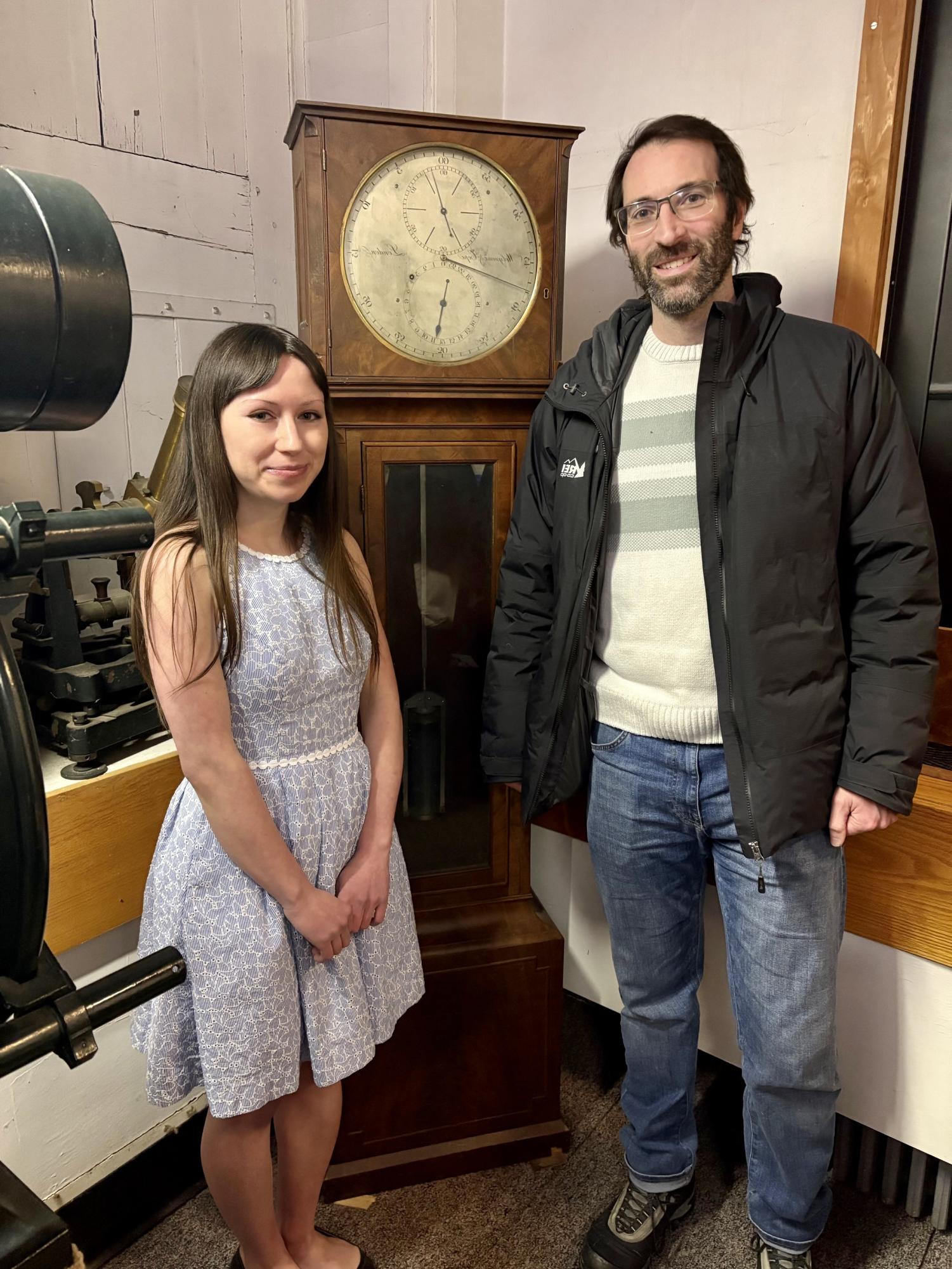
The showcase consisted of a self-guided gallery tour and catered food. Students and faculty began the tour in the central rotunda of the observatory, and later explored the two 60 square-foot rectangular wings of the observatory. The windows were covered with blackout curtains to prevent UV damage to the artifacts, which included astronomical objects from the mid 19th century that were displayed along the walls.
Lerner first proposed the independent project to renovate the space with Lecturer in Astronomy and Observatory Supervisor Kevin Flaherty, whom she had met during her first visit to the observatory. Lerner spent nearly 40 hours during the first week of Winter Study at Special Collections, researching the observatory. She created a timeline from 1838 to the present that traced the history of the observatory. Without a comprehensive record, she pieced together as much information as she could. “It felt like putting together a murder mystery,” Lerner said.
At Special Collections, Lerner also identified several astronomical objects from the 1800s to showcase in an exhibition at the museum.
“Now, in 2026, [these objects feel] like such a piece of history,” she said.
Lerner was especially excited about the mystery of the observatory’s original dome, which was blown away during a windstorm in 1842, Lerner said. The whereabouts of the dome remained unclear for the next 128 years. Mr. Trimarchi, a college facilities employee whose first name is unknown, found it in a heap of scrap metal being packed by facilities for recycling and decided to bring it to his farm. While going through the archives, Lerner came across a chain of emails between professors who had spotted the dome from afar on the farm. According to the emails, the dome still remains on the grounds of the former Trimarchi family farm, which has since been sold to a mineral mining company.
Lerner decided to include the dome’s peculiar history in the renovated museum. “I ended up kind of making it an Easter egg, in small plaques around the rooms that tell the story of the dome,” she said.
For Lerner, early exposure to her parents’ work as filmmakers encouraged her to pursue her own artistic interests, but she ultimately chose to go in her own direction. “I became interested in physical media, which is not something that my parents [practiced in],” she said.
Lerner’s passion for museum exhibition curation is tied to her passion for learning. During her junior year of high school, she started teaching a video art class for local kids ages 7 to 12 through the Echo Park Film Center, a film and video collective in her neighborhood of Echo Park. For the past two summers, she has spent her time teaching students from the Tenderloin Community Elementary School in San Francisco, Calif., through a program run by the city’s Department of Children, Youth, and Families (DCYF).
She enjoys the diversity of her students and is energized by the possibility of being able to teach art to children from different parts of the world. “I grew up in an immigrant enclave in Los Angeles, but it was very monolithic, [mostly] Mexican Americans,” she said. “So to be in this very diverse place is very interesting to me. I love the program I’m working for.”
Last spring, Lerner took a semester off and taught art at a private preschool in San Francisco and at the city’s DCYF.
Lerner hopes to one day become a full-time public school teacher. “In a public school setting, it’s really different with far less resources, but also, in some ways, [there’s] much more gratitude,” she said.
For Lerner, teaching and curating go hand in hand. As a teacher, seeing her students connect with themselves and each other through creative expression is the most rewarding part of her job. As a curator, Lerner is excited by the possibility of highlighting little-known pieces of media and history.
“The notion that I could be bringing that to other people by introducing them to bits of visual culture that they haven’t been exposed to before is the most exciting thing to me,” Lerner said.