Radio plays, a form of theatre relying entirely on voice acting and homemade sound effects, were a mainstay of life before the ’50s, providing a way to enjoy art from the comfort of one’s home before the advent of television. Last Wednesday, WCFM brought the tradition back to the present, hosting its own on-air radio play.
Artist Descending a Staircase, written by Tom Stoppard in 1973, is a surrealist play originally designed for radio, lasting just over an hour. Written decades after radio plays’ prime, the play seeks to explore the human condition through the story of three artists in the 20th century, actor Quin Repetto ’28 said. Mysteriously, one of them dies, and the two left are both convinced that the other is the killer. From there, the play flashes back to World War II, when all three artists are in love with the same woman. Jumping back and forth through time, the play ends without the characters or the audience cracking the case.
Repetto played Beauchamp, an artist who creates sound collages. Repetto commented on her freedom of expression when playing this character. “If art at this point is ludicrous, you might as well lean into it and be utterly ludicrous … making him a ridiculously [buffoonish] but very fun to play.”
Repetto, who also serves as a sound designer for Cap & Bells, was first introduced to the play in the English elective “Beckett, Pinter, and Stoppard,” taught by Senior Lecturer in English and Theatre James Pethica this past fall.
“I really like sound and the way you can manipulate sound and use sound to convey worlds,” Repetto said. “And so this play really stood out to me.”
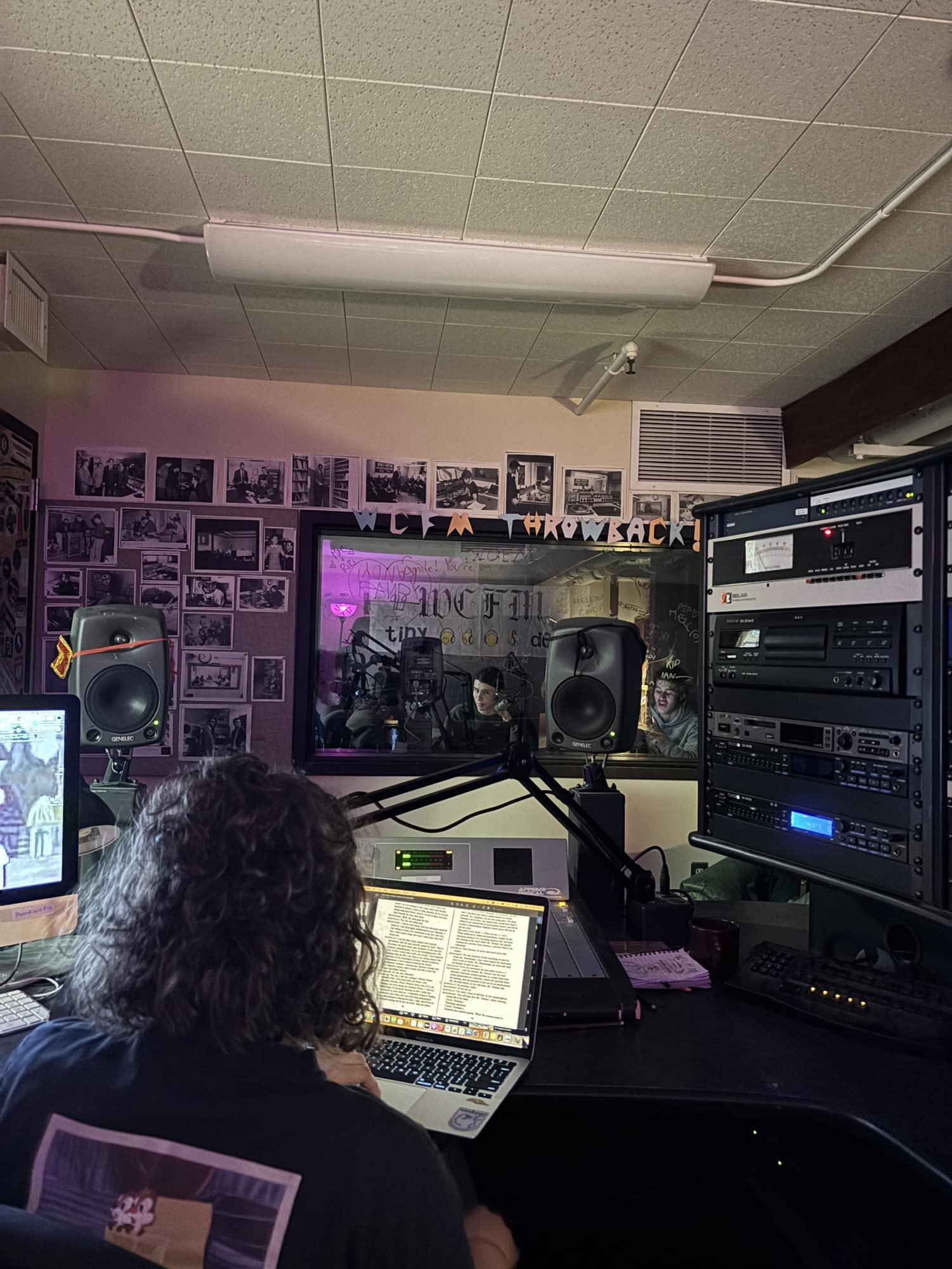
Ana Lucia Gomes ’28, a WCFM programming director, originally wanted to host a radio play last year. At the time, WCFM had rediscovered how to use the station’s talk studio, a room with multiple microphones dedicated to broadcasting live audio, but had not found the right radio play to bring to life. When Repetto pitched Artist Descending a Staircase, Gomes quickly assembled a cast of seven students and decided to direct the sound effects herself.
On the technical side, however, the soundproof design of the talk station itself proved to be a challenge. “All the sound effects were done without [the cast] hearing it,” Gomes said.
Art and sound are recurring themes throughout the play, and Stoppard’s ideas resonate with questions about what art’s place should be in the contemporary world. Gomes saw the play as a poignant commentary on intellectualism and the cost of art. “There’s a lot of conversation about what is art and what is modern art and what we interpret as being valuable,” Gomes said.
The play explores how an audience’s experience of consuming a piece of art can change and personalize the work’s meaning. It also calls into question the meaning of art, especially art that serves as a distraction from the world around you, Repetto explained. In this way, blindness is a strong theme throughout the performance — a fitting theme for a play that is only performed through audio.
The simplicity of radio as an art form was part of the joy of this project, Repetto explained, as its focus on sound makes it easy to produce while maintaining the communal aspect of theatre.
Gomes and Repetto said that they are excited about the possibility of producing more radio plays in the future.
“I was just happy to be a part of it,” Repetto said of her participation in the play.
Editor’s note: Frances Brooks ’29, a member of the Record board and the WCFM board, was not involved in the writing or editing of this article.