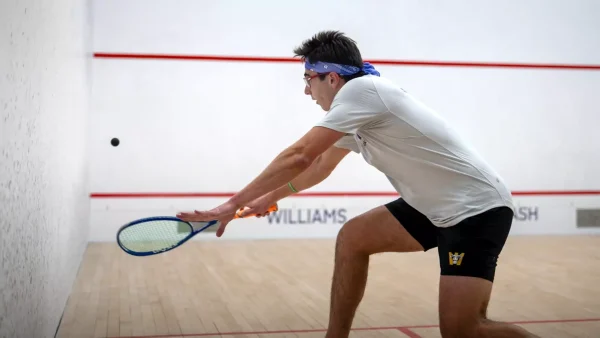
No. 13 men’s squash (9-7, 4-3 NESCAC) kicked off the NESCAC tournament on Saturday with a gritty 5-4 quarterfinal win against the No. 17 Middlebury Panthers (9-8, 6-3 NESCAC) before falling 6-3 to the No. 11 Tufts Jumbos (12-6, 7-2 NESCAC) in the semifinals.
With injuries reshaping their lineup, the Ephs leaned into their depth, drawing on contributions from across the roster. Players outside of the usual top nine competitors stepped into key roles during the postseason. “One through fifteen, we’re a really strong team,” co-captain Asher Leavy ’26 said, referring to the team’s full roster.
The Ephs had a tight match against the Panthers on Saturday, with multiple games lasting over an hour. Leavy, though usually ranked No. 3, moved up to No. 2 for the NESCAC tournament. Regular No. 2 Himanshu Pannu ’28 was unable to compete due to injury. Leavy’s match lasted only 21 minutes, as he quickly secured a 3-0 win. In a crucial match lasting an hour and 13 minutes, No. 3 co-captain Alex Akbari ’26 won 3-1 against what Leavy described as a tough opponent. “[Akbari’s win] was a really great way to set the tone,” he said.
The dominant energy carried over as No. 8 co-captain Rafay Syed ’26 battled back from a two-game deficit to secure a 3-2 win. According to Leavy, this win was pivotal. “I think if he had not done that, we would have lost the match,” he said. “It really motivated a lot of guys to push.”
The rest of the team’s depth was also on full display. Leonard Lee ’26, normally ranked No. 11, stepped into the top nine lineup to play No. 9 and delivered a 3-0 win. “[He] was probably playing some of the best squash I’ve seen him play,” Akbari said of Lee’s performance. “He was playing freely and didn’t let the [first wave’s losses] affect him.”
Syed agreed that Lee’s win was crucial for the Ephs. “[Lee] kind of sucked the air out of the room for the Middlebury guys,” he said. “The first two games, he wiped the floor with the guy.”
Lee’s performance reflected a broader shift in the team’s strategy. Over the course of the season, the Ephs adopted a more aggressive playing style, focusing on controlling the middle of the court. “When we’re adding these weapons, like putting the ball in short and … taking up a stronger presence, it’s helped us [become] more of a threat on court,” Akbari said. “I think [our] squash level is the highest it’s been all season.”
With multiple matches unfolding simultaneously, momentum can shift rapidly across the courts, according to Leavy. Players have to block out the pressure from other matches while on court, he said. “[There’s] a really fine line between being aware of what’s going on around you with other matches, but also focusing on your [own] match,” he said.
After defeating the Panthers, the Ephs were ultimately knocked out of the NESCAC tournament by the Jumbos in their Sunday semifinal matchup. Despite the overall 6-3 loss, Akbari and No. 4 Will Newton ’28 earned hard-fought victories in matches that were nearly an hour long, winning 3-0 and 3-1, respectively. Meanwhile, No. 6 Dylan Scott ’29 contributed the last point with a 3-0 win in just 33 minutes.
Leavy credited their success against the Panthers to the team’s culture. “We’re a tight-knit group, we’re really hardworking,” he said.
The program’s season ambitions extend beyond this weekend’s results. “Our goal every year is to get into the top 10,” Akbari said, a feat the team has not reached since 2011.
Moving forward, the Ephs look toward a match against the No. 12 MIT Engineers (14-4) on Friday, which will determine whether they advance into the top bracket of the College Squash Association championships. Akbari trusts his team to rise to the moment. “I think we have everything that it takes to win,” he said.
Despite the loss to Tufts, the Ephs are focused on mindset going into their decisive match against the Engineers. “[We hope to maintain] positive attitudes in practice that will carry out into the matches and play a little bit more aggressive, be adaptable, and just have fun with the game,” Syed said.