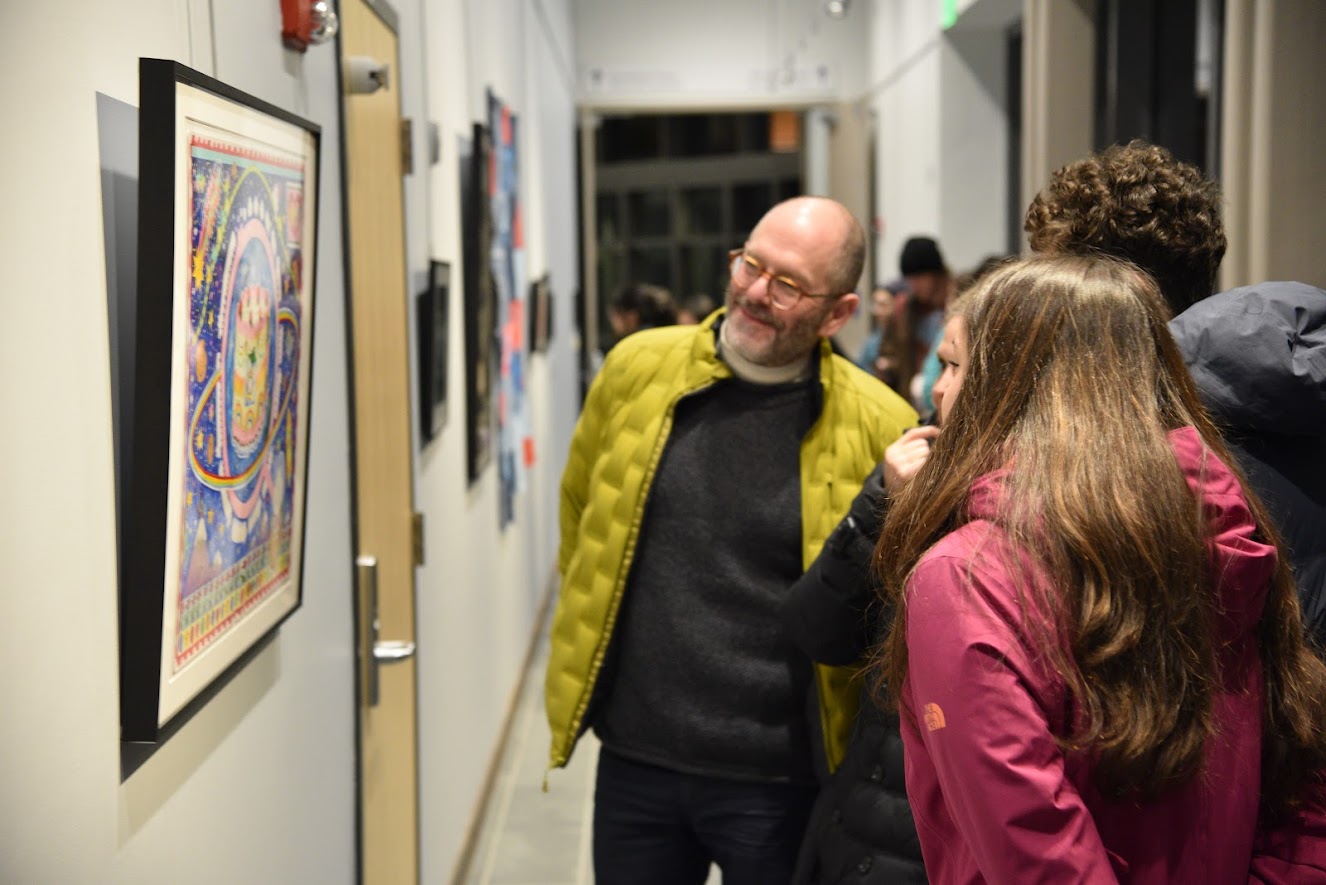
Against the blanketing grey of Saturday’s snow, the ’62 Center for Theatre and Dance glowed with activity as students, alums, and community members gathered with a hot coffee in hand to celebrate the work of 17 students.
In the months leading up to the Williams Art Community Project, these students were guided by prominent figures in the arts, including Trustee at the American Museum of Natural History Laura Whitman ’89 and Chapin Carson ’81, former Senior Vice President at Sotheby’s, a broker of fine art.
Tom Paper ’84, who founded a digital platform for sharing artwork, and Nick Garlid ’25 were the brains behind the event that brought generations of alums working in the art world together with current students.
During Garlid’s junior year, he started the Art Seen, a student gallery at the ’62 Center for Theatre and Dance. “It culminated in this exhibition [that] I put on at the [College] reunion,” he said in an interview with the Record.
This exhibition caught the attention of Paper, who attended his 40th class reunion that summer. “I saw the Art Seen, and I introduced myself to [Garlid],” Paper said. “We talked about the next steps for the Art Seen, and I think we even mentioned doing some kind of collaboration.”
The Williams Art Community Project exhibition presented one framed piece from each student, with additional pieces featured on the Pixeum site. A San Francisco-based digital platform founded, Pixeum was founded in 2020 by Paper as a site specializing in curating and sharing high-resolution digital exhibitions of maps, art, and history. For this event, the digital platform allowed students to display their artwork through a highly interactive online platform, including sound clips of the artists explaining their processes.
“It’s way more powerful to see an image while hearing the artist talk about the story and what motivated them,” Paper said.
Paper hopes that the event will help strengthen the connection between artistic students and alums in the art world. Although the College purports to have a strong community of alums working in art, colloquially called the ‘art mafia,’ Paper found the network covert, especially when compared to the College’s explicit career guidance in finance. Garlid and Paper came up with the idea to have College alums act as jurors — curators who select and evaluate artwork submitted for exhibitions — for student artists and recent graduates.
Pixeum provided a convenient venue for collaboration between the students and professionals, Paper said. “All of the alums have looked at all of the exhibits virtually and [given] feedback to the artists about what they’re doing, how they think of it, and what they can do to improve,” he said. “It’s just the start of this communication between current students and alums.”
Jackie Sedlock, a potter from Pownal, Vt., provided advice to a number of young artists with the help of the virtual platform. She told students at the start of the project that making progress requires producing a lot of work. “Don’t listen to the voices,” she said. “Don’t listen to trends and don’t be intimidated.”
Prospective art history major Eliza Ault ’28, whose curation was featured at the exhibition, learned about the event from a flyer posted in the Spencer Studio Art Building. “I feel like at a school known for its art history program, we don’t usually have opportunities like this,” she said.
Her exhibit centered around a sculpture from the Williams College Museum of Art and a few works from other collections, highlighting contemporary representations of the female nude and how they differ from depictions by pre-modern male artists.
Carlton Roe ’27 appreciated how the event allowed him to focus on a handful of pieces. “Seeing a succession of 12 to 14 pieces of art is really nice, because you can really take your time with each one,” he said.
Garlid said there will be two online exhibitions of the same work in February and March, followed by another in-person show in New York City in late April. Paper and Garlid are planning to organize a bus from the College to the event so that all artists and interested students can attend.
“This project is all about fostering and energizing that community of students and alums who are collectors, artists, and administrators, who think deeply about art and beauty,” Paper said in a speech at Saturday’s exhibition. “We are a connected community because we care about the human experience, and that’s what we hope to do, not just today, but in the future.”
Editor’s note: Christopher Hughes, an Executive Editor at the Record, a former intern with Pixeum, and a former organizer for the Williams Art Community Project, was not involved with the writing or editing of this article.
Correction: A previous version of this article incorrectly stated that the art jurors select, evaluate, and rank the student artwork. The jurors did not rank the artwork.