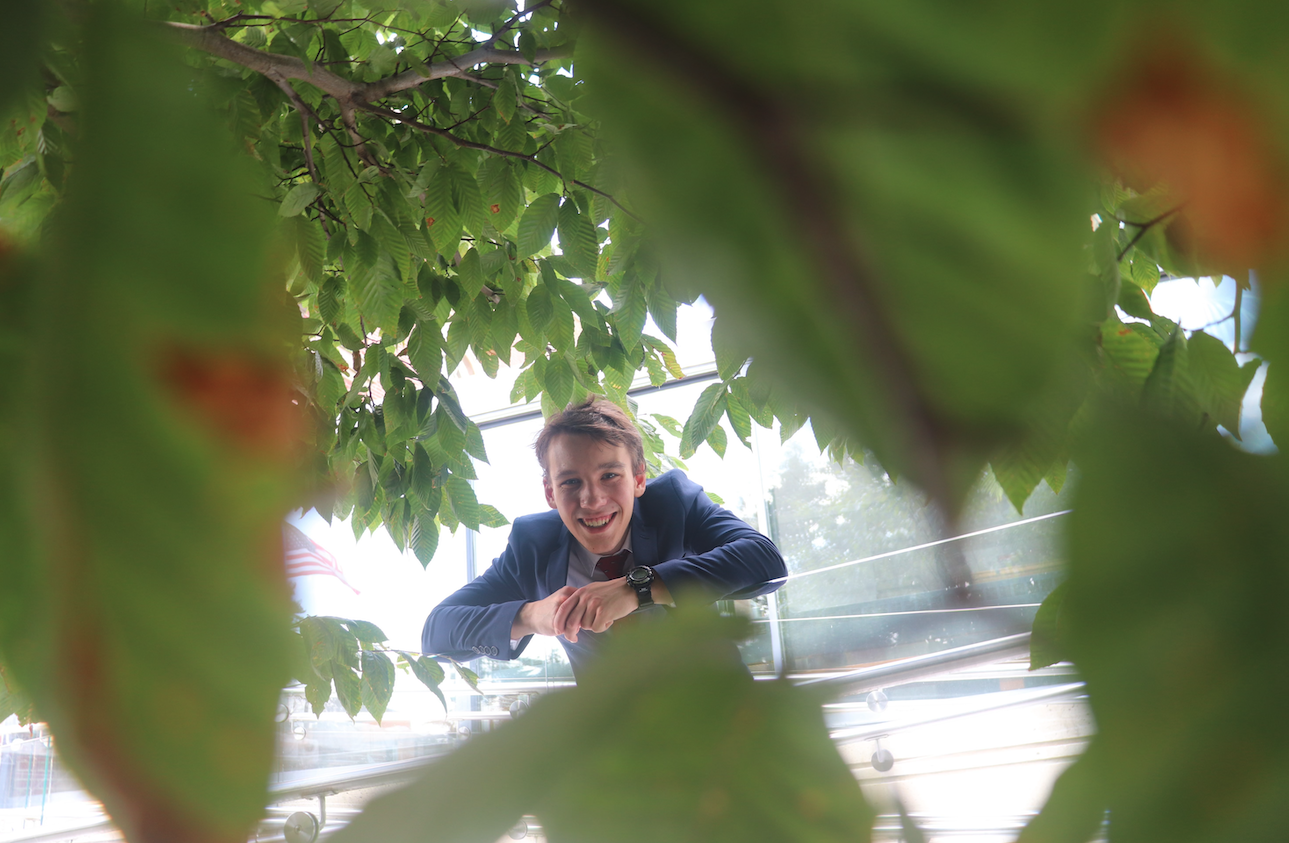
Many of us might consider the organ to be an instrument that is exclusively for churches and older people’s ears, but student-organist Nathaniel Welsh ’26 thinks otherwise. “The organ is a full orchestra at your fingertips.” he said. “It can be lyrical, it can be delicate, it can do all these wonderful, expressive things.”
Welsh doesn’t just play the organ. He’s also a conductor and composer. Although Welsh has many roles within the College’s music community — from head bell-ringer to singer for the concert, chamber, and evening song choirs — many of his artistic endeavors take place outside of the Purple Bubble. Welsh is the assistant conductor of the Northern Berkshire Choral, a Town community choir that comprises approximately 60 local singers. He is also the director of music at the First Congregational Church (FCC).
Although Welsh had brief encounters with the organ during high school, he found his passion for the instrument during his first year at the College, where he studied under Lecturer in Music Tim Pyper. “I remember learning the third movement from Vienna’s Third Symphony my freshman year, and just being really in love with these wonderful lyrical lines,” Welsh said.
Welsh said he especially appreciates the complexity of the instrument. “I love that being an organist means you have to do a lot of things,” he said. “You have to be a good conductor, a good improviser, a good composer. You have to think on the fly. You have to be a good administrator. You have to be a good leader.”
“I like that,” he continued. “It pushes me in all these ways.”
Welsh, who is originally from East Granby, Conn., started learning the piano at age four. He was also an avid member of local church choirs from a very young age. When he arrived at the College, he originally intended to major in philosophy and music, but he dropped philosophy as he grew more serious about music. “[Musicians] get to create community in the act of making art,” he said. “It’s not the solitary thing that is reading philosophy.”
He is also completing a composition thesis for the music department advised by Associate Professor of Music Zachary Wadsworth. For the thesis, Welsh hopes to bring modern issues in contact with older musical traditions, he explained. Welsh is spending his senior year composing a requiem — a Catholic mass for the dead — for the American chestnut tree, a species that once dominated the American northeast but has since been decimated by a fungal disease brought over by transatlantic commerce. “I’m really intrigued by the fact that humans killed the tree, and humans have also tried to bring it back to life, and are trying to bring it back to life actively,” he said. “I want to bring back the idea of the chestnut tree, the idea of our hills being covered by these huge trees.”
The piece is composed for a small choir and an organ and includes lyrics in various languages, including the Latin traditional to requiems, Welsh explained. “It’s interspersed with translations in English and also other poetry,” he said. “There’s a bit of a poem by Walt Whitman. There’s a bit of a text by George Marsh, who’s an early environmentalist. It’s also sort of inspired by Benjamin Britten’s ‘War Requiem,’ and the idea there is to make it a little bit more approachable to listen to, and to contextualize the tree within the larger requiem mass.”
After graduation, Welsh plans to attend graduate school for organ performance. “I’m looking for places that are really able to push me as an organist, offering me access to some really fantastic instruments — something that I don’t have access to in the Berkshires — and to continue engaging with a choral repertoire, which I care about so much,” he said. “I have half a mind to perhaps go into musicology one day and understand why we are making this music,” he added.
Welsh hopes that interested students join the College’s music scene. “I encourage everyone at the College to take advantage of the incredible resources that the music department has to offer,” he said. “Whether through singing in our really fantastic choirs directed by Dr. [Anna] Lenti, or by taking free instrument lessons or free voice lessons, this is a very rare resource, and it’s something that you’re not going to have for the rest of your life. Music is for everyone, and that includes you.”