
As the snow begins to fall and fall athletes enter the off-season, another set of statistics has been established for another year of fall sports at the College. This week, the Record analyzed data from the College’s Athletics website for six fall sports: field hockey, football, volleyball, women’s tennis, and men’s and women’s soccer. The data encompass all games from 2007 to 2025.
Over 19 seasons of games, a glut of statistical data has been recorded. Within all of these data, the Record analyzed two main themes. The first was the Ephs’ performance at home versus away. To test and understand the effect of the venue at which the Ephs competed, the Record plotted the distribution of win margins for home and away games. A Welch Two Sample T-Test was used to test whether there was a significant difference between the average win margin at home and away.
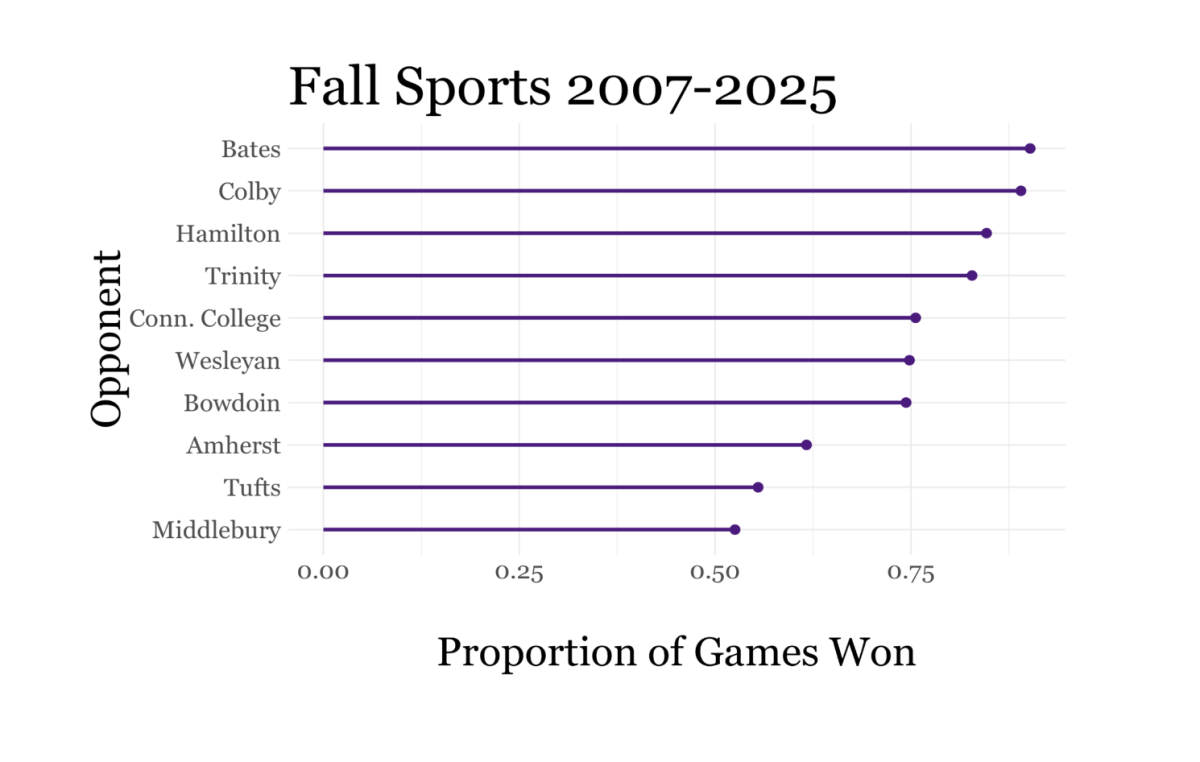
Next, the Record analyzed how the College’s teams stack up against frequent opponents. To understand how teams have performed over the past 19 seasons, the win rate against each opponent for all of their games since 2007 was tabulated. The following charts illustrate the findings from these tests. These findings also help to determine which opponents are most competitive against the Ephs.
The Record found that every team was better at home than away, and that this positive difference was statistically significant at the five percent significance level for each team. Women’s tennis and women’s soccer had the highest win rates on average against the most teams.
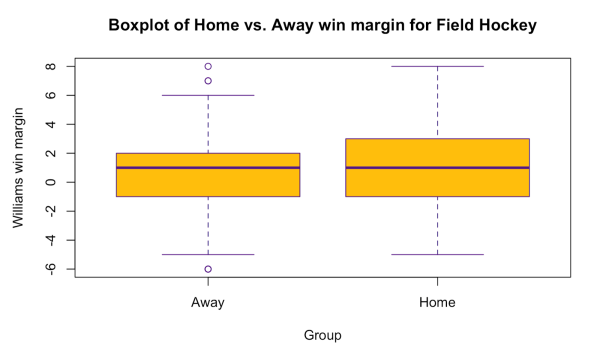
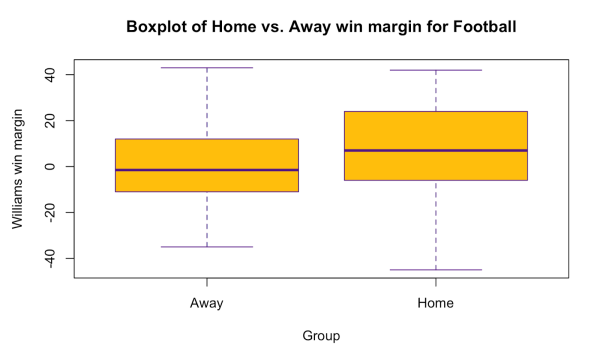
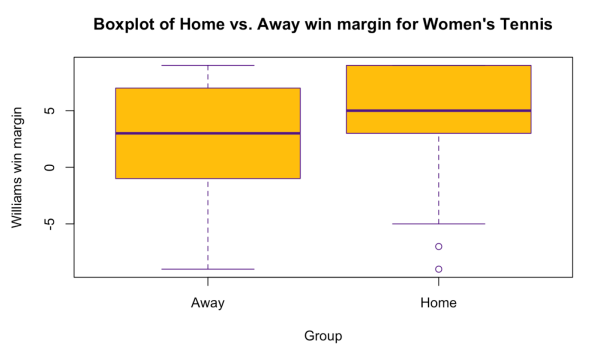
The team-specific boxplots show the distribution of points scored at home and away. The bottom edge of the shaded region represents the first quartile margin for each data set, the top edge the third quartile, and the median is denoted by the purple line inside the shaded region.
The plots exhibit a distinct home advantage for each team over the years. On average, for field hockey, the Ephs win by 1.17 points at home and win by 0.37 points on the road. Among fall sports, field hockey had the second smallest difference in win margin between home and away games. The scores of the different sports are on different scales, so their raw numbers were standardized for purposes of comparison. The similarity between home and away successes for field hockey is surprising, since the Ephs play on a different type of turf at home than they often do on the road.
This disparity is dwarfed by the results for football, as the Ephs win by 7.94 points (over a touchdown) at home and lose by 0.16 points away.
Women’s tennis had the best away average margin of victory over this span, winning by 2.87 points per game (as quantified by singles and doubles match results) on the road and 4.47 points at home.
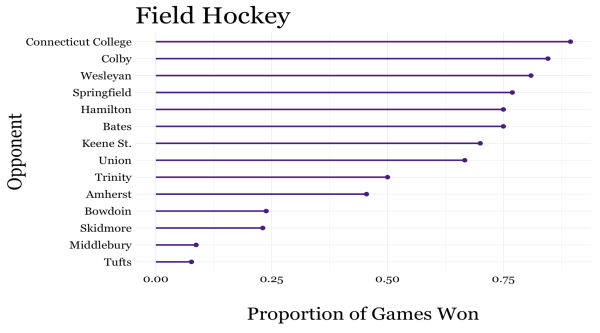
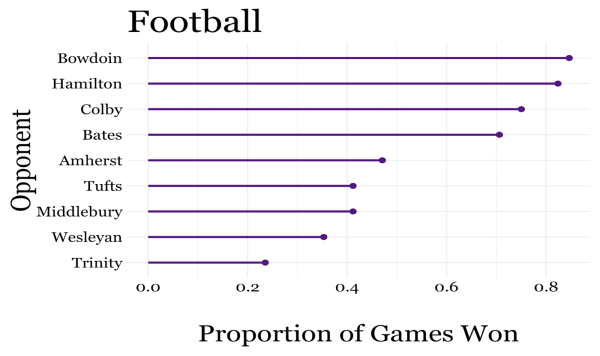
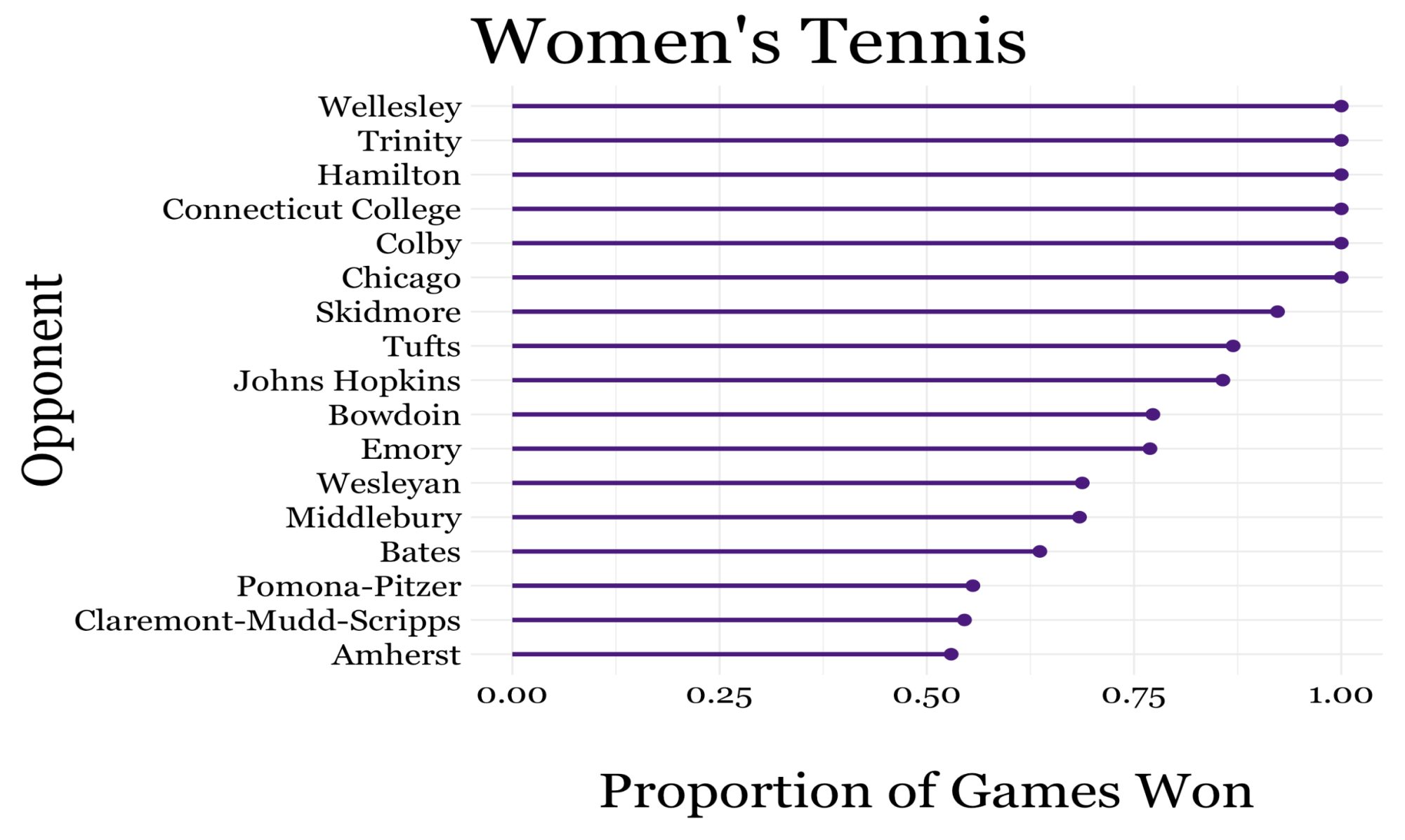
The Record performed a second round of analysis focused on the Ephs’ performances against frequent opponents. These graphs show the proportion of games won by the field hockey, football, and women’s tennis teams against their most common foes since 2007.
The results for field hockey demonstrate that the Ephs defeat NESCAC opponents such as Colby, Wesleyan, Hamilton, and Bates over 75 percent of the time. The team’s closest rivalry is with Trinity, as the two teams are evenly split in their results. Amherst is not far behind in competitive terms, as the Ephs have won slightly fewer than half of their matchups with the Mammoths since 2007.
Football has seen impressive success against five NESCAC opponents while struggling against four teams. Its closest rivalry comes against Amherst — like the field hockey team, the Ephs have won just fewer than 50 percent of their matchups against the Mammoths.
Women’s tennis boasts the strongest success based on this data. The Ephs have won over 50 percent of matches against every common opponent they have faced since 2007. They have won 100 percent of matches against Trinity, Hamilton, and Colby.
 Julia Karp/The Williams Record